By: Courtney Eberhard
Unexpected DNA results can change how you understand your identity—here’s what NPE means, why DNA surprises happen, and where to turn next.
DNA testing often begins with curiosity.
You may want to learn more about your ancestral origins, confirm a branch of your family tree, connect with genetic relatives, or answer a question that paper records could not solve. For many people, DNA results do exactly that.
For others, a match list opens a question they did not know they needed to ask.
- Maybe a close relative appears who does not fit the family story you were told.
- Maybe an expected relative is missing.
- Maybe a surname, relationship prediction, or shared DNA amount points toward a genetic connection that changes what you thought you knew.
These discoveries are often called DNA surprises, and one term you may see in genetic genealogy and genetic identity spaces is NPE.
I work at FamilyTreeDNA, where I’ve seen how DNA testing can help people answer questions about their ancestry, connect with relatives, and uncover unexpected family stories. Over the years, I’ve also heard from customers whose DNA results revealed new information about their parentage, genetic relatives, or family history.
I’m also an adoptee. I always knew I was adopted, but DNA testing still answered questions I couldn’t have explored through records alone—and even raised a few I wasn’t expecting. When I began testing with FamilyTreeDNA, I discovered that one of my genetic family lines included its own NPE, meaning the surname I expected to find among my DNA matches wasn’t actually part of my genetic line. Experiences like that have shown me that DNA discoveries can be both exciting and emotional, even when you think you already know your story.
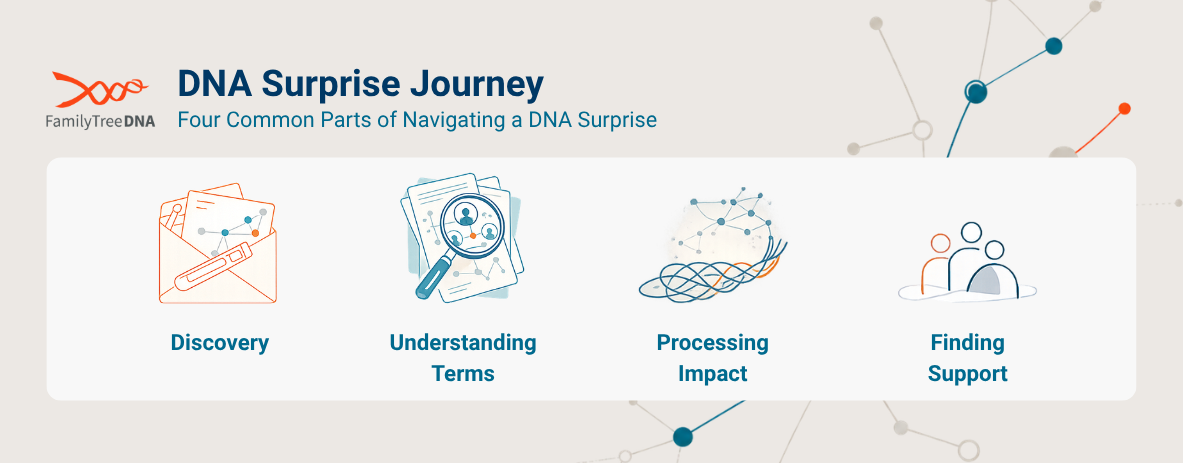
This article is not meant to answer every emotional, legal, or genealogical question that may come after unexpected DNA results. Instead, it is a starting point: a place to understand common terms, recognize what a DNA surprise can look like, and find resources for what comes next.
What Is an NPE?
An NPE is an unexpected discovery about genetic parentage or genetic relationships, often revealed through DNA testing.
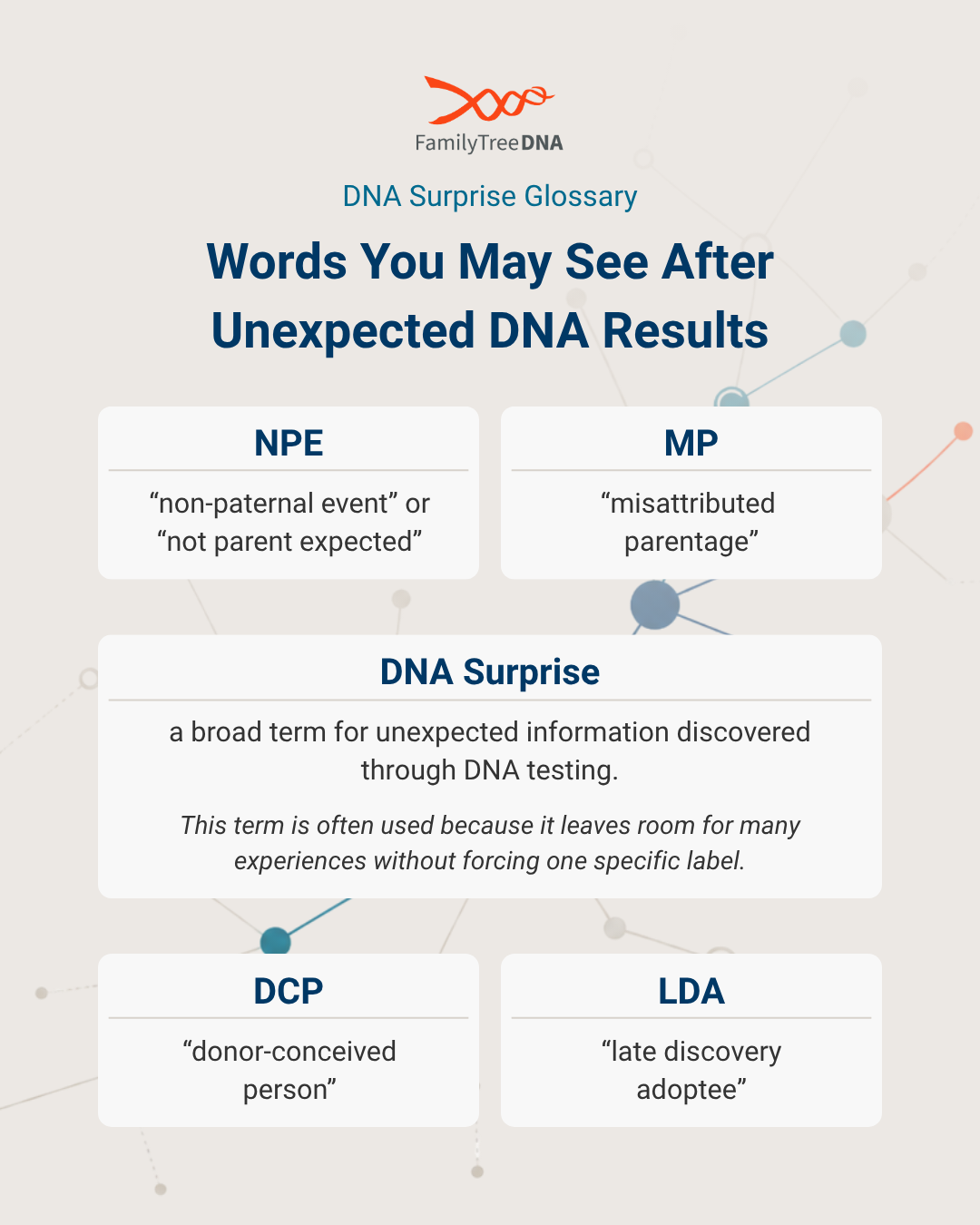
Historically, NPE stood for “non-paternal event”, which referred to a discovery that a presumed father was not someone’s genetic father. Today, some people also use NPE to mean “not parent expected”, which expands the definition to include a broader range of DNA surprises, including adoption and donor conception..
At its core, an NPE usually refers to when someone finds out the dad who raised them isn’t genetically related. This means that DNA results do not match the parentage, family story, or genetic relationship someone believed to be true.
For example, when someone has a DNA surprise, they may discover that:
- One genetic parent is not the person they were raised to believe was their genetic parent.
- One or both genetic parents are unknown.
- They have a previously unknown sibling, half sibling, aunt, uncle, cousin, or other close relative.
- Their family history includes adoption, donor conception, or another event that was not previously known or disclosed.
NPE is one term, but it is not the only term. Some people use it comfortably. Others prefer more specific language, such as:
- DNA surprise
- misattributed parentage
- donor-conceived person
- late discovery adoptee
- late discovery donor-conceived person
The language matters because the experience is personal. When possible, it is best to use the terms someone chooses for themselves.
What Other Terms Are Used for DNA Surprises?
DNA surprises can happen in many different ways, so there are several overlapping terms used in genetic genealogy, adoption, donor conception, and genetic identity communities.
Here are a few you may come across.
DNA Surprise
A DNA surprise is a broad term for unexpected information discovered through DNA testing. This may include unknown parentage, unexpected relatives, donor conception, adoption, misattributed parentage, or family relationships that differ from what someone previously believed.
This term is often used because it leaves room for many experiences without forcing one specific label.
Misattributed Parentage(MP)
MP stands for misattributed parentage. This term is often used when a person’s assumed parentage does not align with their genetic parentage.
Some people prefer MP because it can apply to either parent and may feel more precise than non-paternal event, especially if someone is using NPE to refer to a non-paternal event..
Donor-conceived Person (DCP)
A donor-conceived person was conceived through donated sperm, eggs, or embryos.
Some DCPs grow up knowing their conception story. Others discover it later through DNA testing, family conversations, medical history, or unexpected genetic matches.
DNA testing has changed the landscape of donor conception because genetic matches can sometimes reveal genetic connections even when donor anonymity was expected at the time of conception.
Late Discovery Donor-Conceived Person (LDDCP) is a similar term for a person who discovers they were conceived through assisted reproduction as an adult.
Late Discovery Adoptee (LDA)
A late discovery adoptee is someone who learns later in life that they were adopted.
For some late discovery adoptees, DNA testing is what reveals the truth. For others, DNA testing may come after the discovery and help them learn more about genetic relatives, ancestral origins, or family medical history.
Genetic Identity
Genetic identity refers to the genetic information that connects someone to their genetic relatives, ancestry, and inherited family history.
For many people, genetic identity is not just about names on a family tree. It can also affect how someone understands their background, health history, family connections, and sense of self.
For more terms related to the NPE experience, Right to Know has a comprehensive glossary of terms.
How DNA Testing Can Reveal Unexpected Results
DNA testing compares your DNA to others in a database to identify shared genetic segments and estimate possible relationships. At FamilyTreeDNA, the Family Finder® test is our autosomal DNA test designed for ancestry and genealogy. It can help connect testers with genetic relatives across their ancestral lines.
Most people expect DNA matches to support what they already know. Sometimes, they do. Other times, they raise new questions.
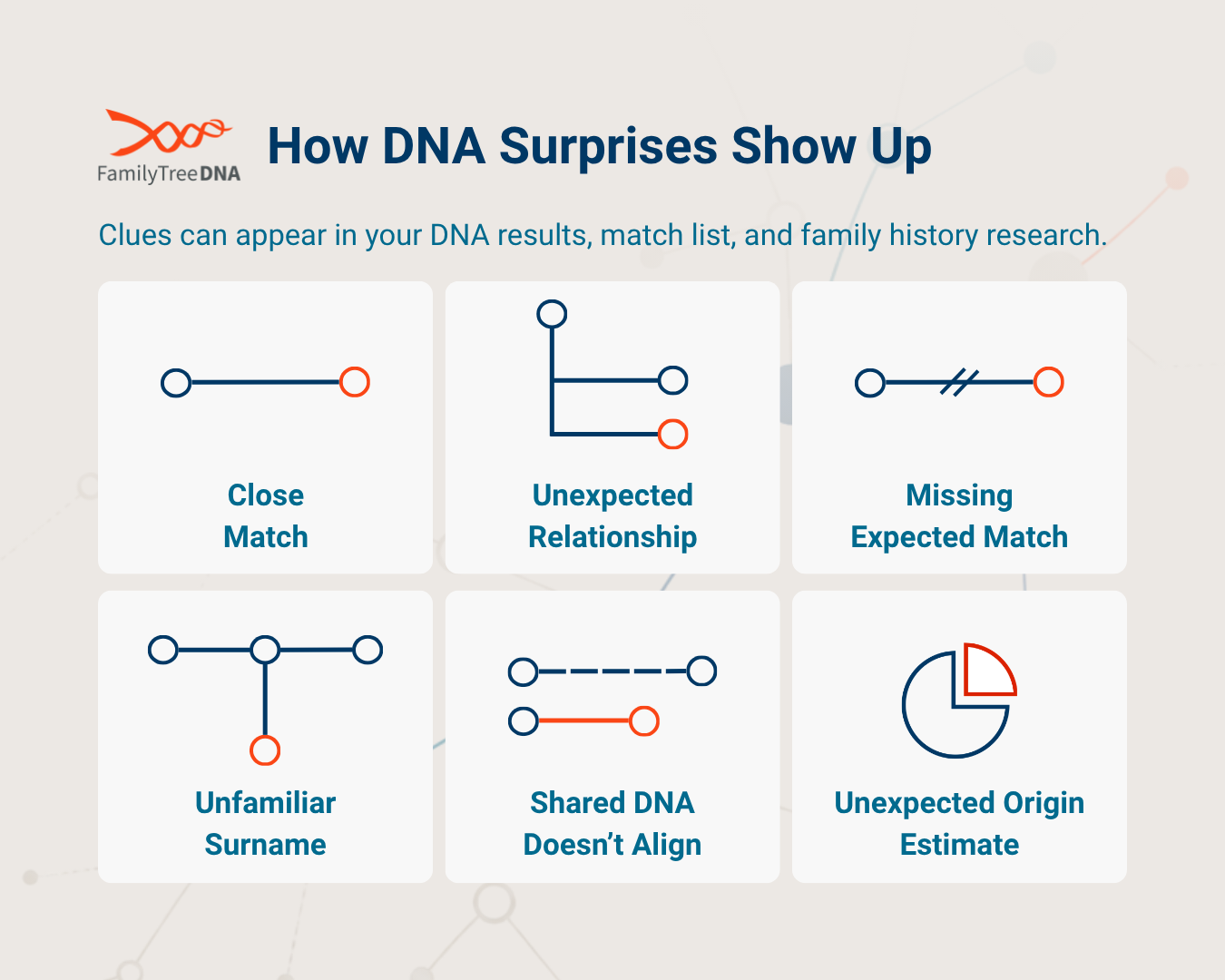
Unexpected DNA results may appear when:
- A close relative match appears with an unfamiliar name.
- A predicted relationship does not match the known family tree.
- An expected parent, sibling, aunt, uncle, or cousin does not appear as expected.
- Your closest matches all connect to surnames or family lines you do not recognize.
- Shared DNA amounts suggest a closer or different relationship than the one you were told.
- Ancestral origin estimates raise questions, especially when paired with unexpected matches.
It is important to say this clearly: ancestral origin estimates alone do not prove an NPE or unexpected parentage.
Origin estimates can be meaningful, but they are estimates based on reference populations and statistical models. If you are trying to understand a possible DNA surprise, close matches, shared DNA amounts, family trees, known relatives, and genealogical records are much more important than origin estimates alone.
DNA results are clues. They can open a door, but they do not always explain the whole story immediately.
What Should You Do After Unexpected DNA Results?
If you have received unexpected DNA results, there is no single correct reaction.
You may feel curious, confused, excited, angry, sad, relieved, overwhelmed, or all of those things at once.
Some people want to research immediately or contact new matches right away.
Others need time and space to process what the results may mean before they look any further.
Both reactions are valid.
Before taking action, it may help to slow down and consider a few first steps.
Take Time Before Contacting New Relatives
When a close match appears, it can feel urgent to message them immediately, but sometimes it’s better to pause.
A DNA surprise may affect more than one person. The person receiving the result may be surprised, but so may the match, the raising family, the genetic family, or others connected to the discovery.
Before reaching out, it may help to think through a few questions:
- What are you hoping to learn? You may be looking for medical history, family context, confirmation of a relationship, or simply a starting point.
- What responses are you prepared for? A new relative may respond warmly, need time, ask questions, or not respond at all.
- What do you feel comfortable sharing first? A short, respectful message can open the door without sharing more than you are ready to share.
- Who can support you if the conversation becomes emotional? A trusted friend, counselor, or support community can help you process what comes next.
You do not have to have everything figured out before making contact. But giving yourself time to think can help you approach the conversation with more clarity.
Save What You Can See
If you are researching a DNA surprise, it can help to save notes as you go.
You may want to document:
- Match names
- Predicted relationships
- Shared DNA amounts
- Known surnames
- Family tree clues
- Messages sent or received
- Questions you want to answer later
This does not mean you need to become a full-time genetic genealogist overnight. It simply helps you keep track of information in a moment that may feel emotionally overwhelming.
Review Your Privacy and Sharing Settings
DNA testing involves personal information, and different people have different comfort levels around visibility and contact.
At FamilyTreeDNA, matching and sharing settings give customers control over their testing experience. If unexpected results have changed how you feel about being visible to matches or receiving contact, take time to review your account settings and make choices that feel right for you.
Find Support Before You Go Further
A DNA surprise can raise questions that are bigger than genealogy.
You may be asking:
- What does this mean for my understanding of my family story?
- Who might be affected by this information?
- What do I want to know before taking another step?
- Do I want contact, more research, or time to process first?
- How much am I ready to share with others?
- Who can I talk to as I sort through what this means?
These are not small questions. You do not have to answer them alone.
Support can come from many places:
- trusted friends
- peer communities
- adoption-competent therapists
- donor-conceived spaces
- NPE support groups
- genetic genealogy educators
- organizations that specialize in genetic identity
Resources for NPEs, Adoptees, and DNA Surprises
One of the most important things to know after a DNA surprise is this: you are not the only person who has experienced this.
The details of your story are yours, but the questions, emotions, and uncertainty that can follow unexpected DNA results are shared by many people across NPE, adoptee, donor-conceived, and unknown parentage communities.
That is why we are expanding this conversation beyond one article.
If You Are Navigating a DNA Surprise: Right to Know
Right to Know supports people impacted by genetic identity issues, DNA surprises, misattributed parentage, adoption, donor conception, and NPEs.
In this series, Kara Rubinstein Deyerin from Right to Know will share more about what can happen after unexpected DNA results, including identity, family dynamics, donor-conceived experiences, and what to consider when new genetic relatives reach out.
If You Are an Adoptee: National Association of Adoptees and Parents
For adoptees, DNA testing can bring both answers and new questions. Some adoptees test to search for genetic family. Others test for ethnicity, health history, or genealogy and unexpectedly uncover new information.
The National Association of Adoptees and Parents (NAAP) supports the adoption community through education, awareness, connection, and resources for adoptees, adoptive parents, and birth parents.
In this series, Jennifer Fahlsing from NAAP will focus specifically on adoption and DNA testing, including what adoptees may want to consider before and after results.
If You Are Ready to Research
Some people are ready to begin researching right away. Others are not. Both are okay.
When you are ready, DNA tools can help you begin organizing clues. At FamilyTreeDNA, autosomal DNA matches can provide relationship estimates, shared DNA amounts, ancestral surnames, family tree links when available, and other information that may help you understand how you connect to genetic relatives.
Depending on your situation, you may also choose to:
- Review your closest autosomal DNA matches.
- Look for shared surnames, locations, or family trees.
- Use notes to track possible connections.
- Compare known relatives when available.
- Work with a trusted genetic genealogy researcher or search angel.
- Combine DNA evidence with records-based genealogy.
DNA can point toward genetic relationships, but it works best when paired with careful research, context, and consent.
A Note on Family, Identity, and DNA
DNA can reveal genetic relationships, but DNA does not decide what family means to you.
For some people, unexpected DNA results bring clarity. For others, they bring grief. Some people build relationships with genetic relatives. Some do not. Some feel affirmed. Some feel shaken. Many feel several things at once.
As an adoptee, I know that questions about identity and family can be layered. Sometimes, giving those layers a name can help make them feel less impossible to sort through. As someone who works at FamilyTreeDNA, I also know that genetic genealogy can be a meaningful tool for people looking for answers. DNA testing can help uncover biological connections, clarify family history, and open doors that records alone may not. At the same time, those answers can carry emotions, questions, and relationships that take time to understand.
Both can be true.
DNA testing can help uncover genetic connections, but people are more than their results. Behind every match list are real families, real histories, and real emotions.
If your DNA results have surprised you, you do not have to rush to define what it all means. You can move at your own pace. You can ask questions. You can seek support. You can decide what kind of contact, research, or next step feels right for you.
And most importantly, you are not alone.
Frequently Asked Questions About NPEs and Unexpected DNA Results
What does NPE mean in DNA testing?
In DNA testing, NPE usually refers to an unexpected discovery about genetic parentage or a close genetic relationship. It has historically meant “non-paternal event,” but many people now use it to mean “not parent expected.”
Is an NPE the same as adoption?
Not exactly. An NPE and adoption are not the same, though the experiences can overlap. An adoptee may discover genetic relatives through DNA testing, while someone with an NPE may discover unexpected parentage despite not being adopted.
Can origin estimates prove an NPE?
Origin estimates alone cannot prove an NPE. Unexpected origin results may raise questions, but close DNA matches, shared DNA amounts, family trees, and genealogical records are much stronger tools for understanding genetic relationships.
What should I do before contacting a new DNA match?
Before contacting a new DNA match, consider what you want to ask, how much you want to share, and whether you are prepared for different kinds of responses. It may also help to seek support from someone familiar with DNA surprises, adoption, donor conception, or unknown parentage.
Can FamilyTreeDNA tell me who my genetic parent is?
FamilyTreeDNA provides DNA matches, relationship estimates, shared DNA information, and tools that can help with genetic genealogy research. Identifying a genetic parent usually requires interpreting matches, comparing family trees, reviewing records, and sometimes testing additional relatives.
Learning the meaning of NPE or DNA surprise may be the first step in understanding unexpected DNA results, but it is rarely the whole journey.
Whether your results brought clarity, confusion, grief, hope, or questions you were not prepared to ask, there are resources available. You can learn the language. You can find support. You can explore answers when you are ready.
DNA testing can reveal connections, but you get to decide what those discoveries mean in your life.
