By: Laurie Constantino
Three brick walls. Thirty years of research. See how Big Y-700 DNA testing helped confirm the African ancestry of Joshua “Old Jock” Perkins — and what’s still unresolved.
Documentation gaps are one of the most common obstacles for Americans researching African ancestry. For descendants of Joshua “Old Jock” Perkins, Big Y-700 DNA testing proved what historical records alone could not — and opened a door that had been closed for generations. Two brick walls have been broken. One remains.
Can Big Y-700 help with identifying African ancestry?
Big Y-700 DNA testing can help confirm African ancestry by identifying Y-DNA haplogroups passed from father to son. In the Perkins family case, it proved that all five sons of Joshua “Old Jock” Perkins shared a common ancestor of African descent.
Three Brick Walls — and What Big Y-700 DNA Testing Revealed
Not every brick wall gets broken the same way. Here’s how Y-DNA testing tackled three very different genealogical challenges in the Perkins family tree.
Brick Wall 1: Challenging a Family’s Racial Identity With DNA
Question: Did Old Jock Have African Ancestry?
Despite documented evidence identifying Joshua “Old Jock” Perkins (1732–1801) as a “free person of color,” some descendants insist he had wholly European ancestry. Y-DNA testing conclusively proved Old Jock was of African descent on his paternal line.
Status: Resolved. See how Y-DNA broke through this brick wall.
Brick Wall 2: Proving Family Relationships Without Documentary Evidence
Question: Were Old Jock’s Five Sons Really His?
Old Jock had five sons: George, Isaac, Jacob, Joshua Jr., and Lewis. Circumstantial evidence suggests each of the five sons’ identities, but documented evidence to prove their relationships to Old Jock does not exist. When combined with the circumstantial evidence, the Big Y-700 test proved all five men were descended from Old Jock.
Status: Resolved. See how Big Y-700 confirmed the connection.
Brick Wall 3: Tracing an Unknown Paternal Line Through Y-DNA Matches
Question: Is There a Perkins-Driggers Connection?
Old Jock’s father is unknown. Initial Y-DNA testing suggested Old Jock’s father could be a descendant of Emanuel Rodrigues Driggus Driggers (1607–1685). Although most historians believe Emanuel was Angolan, some deny his African heritage and claim Emanuel was European on his paternal line. The Driggers Y-DNA story is complex, and further Y-DNA testing is needed to break through this brick wall.
Status: Unresolved. Follow the Perkins-Driggers investigation.
Before the DNA: Building the Perkins Family Tree
My dad was young when his white-skinned, red-headed mother died. After her death, he lived off and on with his maternal Perkins grandmother; she wasn’t much of a talker. Frustrated by how little he knew about his family background, my dad devoted his retirement years to family history research, focusing on his mother’s Perkins family.
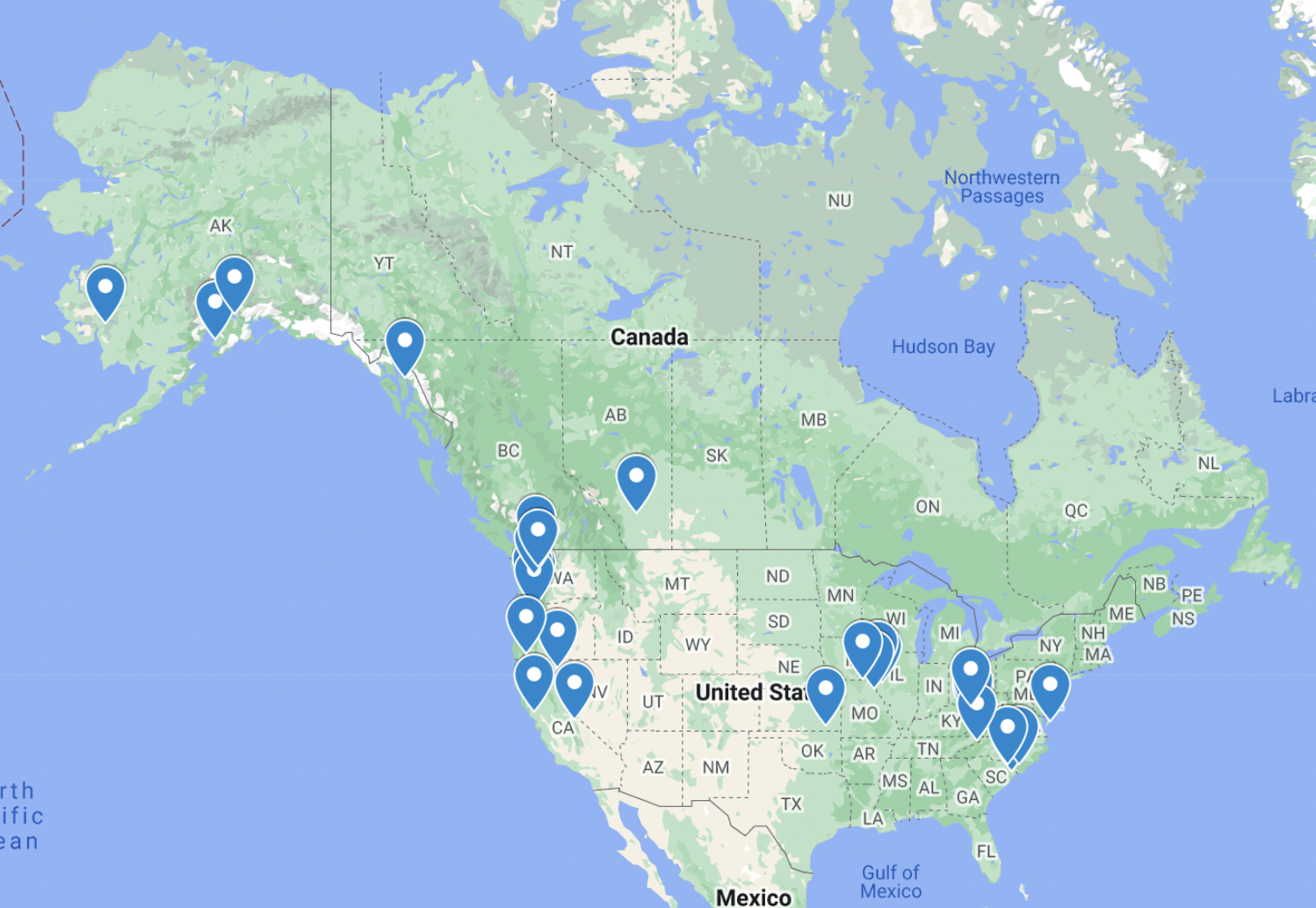
No one in my Perkins line has died in the place they were born. From 1732 to the present, early generations moved from state to state, always to the latest frontier. Because my dad researched before genealogical records were digitized, he spent many vacations traveling to places his Perkins family had lived, searching for clues about their lives.
During his travels, he heard rumors of dark-skinned family members but found no evidence the rumors were true. My dad grew up believing his Perkins roots were in England.
By the late 1980s, my dad had built a solid, documented record for George Perkins, my 5th great-grandfather, born in 1754 in South Carolina. However, my dad hit a brick wall when he tried to identify George’s father.
Land and tax records from 1787–1807 place George and several other Perkins men in Washington County and Carter County, Tennessee. After finding these records, my dad took a research trip to the Knox County Public Library in Tennessee, where he found the McClung Historical Collection.
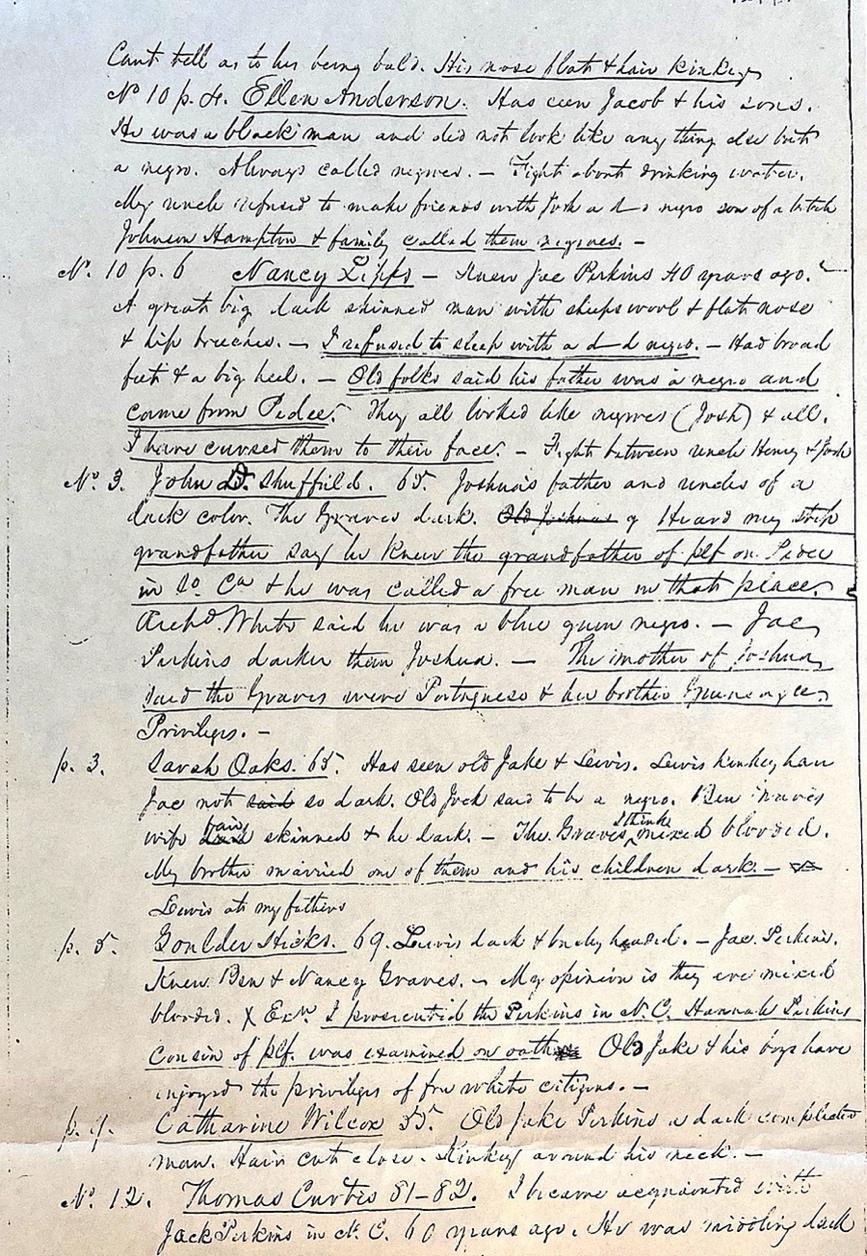
In the McClung Collection, he found a genealogical treasure trove: detailed notes from Perkins v. White, an 1858 trial that litigated the Perkins family’s race.
The 1858 Trial That Put the Perkins Family’s Race on Record
The case arose in July 1858 when Old Jock’s great-grandson brought a libel action suit against his neighbors for repeatedly saying the Perkins family were “Negroes”. According to Tennessee law, this meant the family:
- Were prohibited from owning their stores and selling their equipment
- Should be indicted for the crime of living with their white wives.
The Perkins family denied they had sufficient “Negro” heritage to meet Tennessee’s definition of “not white.” They claimed to be Portuguese.
Trial testimony focused on “proving” Old Jock’s race — and therefore the race of his sons. Over 80 witnesses gave graphic, often offensive, testimony about the family’s facial features, color, hair, body odor, and reputation. Trial testimony established that Old Jock had five sons:
- George
- Isaac
- Jacob
- Joshua Jr.
- Lewis
Ultimately, the jury found the neighbors had not libeled Perkins, concluding the family was “not white” as defined by Tennessee law on the eve of the Civil War.
Using a combination of court, land, and tax records, my dad successfully traced Old Jock to Accomack County, Virginia, where he appears in the records as the son of a “moletto” indentured servant named Esther Perkins. My dad theorized that Old Jock’s unknown father was also of African descent. However, despite his best efforts, my father could not identify Old Jock’s father.
Brick Wall 1: How Y-DNA Proved Old Jock’s African Ancestry
Question: Did Old Jock Have African Ancestry?
Despite contemporaneous historical documents identifying Old Jock as a “free person of color,” some modern Perkins family members could not accept that their family lineage was not wholly “white.” My dad’s correspondence files reflect lengthy disputes with those who refused to accept that Old Jock had African ancestry. There was no historical document that could convince the non-believers.
Unfortunately, my dad died before the advent of modern Y-DNA testing—the one definitive way to prove the truth of his hypothesis.
Although autosomal DNA (atDNA) shows many Old Jock descendants have African ancestry, atDNA is insufficient to show the African DNA came from Old Jock, as opposed to other ancestors. For this, we needed Y-DNA testing.
Y-DNA passes from father to son relatively unchanged, with only small, intermittent mutations over the centuries. Because Y-DNA is so stable, it can provide solid, genealogically relevant information about a person’s paternal line.
For Y-DNA testing, there must be an unbroken father-to-son line to the ancestor in question. A Y-DNA line can “daughter out” when a father only has daughters, or may disappear entirely when an only son dies without children.
Although Y-DNA testing could prove Old Jock was of African descent on his paternal line, my close Perkins family “daughtered out” several generations ago. Therefore, I needed to find a Y-DNA tester on another Perkins line.
Finding a Y-DNA Tester Through Traditional Genealogy Research
While looking for a tester, I built out my Perkins family tree, making it as deep and wide as possible. I did this to help find a Y-DNA tester and because Y-DNA results are significantly more meaningful when supported by genealogical evidence.
After several years of tree building, I found an Old Jock descendant (Tester 1) whose ancestor, like mine, was Old Jock’s son George Perkins. Tester 1 had taken a Y-12 test at FamilyTreeDNA that identified his Y-DNA haplogroup as E-M96, an African haplogroup.
This test alone was insufficient to conclude that Old Jock had African ancestry on his paternal line. Adoptions and affairs, for example, can change a person’s paternal line. I needed confirmation that Tester 1’s haplogroup came from Old Jock.
Y-12 tests are of limited utility because they analyze so few locations on the Y-chromosome; they are no longer offered by FamilyTreeDNA. I worked with Tester 1 to upgrade his test to a Y-37, which confirmed his E-M96 haplogroup.
Among Tester 1’s Y-37 matches were three Perkins men I was able to trace to Old Jock’s presumed sons Isaac, Jacob, and Lewis.
With this, we had strong evidence to prove Old Jock was of African descent on his paternal line — breaking through Brick Wall 1. However, Y-37 evidence was insufficient to prove the relationship between Old Jock’s presumed sons.
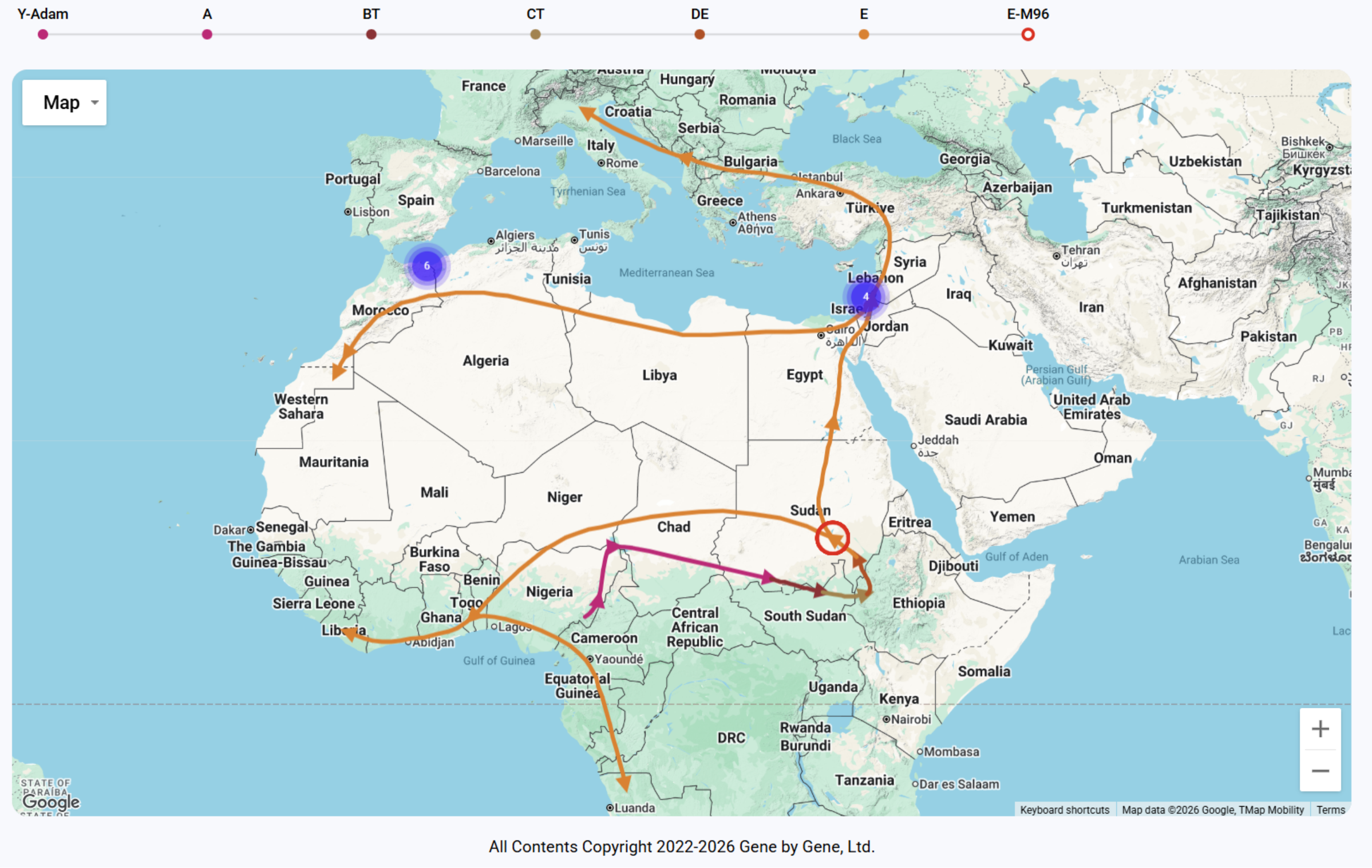
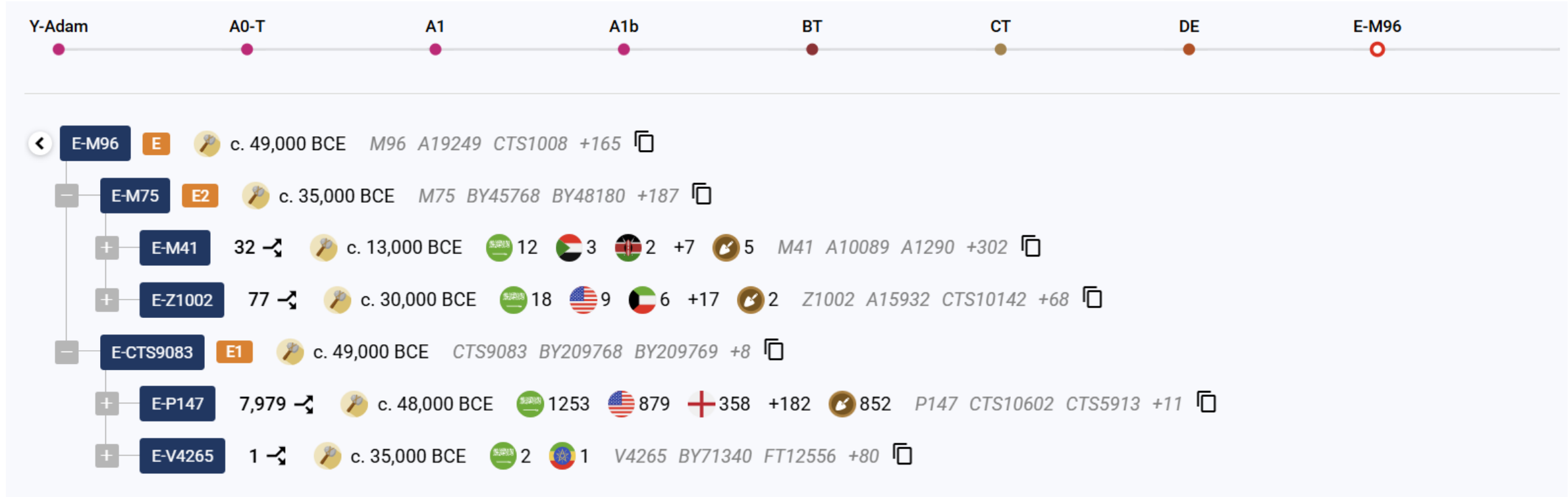
Caveat: E-M96 is an African haplogroup that branched from the world haplotree about 48,000 BCE. Multiple American families with African ancestry and carrying a variety of surnames have the E-M96 haplogroup.
In other words, not every man with haplogroup E-M96 is a descendant of Old Jock. However, if a man has a haplogroup other than E-M96, he can be eliminated as being descended from Old Jock on his paternal line.
Brick Wall 2: How Big Y-700 Connected Old Jock to All Five Sons
Question: Were Old Jock’s Five Sons Really His?
As documented in Perkins v. White court records, Old Jock had five sons. Circumstantial evidence suggested the sons’ identities, but solid, documented evidence to prove their relationships does not exist. Early Y-37 testing showed four of the presumed sons shared the E-M96 haplogroup (the descendants of the fifth son had not yet been tested). However, because E-M96 is such an old haplogroup and is tied to multiple surnames, to find a definitive answer, I needed the descendants of all five presumed sons of Old Jock to take the Big Y-700 test.
After upgrading Tester 1 to the Big Y-700 test, I contacted his Y-37 matches and found a documented descendant of Old Jock’s presumed son Isaac who was willing to take the Big Y-700 test. The next challenge was finding documented descendants of Old Jock’s other sons to test.
Using a Facebook Group as a Catalyst for Y-DNA Research
My search for Y-DNA testers coincided with starting the Old Jock Perkins Family Research Group on Facebook with my distant Perkins cousin, Ramona Young. Our plan was to share decades of my dad’s, Ramona’s, and my Perkins family research with other family members.
We wanted a forum to:
- collaborate with others
- make new discoveries about our mutual Perkins ancestors
- share information about our Perkins family Y-DNA discoveries
- find paternal line Perkins men to take Y-DNA tests
The Facebook group succeeded beyond our wildest dreams. We started it in June 2020 and now have over 450 Perkins family members in the group. (Editor’s Note: As of June 2026, the Facebook Group has over 650 members.)
More people analyzing and reanalyzing family documents led to new and important discoveries about the family. We’ve formed a bond among widely dispersed family members by sharing stories, histories, pictures, newspaper articles, and obituaries.
Many of Old Jock’s descendants faced race-based discrimination, persecution, and challenges throughout their lives. Through the Facebook group, we’ve learned of Perkins men who were prosecuted for illegally “voting while black” and others who were indicted for being married to “white women.”
Some branches of the Perkins family set down deep roots along isolated Louisiana bayous and in the hills of eastern Kentucky and Tennessee, where they formed tight-knit insular communities with deep ties to extended family that endure to this day.
Others, like my family, were relentlessly on the move — passing as “white” and paying the steep price of losing their history and family connections, either by intentionally severing ties or by simply forgetting over time, distance, and generations.
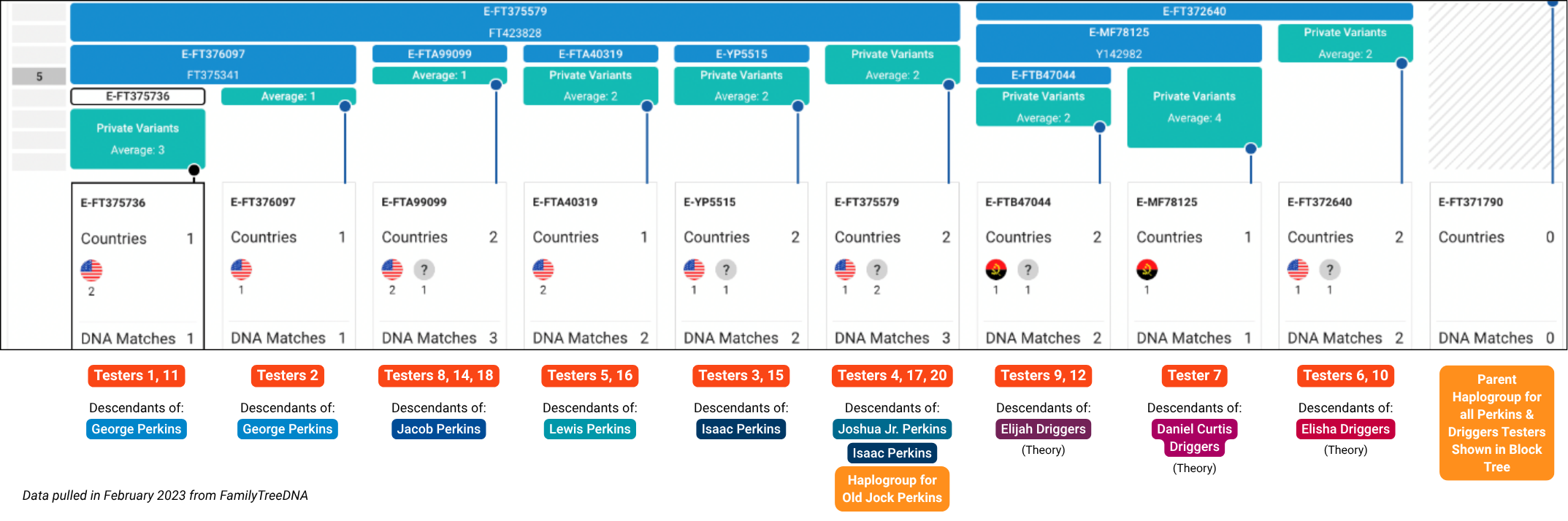
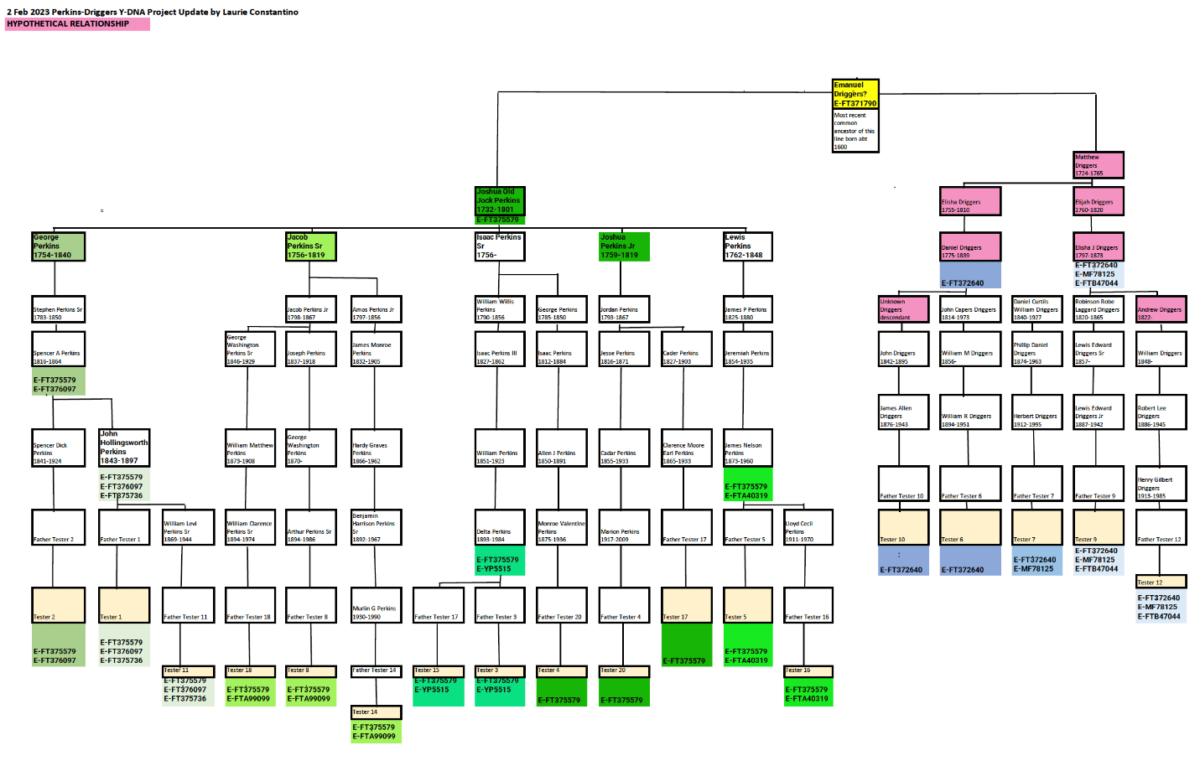
Through the Perkins Facebook group, we found all the necessary Y-DNA testers to conclusively prove that descendants of George, Isaac, Jacob, Joshua Jr., and Lewis Perkins are descended from a common ancestor. When combined with the available documented evidence, Big Y-700 testing proved all five men are descended from Old Jock and share a common ancestor of African descent.
The following chart shows the Big Y-700 testing we’ve done to date for Old Jock’s descendants.
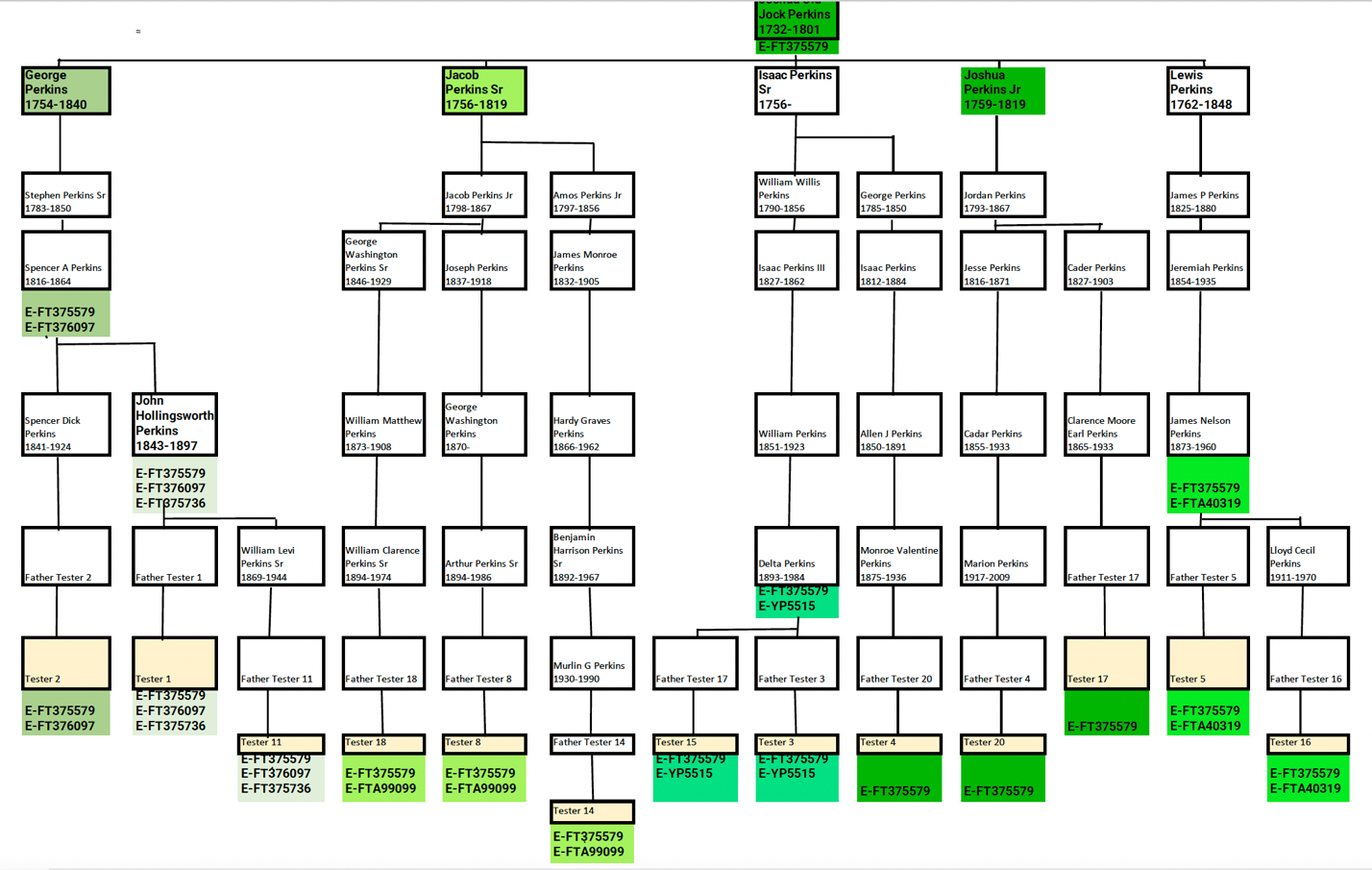
Research Tip: When Tester 1’s Y-700 results first came back, he had no Big Y-700 matches and belonged to an ancient haplogroup that was thousands of years old, well beyond genealogical time. Because a single Big Y-700 test can provide so little information, this is the point when some get frustrated with Big Y-700 testing and feel like it is a waste of time and money.
Instead of giving up, it’s more useful to search out and find additional testers. As the above chart shows, if one has the patience, perseverance, and resources, Big Y-700 testing can provide solid proof of important genealogical relationships.
Brick Wall 3: What Y-DNA Matches Revealed About Old Jock’s Paternal Line
Question: Is There a Perkins-Driggers Connection?
Despite the Y-DNA testing we’ve done, Old Jock’s father remains unknown. The testing did, however, provide us with important clues about Old Jock’s father’s identity.
All the Y-DNA matches for the Perkins men we’ve tested are either descendants of Old Jock or have the surname Driggers. Is Driggers Old Jock’s missing father?
At my request, two Driggers matches agreed to Big Y-700 testing; their Big Y-700 haplogroup, E-FT372640, is closely related to E-FT375579, Old Jock’s haplogroup. Both haplogroups branched off from E-FT371790, with their most recent common ancestor estimated to have been born about 1600.
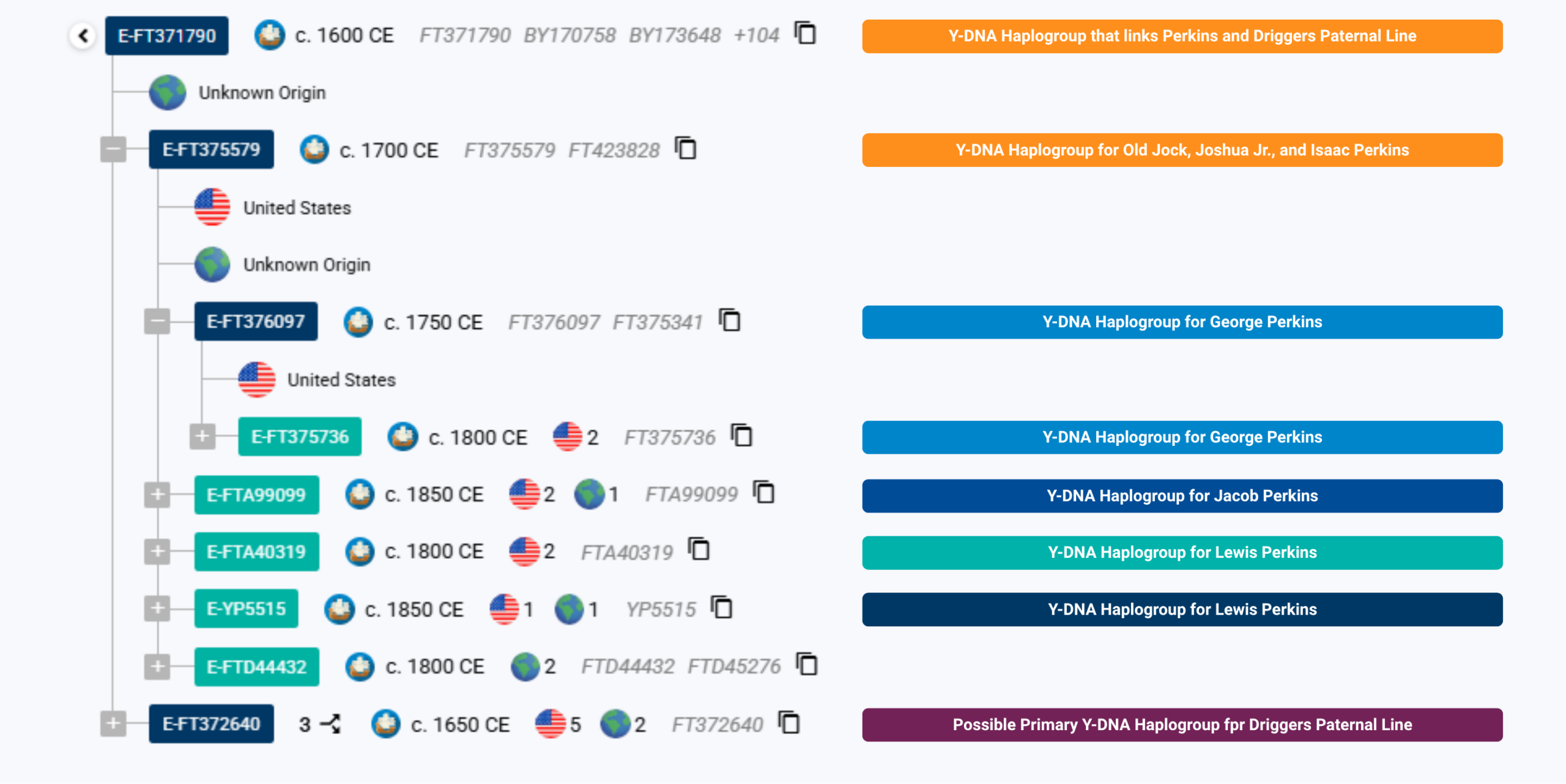
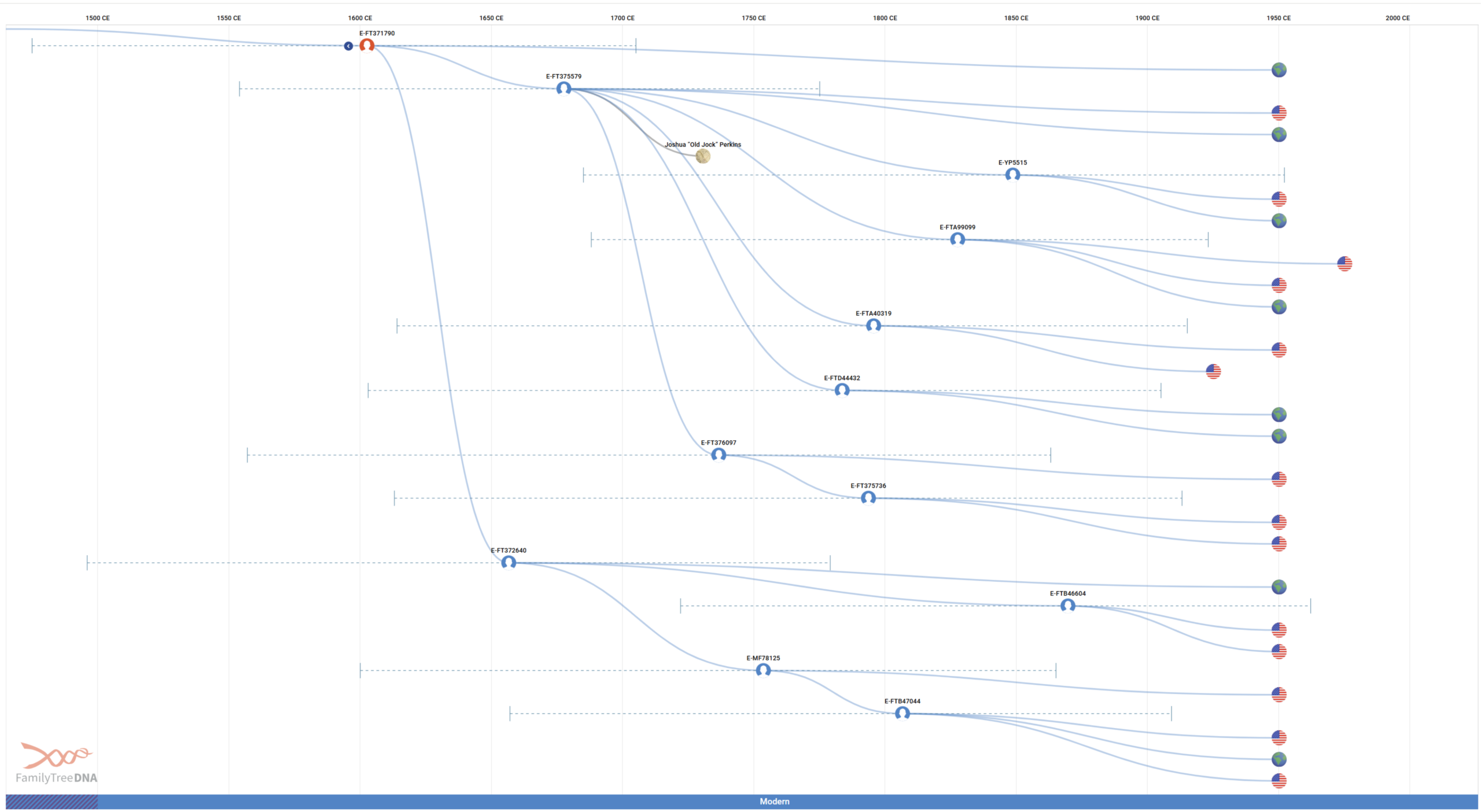
All the Driggers matches appeared to be descendants of Emanuel Rodrigues Driggus Driggers (1607–1685). Emanuel’s estimated 1607 birth year is consistent with the estimated age of the most recent common ancestor for haplogroups E-FT372640 (Driggers) and E-FT375579 (Perkins).
How Land Records Support a Possible Perkins-Driggers Link
Some historians believe Emanuel Driggers was one of the Angolans brought to the Americas on the San Juan Bautista, arriving in Jamestown in 1619; others speculate Emanuel was the child of a 1619 Angolan. In any case, Emanuel is documented as having been in Northampton County, Virginia, in 1645.
In 1675, “Manuel Rodriggus, negro,” leased two plots of land in Northampton County for 99 years. These plots were next to a plot where a man named James Gibson had a plantation. Old Jock was born in 1732 and indentured to James Gibson in 1734. Both events occurred during the period of Emanuel Rodrigues Driggus Driggers’ lease of land next to James Gibson. This proximity evidence is consistent with Old Jock’s unknown father being a descendant of Emanuel.
Here is the status of Perkins and Driggers testing for those Driggers linked to haplogroup E-FT371790 (pink boxes represent hypothetical relationships).
NPEs, Adoptions, and the Limits of Surname-Based Y-DNA Research
Most claim Emanuel is the direct ancestor of all Americans with the surname Driggers. He had at least eight children, two of whom were adopted. In addition to the descendants of Emanuel’s sons, there were single Driggers women whose children took their mother’s surname. There are yet others, as in all families, with “birth certificate” Driggers fathers who weren’t biological fathers — commonly referred to as an NPE, or Not Parent Expected. In other words, not all Driggers are paternal line descendants of Emanuel.
Unfortunately, before 1850, we’ve found only fragmentary documentary evidence about the Driggers family, making it impossible to trace the line between Emanuel and living family members with any certainty. Although we’re hopeful Y-DNA testing will fill in some gaps, DNA evidence needs to be supported with traditional genealogical records.
Where the Driggers-Perkins Y-DNA Research Stands Today
Before we can sort out the connection between Old Jock and the Driggers family, we need to fully develop the Y-DNA story of the Driggers family. To facilitate this, I became an administrator of the Driggers-Perkins Y-DNA Group Project at FamilyTreeDNA and a co-administrator of the Driggers Family Research Group on Facebook. The goals of the Y-DNA project include determining:
- If Emanuel Driggers was of African descent on his paternal line
- some claim, without evidence, that Emanuel’s father was Portuguese, Italian, or Spanish
- The relationships among the various Driggers families in America
- Which Driggers families are paternal-line descendants of Emanuel
To date, nine men with the surname Driggers have taken Y-DNA tests at FamilyTreeDNA:
- Five have E-FT372640, the African Y-DNA haplogroup discussed above
- One has E-Z36296, an African Y-DNA haplogroup that formed about 100 BCE and is only distantly related to E-FT372640
- Three have Northern European Y-DNA with connections to unrelated paternal line surnames (Roberts, Leonard, Hazelwood, and Sumrall)
(Editor’s Note: As of June 2026, the Group Time Tree for the Driggers DNA Project shows five members with a parental haplogroup of E-FT372640 and fourteen with E-FT375579 — both branching from E-FT371790, estimated to have been born around 1640 CE. Results are based on public data from the Group Time Tree.)
Here is the status of Driggers Y-DNA testing done to date (pink boxes represent hypothetical relationships):
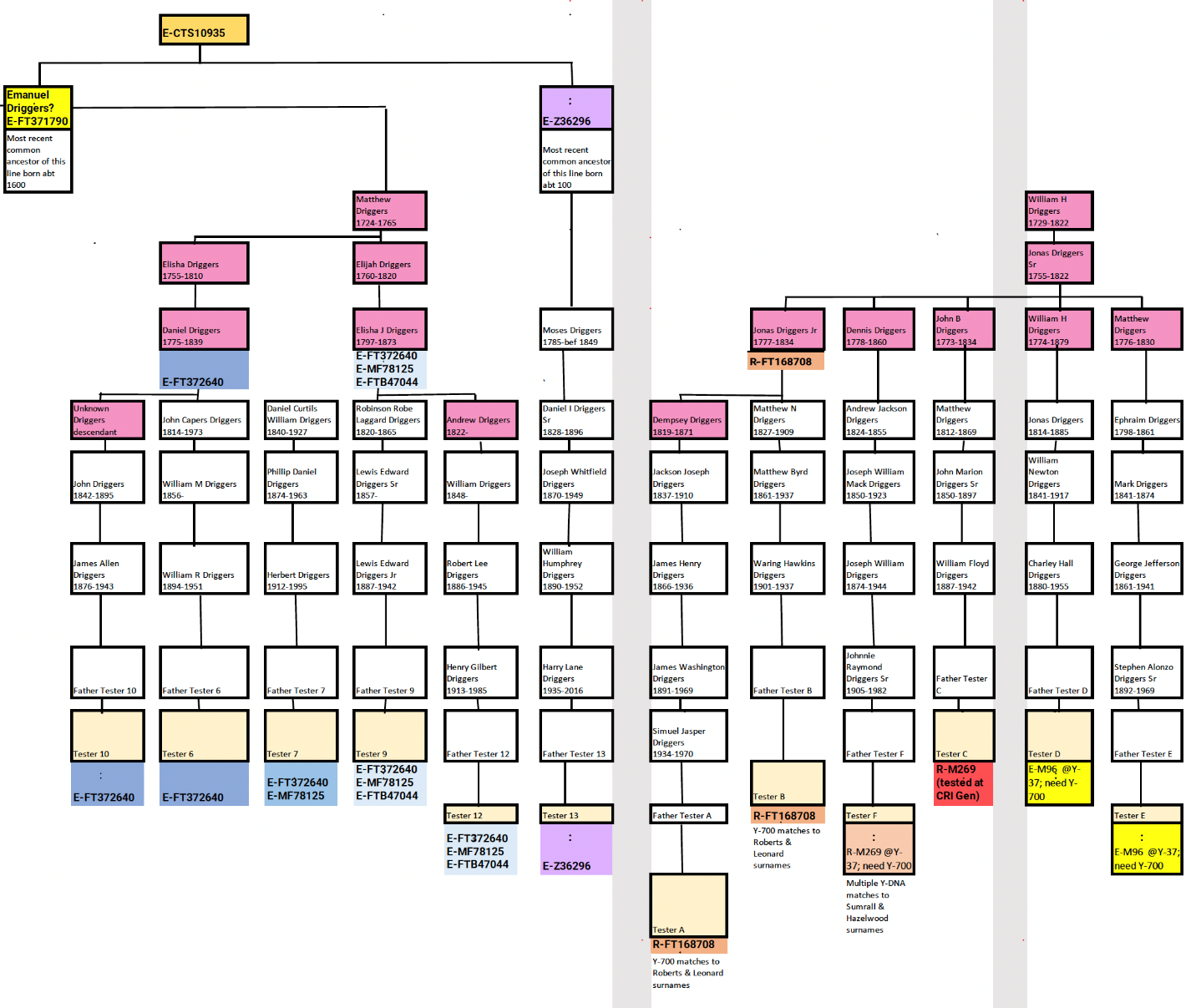
Given what historians tell us about Emanuel’s Angolan origins, I theorize the five men with E-FT372640 are Emanuel’s direct paternal line descendants, and the rest are either descended from Driggers’ daughters, adoptees, or NPEs.
Y-DNA testing of Driggers men remains ongoing.
Crowdfunding Y-DNA Research: How We Funded Big Y-700 Testing
Y-DNA testing at the scale we’ve done in the Driggers-Perkins Y-DNA Project is not cheap, even when purchasing test kits during FamilyTreeDNA’s regular sales. I’m often asked how we’ve been able to pay for so much Big Y-700 testing.
Initially, I paid for most of the testing with funds that came as generous Christmas and birthday gifts from my immediate family. By the time my family was tapped out, the Old Jock Perkins Facebook group was going strong, and a number of enthusiastic members had donated to the General Fund of our Driggers-Perkins Y-DNA Project.
Some Perkins family members have been extremely generous; all project participants are forever in their debt. We’ve also had General Fund donations from members of the Driggers Facebook group. Occasionally, men can afford to pay for their own testing; I’m ecstatic when this happens.
Both the Perkins and Driggers Facebook groups have been instrumental to the success of our Y-DNA Project. If the Facebook groups did not exist, the Y-DNA Project is unlikely to have succeeded.
Successful genealogical research is a family affair — collaboration and cooperation play key parts. I am eternally grateful to all my Perkins and Driggers collaborators. Special thanks to the Perkins and Driggers men who have tested their Y-DNA; they made everything described in this article possible.
About the Author
Laurie Constantino
Group Project Administrator
Laurie Constantino has researched her Perkins family for more than 30 years, building on decades of family history research compiled by her father, Earl Patterson Otto (1921-2009.)
She is the author of “Joshua ‘Old Jock’ Perkins and His Son George: From Virginia to Iowa, From Indentured to Free, From Black to White,” published in the Journal of the Society of the First African Families of English America, Volume 1 (5 Mar 2022). She is the administrator of the Driggers-Perkins DNA Project at FamilyTreeDNA, a co-administrator of the Joshua “Old Jock” Perkins Family Research Group on Facebook, and a co-administrator of the Driggers Family Research Group on Facebook.
What about Europeans with African ancestry?
I have started a similar effort on my Bossert line, not because of ethnicity but for country of origin and because the name is spelled so many different ways; Bossart, Buzzard, Buzart, etc. It is challenging to identify shared lines with documentary evidence
I’m with Bill Watson. The man said he was Portuguese – I expect he was – AND named Rodrigues.