By Jennifer Fahlsing
DNA testing can help adoptees explore biological family connections, but the journey often reaches far beyond genealogy.
For many people, taking a DNA test is an exercise in curiosity—a way to confirm a family story or add new branches to a well-documented tree. For adoptees, that same test can carry far more weight: the possibility of answering questions that may have shaped an entire lifetime.
- Who am I?
- Where do I come from?
- Why was I placed for adoption?
When results arrive, the experience is rarely just interesting. For adoptees, DNA testing is not simply about expanding a tree—it can be about building one for the first time.
Jump to a section
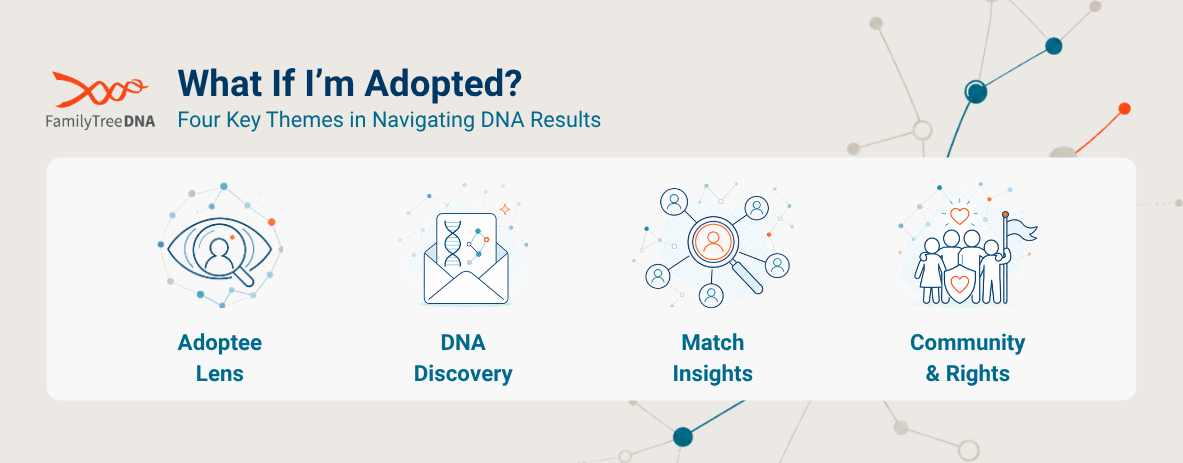
What is an Adoptee | Adoptee Experience | DNA Surprises | DNA Matches | Events | Adoptees Bill of Rights
What Is an Adoptee?
An adoptee is someone who has been legally adopted by a parent or parents who are not their biological parent or parents. In legal terms, adoption creates a parent-child relationship between a person and their adoptive parent or parents. It also transfers parental rights and responsibilities through a formal legal process.
But adoption is not only a legal event. It can also shape a person’s identity, family relationships, medical history, cultural connections, and sense of origin throughout life.
There is no single adoptee experience. Some people have always known they were adopted. Others learn later in life and may identify as Late Discovery Adoptees. Some adoptions are open, while others involve sealed records, limited information, or no contact with biological relatives.
Because of that, DNA testing may feel different depending on what someone already knows, what they hope to learn, and what information has been unavailable to them.
The Adoptee Experience Is Different—and It Matters
In genetic genealogy, unexpected results—often referred to as non-paternal events (NPEs)—are not uncommon. They bring shock, confusion, grief, and sometimes clarity. But adoptees enter this space from a fundamentally different starting point: the absence of known biological connection.
Within the adoption constellation, Late Discovery Adoptees (LDAs) often experience DNA results in ways that closely mirror NPEs. A test taken out of curiosity can reveal mismatched relatives, unexpected close connections, or no alignment with the family they believed was theirs.
How Adoptees and Late Discovery Adoptees Overlap With DNA Surprises
Both NPEs and LDAs must reconcile two competing realities:
- the identity they were given
- the genetic evidence in front of them
Both may face the realization that a long-held family narrative was incomplete or untrue. And both must navigate the emotional and psychological impact of reconstructing identity—often without a roadmap.
For adoptees who have always known, DNA testing represents a different kind of threshold: the movement from unknown to known. A match list may offer, for the first time, biological connection—shared DNA, shared traits, shared history.
There is no single response. Some feel relief. Others feel grief. Many experience both. All of it is valid.
When DNA Builds More Than a Tree
For genealogists, DNA testing confirms relationships and extends documented lines. For adoptees and LDAs, it does that—but it also introduces additional layers.
Understanding Identity Through DNA
DNA can answer foundational questions about biological parents, siblings, and heritage. Even a single close match—or a cluster of related matches—can provide grounding for those who grew up without biological reference points.
How DNA Results Add Context
Results may confirm, contradict, or complicate the story surrounding an adoption. For LDAs, this may mean uncovering information that was intentionally withheld.
How DNA Discoveries Affect Family Systems
Every DNA discovery exists within a network of relationships. A close match may represent a parent, sibling, or extended relative—each with their own history and awareness. Many adoptees proceed carefully, aware their search may impact others within the adoption constellation.
When DNA Matches Lead to Connection
DNA matches can lead to contact—and sometimes reunion. But identifying a relationship through shared DNA is not the same as building one. A centimorgan range can suggest how people are related; it cannot define how that relationship will unfold.
What DNA Matches Can Help Adoptees Learn
For those in the adoption constellation navigating DNA results, a thoughtful approach can make all the difference.
- Take your time. There is no urgency to act on your results. Processing what you’ve learned is part of the work.
- Learn what your matches are telling you. Understanding shared DNA, centimorgan ranges, and shared matches can help you begin to see patterns and possible relationships.
- Use tools intentionally. Platforms like FamilyTreeDNA provide tools such as shared match lists and chromosome browsers that support building and confirming biological connections.
- Build context before making contact. One of the most common regrets we hear is reaching out too quickly. Taking time to understand your results—and to prepare for a range of responses—can make future connections more stable and less overwhelming.
- Seek adoption-competent support. Interpreting DNA is one process. Integrating what it means is another. Both deserve attention.
Watch Next
FamilyTreeDNA offers step-by-step video tutorials for working with unknown matches in your Family Finder® match list.
Part 1: Where to start with unknown matches
Part 2: Using DNA Tools to Identify Unknown Matches
Part 3: How to Identify Unknown Matches With Unknown Parentage
For adoptees and Late Discovery Adoptees, support is not only about finding information. It can also mean finding spaces where these experiences are understood, discussed, and taken seriously.
How NAAP Supports Adoptees and Families
The adoption constellation includes people who understand both the technical and human sides of DNA discovery.
At the National Association of Adoptees and Parents (NAAP), we are guided by a simple but powerful mission: to unify the adoption community and elevate our diverse voices by promoting dialogue, understanding, and healing through education, awareness, and connection.
Everything we do flows from three commitments: Educate. Elevate. Empower.
Adoptee-centered Events
We believe adoptee and LDA voices belong in the DNA and genealogy space—because for us, this is not just data. It is a lived experience.
Bringing Adoptee Voices Into DNA, Genealogy, and Policy Spaces
That’s why NAAP carries its message beyond the echo chamber, exhibiting at RootsTech, the National Genealogy Society (NGS), and the National Conference of State Legislatures (NCSL)—bringing the adoptee and LDA perspective directly to genealogists, industry leaders, and policymakers shaping the tools and laws that impact our lives.
Beyond advocacy and education, NAAP also creates spaces where adoptees, Late Discovery Adoptees, families, and professionals can gather, learn, and be heard.
Conferences and Community Gatherings
NAAP will also be relaunching its Annual Conference in 2027 and co-hosts the Untangling Our Roots Summit, a biennial gathering that brings together the adoption, assisted reproduction, and NPE populations—because these experiences often overlap, and the need for shared understanding is real.
Free Virtual Events
NAAP hosts Adoption Happy Hour, a free Zoom program held on the 1st and 3rd Fridays of each month. Upcoming webinars include:
- Putting Yourself Together After Reunion with Dr. Joyce Maguire Pavao
- Migrating Towards Wholeness with Dr. Liz DeBetta
Why Access to Origins Matters
For many adoptees, questions about identity, origins, medical history, and adoption records are not abstract. They can affect how a person understands themselves, their family story, and their place within both biological and adoptive family systems.
The Adoptees Bill of Rights affirms that adoptees deserve dignity, access to their own records, knowledge of their origins, and the freedom to live as whole and complete people.
Adoptees Bill of Rights
At the heart of everything NAAP does is a foundational belief: that every adoptee has the right to know their origins, to possess their original birth certificate and adoption records, to access their full medical and social history, and to live without guilt as a whole and complete person. These are not privileges—they are rights. And until they are universally recognized, we will keep showing up.
DNA testing has the power to answer questions—but it can also reshape them. For adoptees and Late Discovery Adoptees, it is not just about identifying relatives. It is about understanding yourself.
Your story matters. Your search matters. And you deserve informed, compassionate support as you navigate both.
Connect with NAAP:
Frequently Asked Questions From Adoptees
Can DNA testing help adoptees find biological family?
Yes, DNA testing can help adoptees identify genetic relatives, compare shared matches, and gather clues that may lead to biological family connections.
What is a Late Discovery Adoptee?
A Late Discovery Adoptee, or LDA, is someone who learns later in life that they were adopted.
Are adoption and NPE the same thing?
No, adoption and NPE are not the same, but both experiences can involve unexpected DNA results, identity questions, and new family information.
Should adoptees contact DNA matches right away?
Not always; many adoptees benefit from taking time to understand their results, build context, and prepare emotionally before making contact.
What support is available for adoptees after DNA results?
Adoptees may find support through adoptee-led organizations like NAAP, adoption-competent professionals, virtual programs, and peer communities.
About the Author
Jennifer Fahlsing
Co-Founder & President, National Association of Adoptees and Parents (NAAP)
Jennifer Fahlsing is the co-founder and president of the National Association of Adoptees and Parents (NAAP), a 501(c)(3) educational organization dedicated to enhancing the lives of adoptees by unifying and elevating voices across the adoption constellation.