By: Katy Rowe-Schurwanz
Explore the mtDNA Series
Start with the basics, then continue through the series to learn how mitochondrial DNA testing works, what your results mean, and how to use mtDNA in genealogy.
- What Is Mitochondrial DNA (mtDNA)?
- How Mitochondrial DNA Testing Works
- Understanding mtDNA Haplogroups and Your Results (current article)
Learn how to read mtDNA test results, interpret your mtDNA haplogroup, and explore your maternal ancestry back to Mitochondrial Eve.
Understanding your mtDNA test results is the key to unlocking your direct maternal ancestry.
While mtDNA testing doesn’t connect you to relatives in the same way as autosomal DNA, it provides powerful insights into your maternal line—revealing where your ancestors came from, how they migrated over time, and how you connect to others who share that lineage.
In this guide, you’ll learn how to read your mtDNA results, understand your haplogroup, interpret your matches, and use your reports to explore your maternal ancestry.
How to Read Your mtDNA Test Results
Your direct maternal ancestry is identified through small changes in your mitochondrial DNA that have accumulated over thousands of years.
Your mtDNA results help explain your direct maternal ancestry through your haplogroup, matches, genetic distance, and ancestry tools. Together, these results can help you understand your maternal origins, trace your line farther back in time, and explore how your lineage connects to others.
- Your haplogroup places your maternal line on the mtDNA Tree of Humankind
- Your matches show people who share your direct maternal line
- Your genetic distance helps show how closely your mtDNA matches another tester’s mtDNA
- Your reports and maps help you explore origins, migration, and shared maternal ancestry
In this guide, you’ll learn about:
mtDNA Haplogroups | mtDNA Mutations | mtDNA Haplotree
You’ll also learn how to about mtDNA reports and tools:
Your mtDNA Matches | Matches Map | Ancestral Origins | Haplogroup Origins | Migration Map | mtDNA Discover™ Haplogroup Reports
Understanding Your mtDNA Haplogroup
Your mtDNA haplogroup is one of the most important parts of your mtDNA test results. It helps identify your maternal ancestry and shows where your lineage fits on the mtDNA Tree of Humankind.
Understanding your haplogroup is the first step in learning what your mtDNA results can tell you.
What is an mtDNA Haplogroup?
An mtDNA haplogroup is a genetic group that represents your direct maternal line and traces your ancestry back thousands of years. It is the foundation of your mtDNA test results and helps explain your maternal origins and migration patterns.
What Do the Letters and Numbers Mean?
mtDNA haplogroups are named using a combination of letters and numbers that represent branches on the mtDNA Tree of Humankind. Each additional letter or number reflects a new branch in your maternal line, helping to define your ancestry more precisely.
Think of your haplogroup like an address. The root haplogroup—shown as a letter such as H, V, U, J, or L—is like the country. It represents a very broad ancestral group.
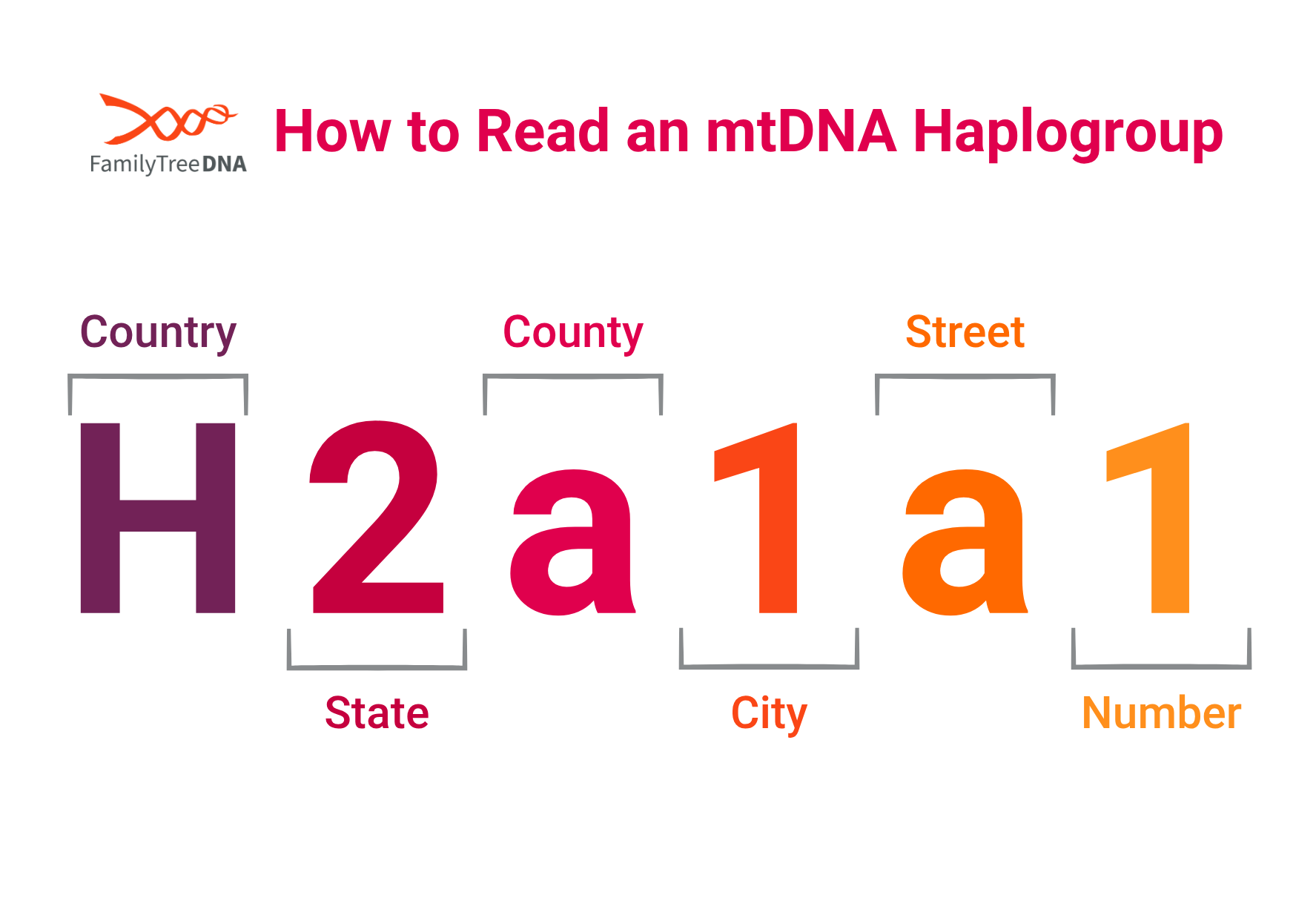
Past the root, haplogroups are divided into smaller branches using alternating numbers and letters. With a full mtDNA test, your haplogroup won’t just be a root like H—it could look something like H2a1a1. Each added character provides more detail about your maternal lineage.
Using the address analogy, if H is the country, then 2 might represent the state, A the county, 1 the city, and so on. While haplogroups don’t map to exact locations like a street address, a more detailed haplogroup can provide deeper insight into where your maternal ancestors lived and how they moved over time.
Why Do Some People Have Partial Haplogroups and Others Full Ones?
Whether you receive a partial or full mtDNA haplogroup depends on how much of your mitochondrial DNA was tested. Tests that analyze only part of your mtDNA can provide a partial haplogroup, while tests that examine the full mitochondrial genome can assign a more detailed, complete haplogroup.
Some autosomal DNA tests, such as those from 23andMe and Living DNA, include a small number of mtDNA markers. Because these tests are designed to focus on autosomal DNA, they only capture enough mitochondrial data to estimate a partial haplogroup.
Earlier mtDNA tests, such as FamilyTreeDNA’s discontinued mtDNA and mtPlus tests, also analyzed only portions of the mitochondrial DNA (HVR1 or HVR1 and HVR2), which limits how specific the haplogroup can be.
In contrast, the mtFull Sequence test examines the entire mitochondrial genome. This allows for a much more precise haplogroup assignment, providing deeper insight into your maternal ancestry.
Why Does a Full Haplogroup Matter?
The more of your mtDNA that is tested, the more specific your haplogroup becomes. A partial haplogroup provides a broad view of your maternal ancestry, often tracing your line back to ancient origins thousands of years ago.
A full haplogroup offers a much more detailed view. It can place your maternal line more precisely on the mtDNA Tree of Humankind, helping you better understand your ancestry and how your lineage connects to others over time.
What are mtDNA mutations?
mtDNA mutations are small changes in your mitochondrial DNA that have occurred over many generations. These changes are what allow scientists to trace maternal lineages and group individuals into mtDNA haplogroups.
The specific combination of mutations in your mitochondrial DNA forms your unique genetic signature, sometimes called a haplotype. This signature is what allows scientists to group individuals into haplogroups and compare results between testers.
Types of mtDNA mutations
You don’t need to memorize every type of mutation to understand your results, but knowing how they work can help you better interpret your haplogroup and matches.
There are several types of mtDNA mutations you may see in your results:
- Transitions
- Transversions
- Reversions
- Insertions
- Deletions
- Heteroplasmies
Transition Mutations Show Complementary Changes
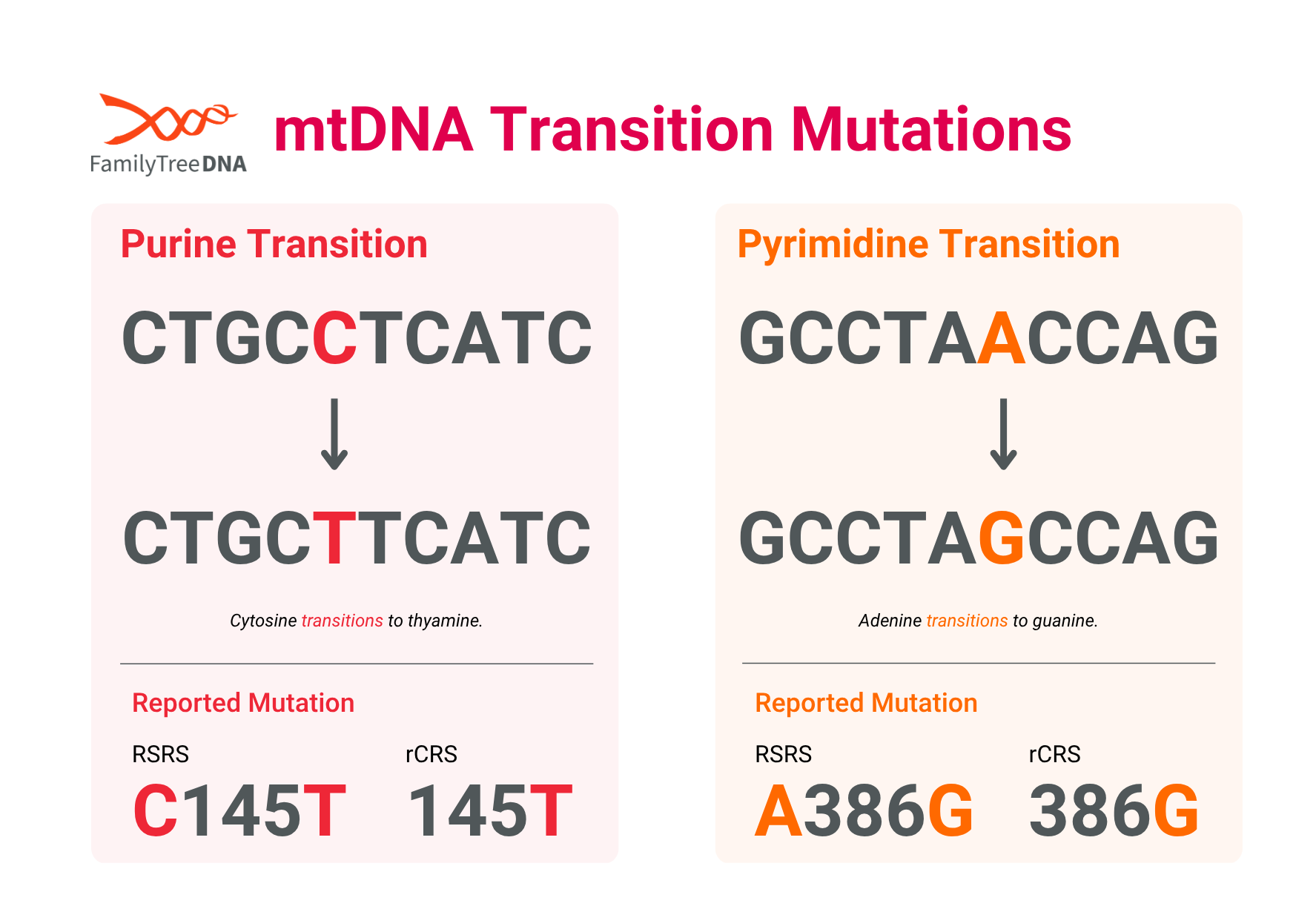
Transition mutations occur when one nucleotide changes to another of the same type.
- purine to a purine (A ↔ G)
- pyrimidine to a pyrimidine (C ↔ T).
In your mtDNA results, transitions are written with the original nucleotide, followed by the position, and then the new nucleotide.
Example:
If a C at position 146 changes to a T, it is written as C146T.
Transversion Mutations Show Base Switches
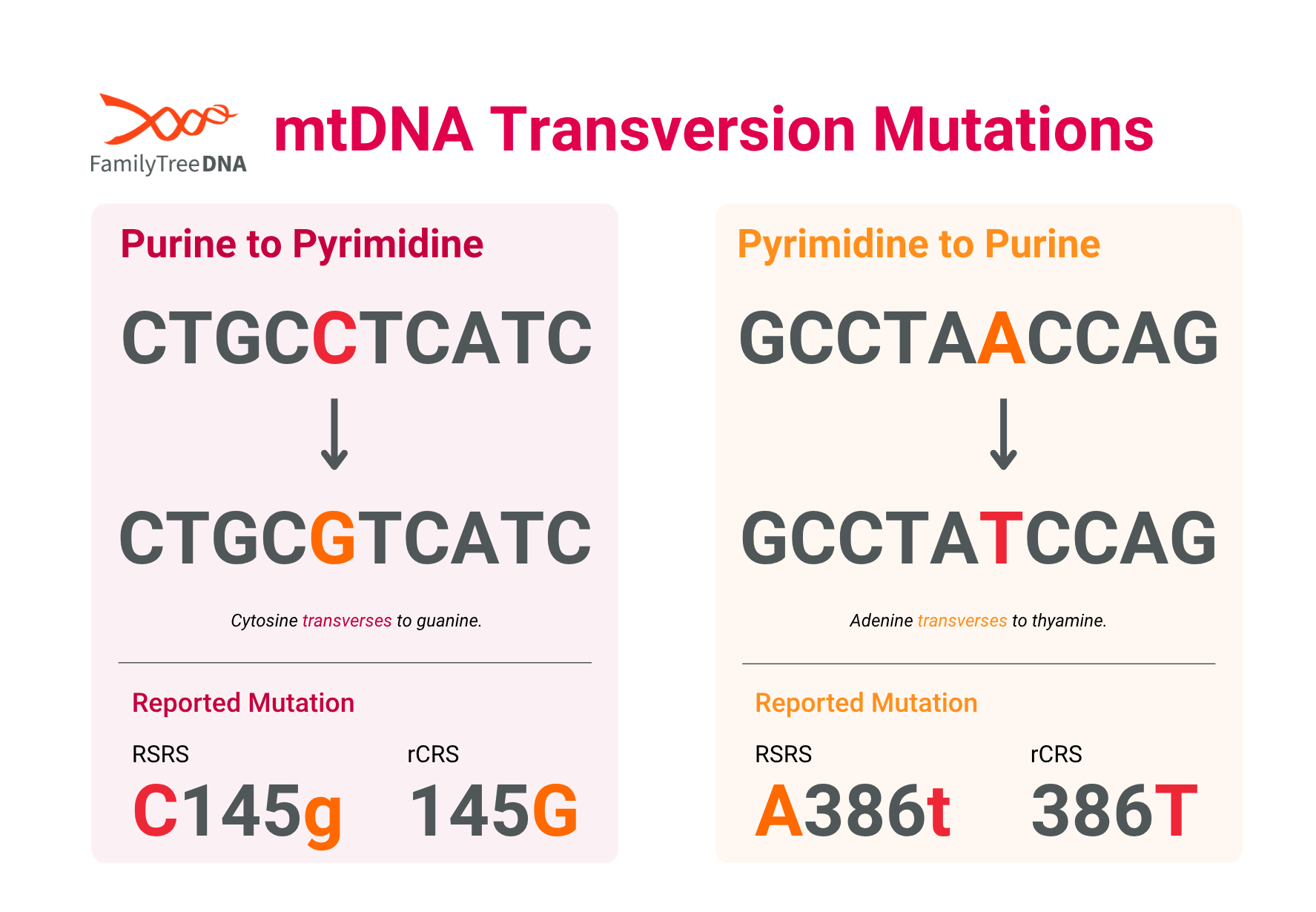
Transversion mutations occur when a nucleotide changes to a different type—either a purine to a pyrimidine or a pyrimidine to a purine.
- purine to a pyrimidine
(A ↔ C, A ↔ T, G ↔ C, G ↔ T) - pyrimidine to a purine
(C ↔ A, C ↔ G, T ↔ A, T ↔ G)
In your mtDNA results, transversions are written with the original nucleotide, followed by the position, and then the new nucleotide in lowercase.
Example:
If an A at position 825 changes to a T, it is written as A825t.
Reversion Mutations Show a Nucleotide Has Changed Back
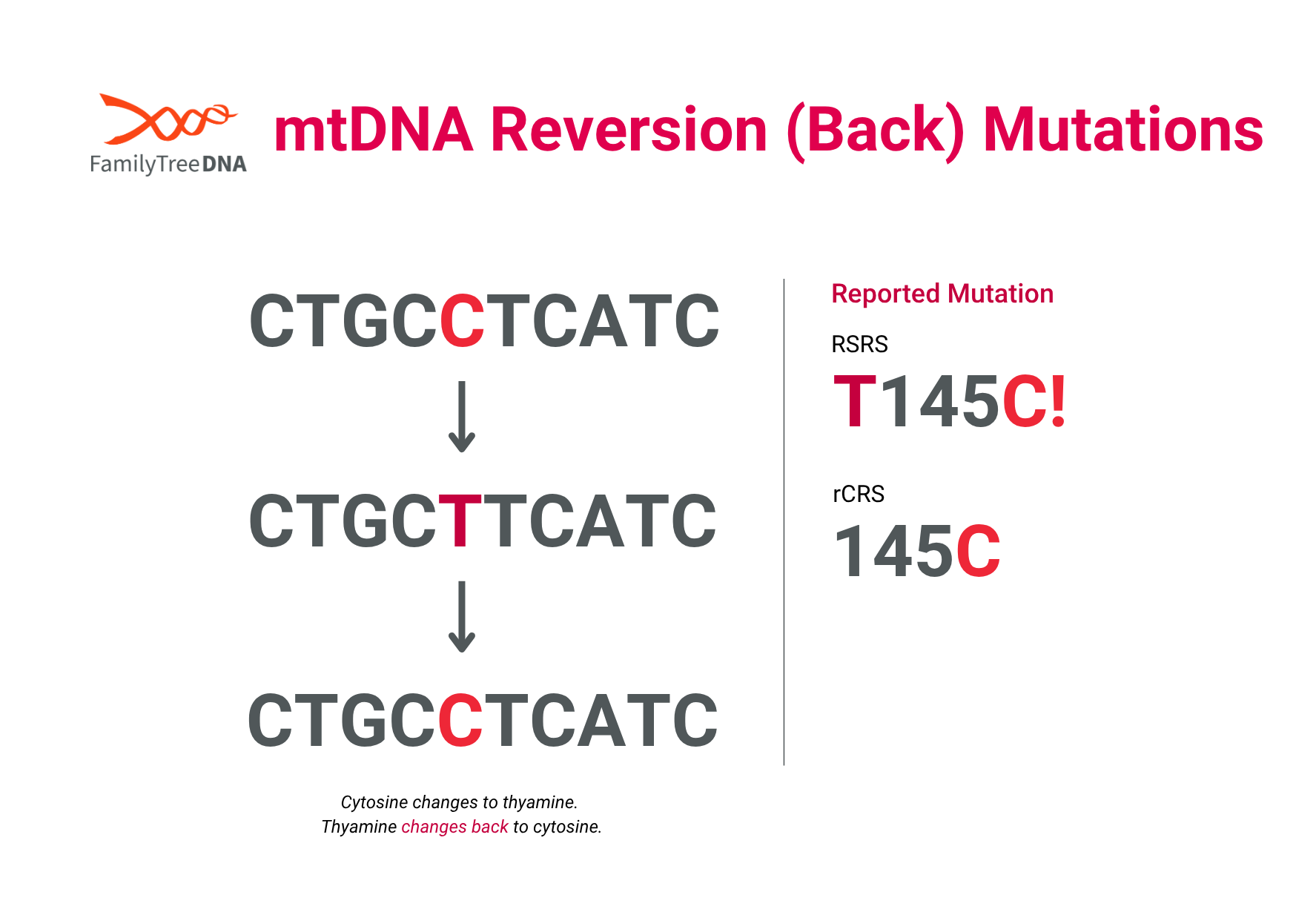
Reversion mutations occur when a nucleotide changes and then later changes back to its original (ancestral) state.
In your mtDNA results, reversions are marked with an exclamation point (!), showing that a mutation has reversed back to the original value.
Example:
If the original nucleotide at position 152 is C, it mutates to T, and then later changes back to C, it is written as T152C!.
If a position has changed back more than once, multiple exclamation points may be used.
Insertion Mutations Show Added DNA Positions
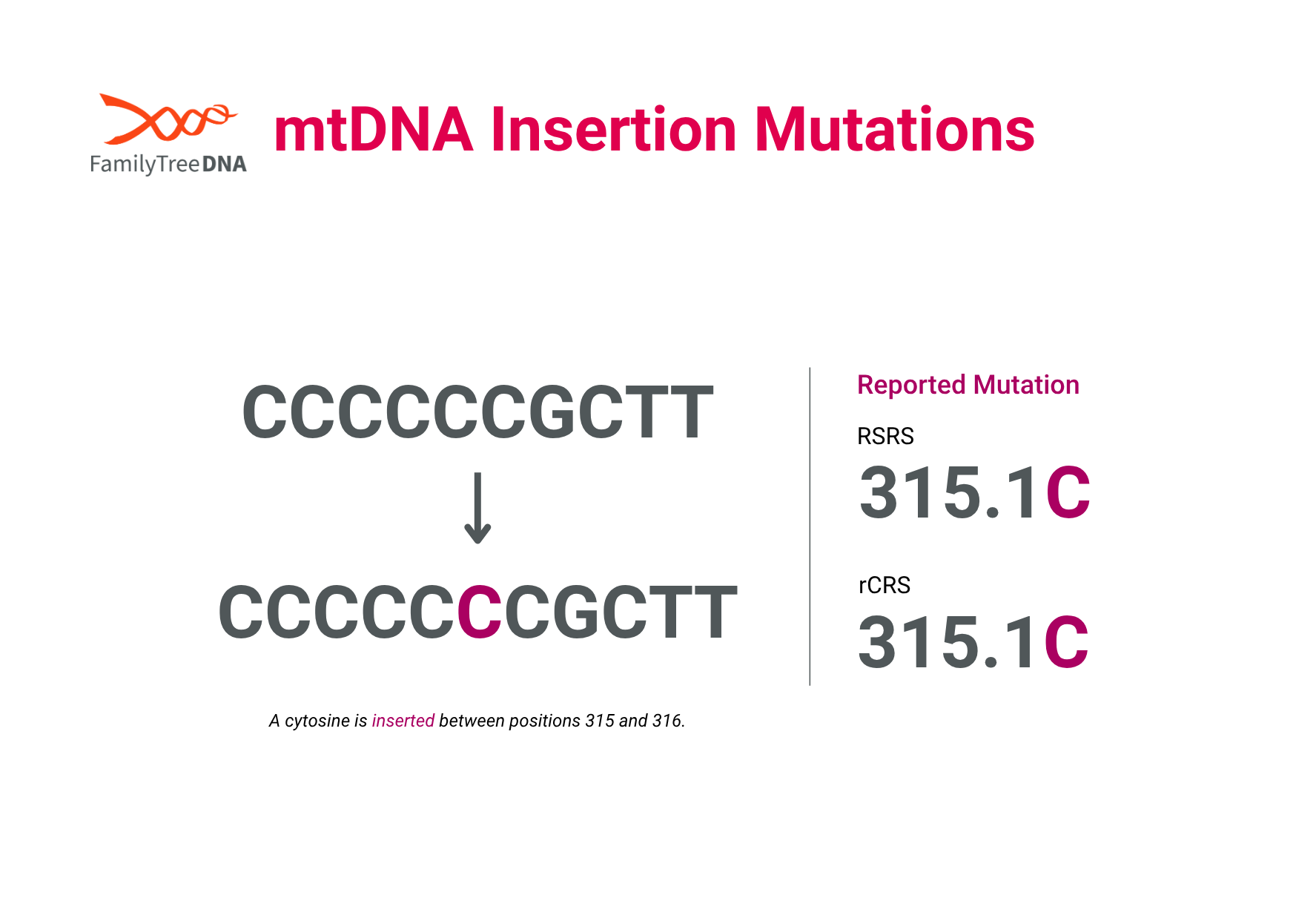
Insertion mutations occur when one or more nucleotides are added between positions in your mitochondrial DNA.
In your mtDNA results, insertions are typically shown using a decimal point to indicate where the additional nucleotide appears.
Example:
An insertion at position 315 may be written as 315.1C, indicating an added nucleotide at that location.
Deletion Mutations Show the Absence of a Nucleotide
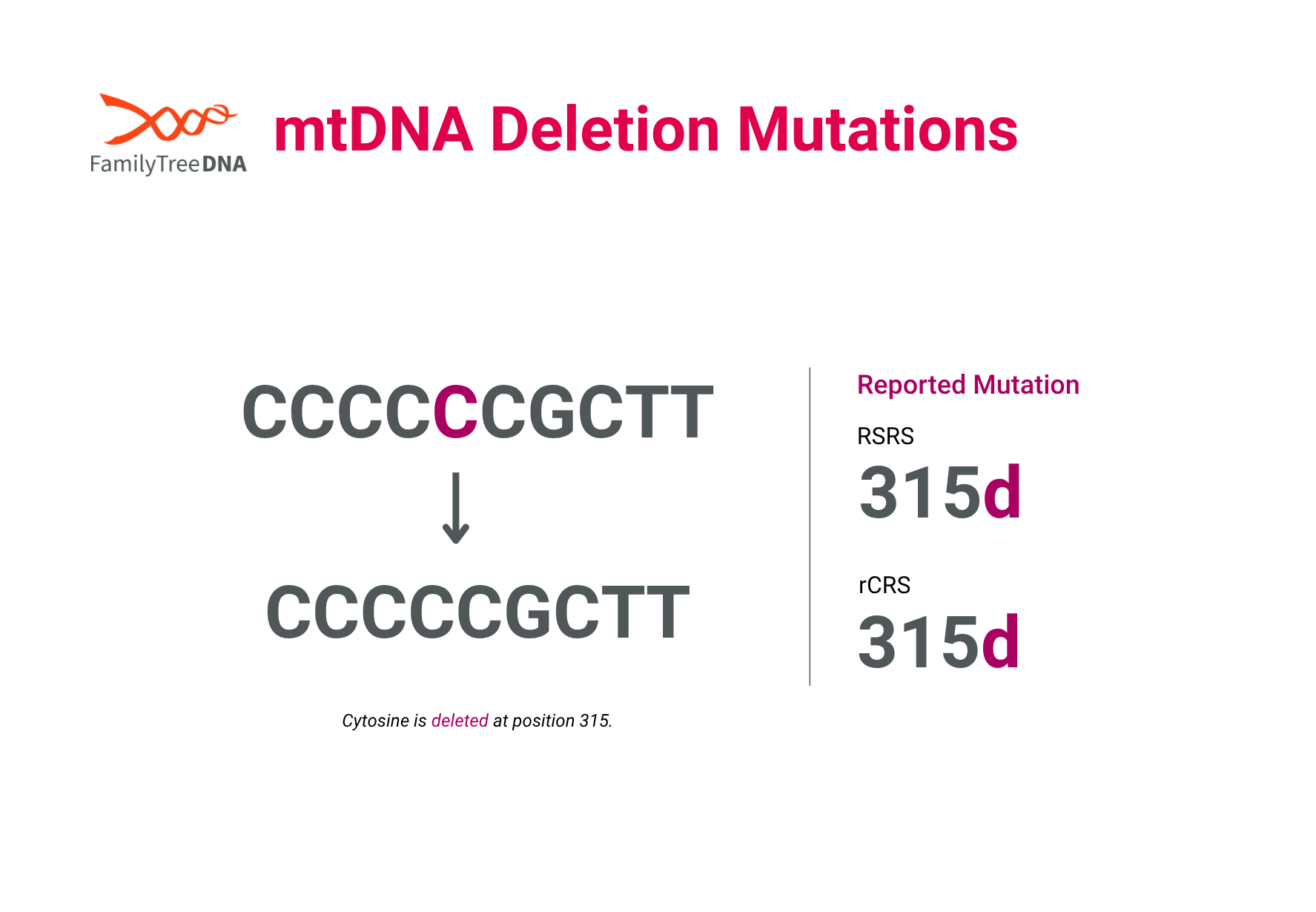
Deletion mutations occur when a nucleotide is removed from your mitochondrial DNA at a specific position.
In your mtDNA results, deletions are shown by listing the position without a nucleotide, followed by either a lowercase d or a dash (-).
Example:
A deletion at position 522 may be written as 522d or 522-.
Deletions are a normal part of mtDNA variation. In fact, deletions at positions 522 and 523 are very common and appear in many haplogroups.
Heteroplasmy Mutations Show a Change Currently Happening
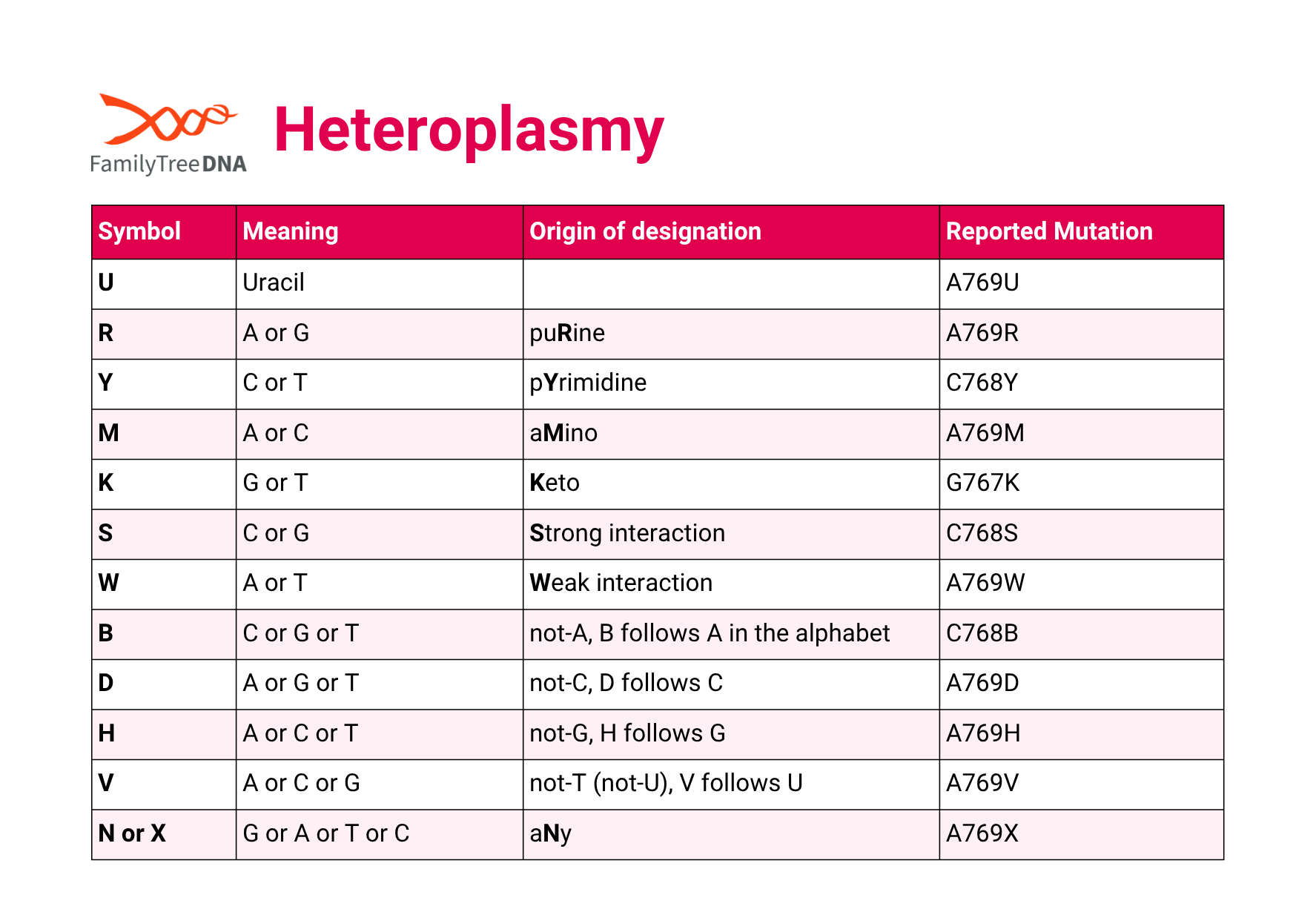
Heteroplasmy occurs when more than one nucleotide is present at the same position in your mitochondrial DNA. This means a change is still in progress and hasn’t fully replaced the original value.
Heteroplasmies are only reported when they are detected in a significant portion of your DNA reads (typically 20% or more). The way they appear in your results depends on which nucleotides are present.
Example:
If you see a letter at a position that is not one of the standard nucleotides (A, C, T, or G), and it is not a deletion, it is likely indicating a heteroplasmy.
Deletions are a normal part of mtDNA variation. In fact, deletions at positions 522 and 523 are very common and appear in many haplogroups.
These differences are what make mitochondrial DNA useful for genealogy. Without mutations, everyone would share identical mtDNA, making it impossible to distinguish between maternal lineages or trace connections through your direct maternal line.
These mutations don’t just help identify differences between individuals—they also allow scientists to trace maternal lineages back thousands of years.
Mitochondrial Eve and Migration Patterns
If you trace all maternal lineages back in time, they eventually converge on a single common ancestor known as “Mitochondrial Eve.” She is the most recent woman from whom all living people today inherit their mitochondrial DNA.
Mitochondrial Eve lived in Africa over 150,000 years ago. She was not the only woman alive at the time, but she is the only one whose direct maternal line continues uninterrupted in people living today.
This does not mean other maternal lineages never existed—only that they did not continue to the present. As more modern and ancient DNA is studied, our understanding of these lineages and their timelines may continue to evolve.
Mitochondrial Eve is associated with mtDNA haplogroup L, the root from which all other haplogroups on the mtDNA Tree of Humankind descend.
Each haplogroup represents a branch on that tree, formed by mutations that occurred at a specific time and place. By studying both modern populations and ancient DNA, scientists can estimate where these branches formed and map how maternal lineages spread across the world.
These migration paths—from Africa to other continents—are reflected in your mtDNA results, helping you understand the deep origins of your maternal ancestry.
rCRS vs RSRS: How mtDNA Mutations Are Reported
To compare mtDNA test results, scientists use standard reference sequences. These references act as a baseline, allowing mutations to be identified and compared across individuals.
Each position in mitochondrial DNA is assigned a number and a reference value, known as the ancestral value. If your DNA has a different value at that position, it is considered a mutation.
There are two main reference systems used in mtDNA testing:
- rCRS (Revised Cambridge Reference Sequence)
- RSRS (Reconstructed Sapiens Reference Sequence)
The rCRS is based on one of the first mitochondrial genomes sequenced and reports mutations by listing the position followed by your value. For example, a change at position 263 to G is written as 263G.
As global mtDNA testing expanded, researchers found that the rCRS—based on a single individual of European descent—was not representative of the full diversity of human populations. To address this, scientists introduced the Reconstructed Sapiens Reference Sequence (RSRS) in 2012.
The RSRS is designed to represent the ancestral mitochondrial sequence of Mitochondrial Eve. Instead of comparing your DNA to a single modern individual, it traces your mutations from this common maternal ancestor to you.
For this reason, mtDNA results are often interpreted using the RSRS system. Like rCRS, each position is assigned a location and an ancestral value. However, RSRS reports mutations by listing the ancestral value, the position, and then your mutation. For example, if the ancestral value at position 769 is A and your value is G, it is written as A769G.
mtDNA Tree of Humankind
All mtDNA haplogroups are organized on the mtDNA Tree of Humankind, also known as the mtDNA Haplotree. This tree represents a global family tree of all maternal lineages, tracing back to Mitochondrial Eve.
For many years, the mtDNA Tree of Humankind was based on the Phylotree, an academic resource last updated in 2016. It was built using just over 24,000 mtDNA samples, many of which were partial sequences, and there are currently no plans for further updates.

Because of this, most haplogroups on the Phylotree represent very ancient branches, often thousands of years old. While useful for understanding deep ancestry, these older branches are less helpful for identifying connections within a genealogical timeframe.
In 2025, FamilyTreeDNA built upon this foundation and launched an updated mtDNA Tree of Humankind using a significantly larger dataset of full mitochondrial sequences. This expanded data allows for the identification of many new branches—especially more recent ones that can help refine maternal lineages.
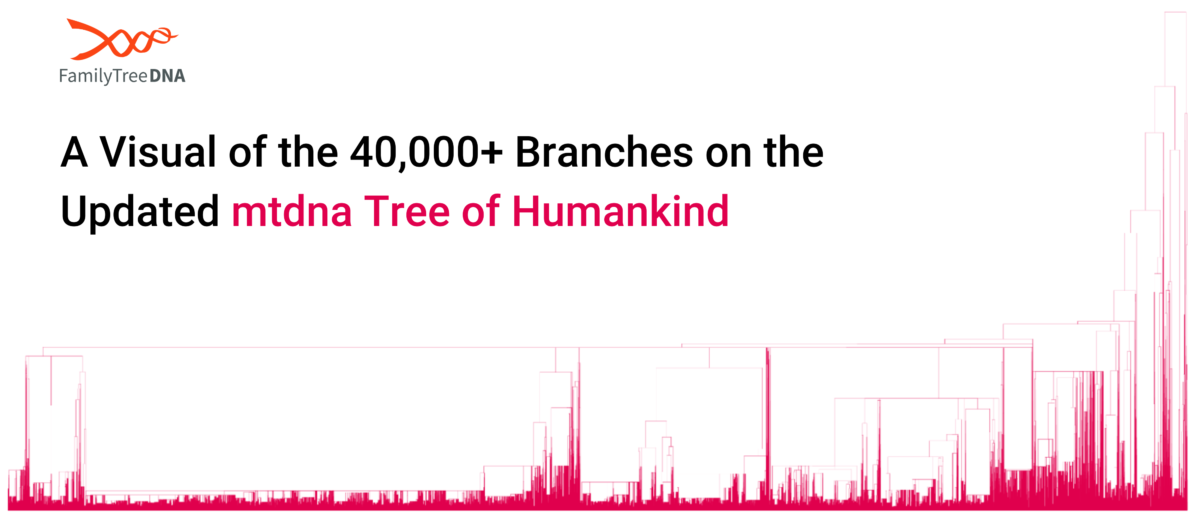
Today, this remains the largest mtDNA haplotree available, continuing to grow as more testers contribute data.
With more detailed branching, the mtDNA Tree of Humankind can provide better estimates for when a common maternal ancestor lived. As the tree continues to grow, more haplogroups are expected to fall within a genealogical timeframe, making it easier to discover connections and break through brick walls in your research.
While the mtDNA Tree of Humankind helps place your lineage in a broader historical context, your matches connect you to other people who share that lineage.
Interpreting Your mtDNA Matches
While your haplogroup helps place your maternal ancestry on the mtDNA Tree of Humankind, your matches connect you to other people who share that same maternal line. This is where your mtDNA test results become more actionable, helping you identify potential connections and explore your shared ancestry.
What Are mtDNA Matches?
mtDNA matches are people who share a common maternal ancestor with you on your direct maternal line. These matches represent individuals whose mitochondrial DNA is similar enough to suggest a shared lineage.
These matches are identified by comparing your mitochondrial DNA to other testers in the database. The more similar your mtDNA is to another person’s, the more recently you likely shared a common ancestor.
Genealogists often use mtDNA matches alongside historical records to confirm maternal lines or identify shared ancestry when surnames are unknown.
With the mtFull Sequence test, matches are grouped into three levels based on how much of your mtDNA is compared: HVR1, HVR2, and the Coding Region.
What is Genetic Distance In mtDNA Test Results?
Genetic distance (GD) is the number of differences between your mtDNA and another person’s mtDNA.
As maternal lineages branch apart over time, they accumulate different mutations. The more mutations two individuals share, the more recently they share a common maternal ancestor.
When one person has a mutation that another does not, it is counted as genetic distance. A genetic distance of 0 means an exact match, while higher values indicate a more distant relationship on the maternal line.
HVR1 and HVR2 Match Levels
At the HVR1 and HVR2 levels, you must be an exact match—meaning there are no differences between your mtDNA and your match’s mtDNA in those regions.
Matches at these levels often reflect very distant connections, and your common maternal ancestor may have lived before genealogical records.
However, these matches can still be useful. Some testers may have only completed earlier, lower-level mtDNA tests, which means they do not have results for the full coding region.
Coding Region Match Levels
The Coding Region provides the most detailed level of mtDNA matching.
At this level, you may match with a genetic distance of up to 3, meaning there are only a small number of differences between your mtDNA and your match’s mtDNA.
These matches are more likely to reflect a shared maternal ancestor within a genealogical timeframe, making them the most useful for genealogical research.
How to Interpret Your mtDNA Matches
You may not recognize the names of your mtDNA matches—and that’s completely normal. Because surnames often change with each generation, especially along maternal lines, names alone are not always helpful for identifying connections.
Instead, focus on the earliest known direct maternal ancestors listed by your matches, along with the names and locations in their maternal line family trees. These details are often the most useful for finding connections.
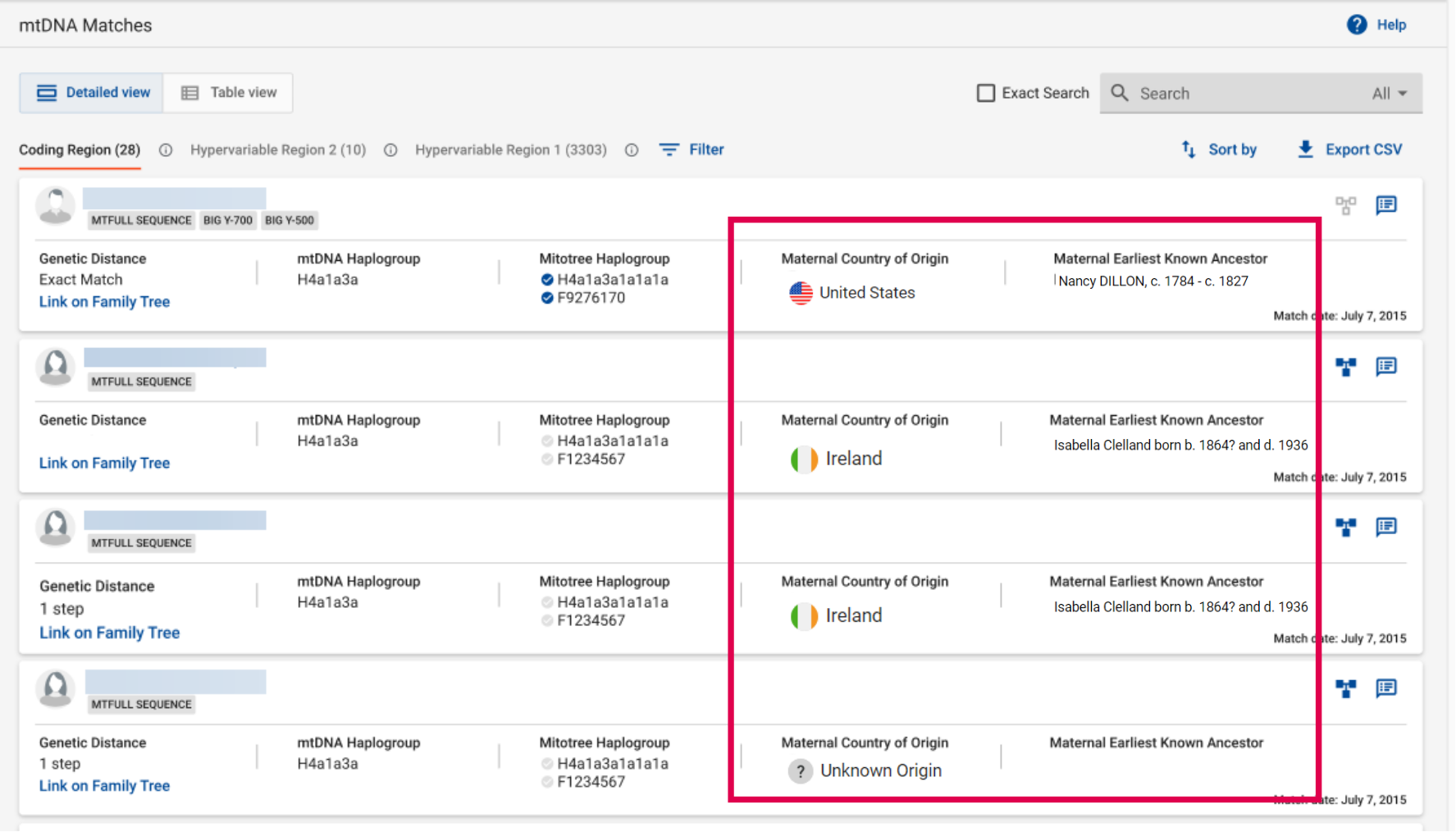
How to Navigate Your Matches List
On your mtDNA matches page, you’ll see an Earliest Known Ancestor column showing the information your matches have entered. Some matches may have traced their maternal line farther back than you, while others may have less information available.
To the right of each match, you may see icons that allow you to:
- contact your match
- add notes
- view their shared family tree (if available)
When reviewing a match’s tree, start with the pedigree view and follow the direct maternal line. You may find a name or location that connects to your own research.
How to Prioritize Your Matches
Start with the matches who are closest to you genetically:
- Coding Region matches with a genetic distance of 0
- then genetic distance 1, 2, and 3
- followed by HVR1 + HVR2 matches
- and finally HVR1-only matches
This approach helps you focus on the matches most likely to share a more recent common ancestor.
What to Keep in Mind
The information provided by your matches is self-reported, which means it may be based on family tradition rather than confirmed records.
It’s also important to remember that your common ancestor with a match may have lived earlier than the ancestor they have identified. For example, a match may list an ancestor in Kentucky in the 1800s, while your maternal line is documented in Australia. This doesn’t mean your ancestors are from the same place—it means your shared ancestor likely lived earlier, before the line split and migrated to different regions.
By combining genetic distance, ancestor information, and family trees, you can begin to build meaningful connections along your maternal line.
Now that you understand how to interpret your matches, you can use your reports and tools to explore your maternal ancestry in more detail.
How to Use Your mtDNA Reports and Tools
mtDNA test results include several tools designed to help you interpret your haplogroup, matches, and maternal ancestry. These reports provide additional context about your origins, migration patterns, and how your lineage connects to others.
In this section, we’ll walk through the key tools available in your results:
- Matches Map
- Ancestral Origins
- Haplogroup Origins
- Migration Map
- mtDNA Discover Haplogroup Reports
Matches Map
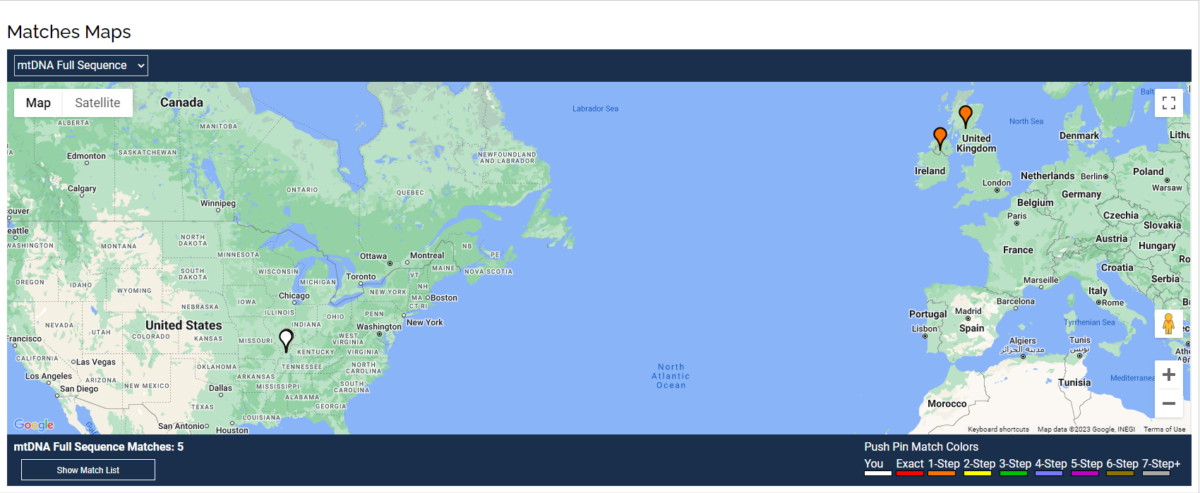
The Matches Map helps you visualize where your matches’ maternal ancestors lived, making it easier to identify potential connections through shared locations. For mtDNA research, geography is often more useful than surnames, especially when tracing maternal lines.
What is the Matches Map?
The Matches Map is a visual tool that displays the locations of your matches’ earliest known direct maternal ancestors. Matches who have provided a specific location will appear as pins on the map.
What Does It Show?
Each pin represents a match and includes details such as the match’s name, their earliest known maternal ancestor, birth and death dates, location, and contact information.
Because mtDNA follows the direct maternal line, locations are often more useful than surnames for identifying connections.
How to Use It
You can filter the map by match level to focus on your closest or most distant matches.
Look for matches whose maternal ancestors lived in the same location as your own. Even if you don’t know your ancestor’s maiden name, you may know where she lived—and shared locations can be a key clue for making connections.
When you find a potential match, compare dates and locations carefully and continue researching using traditional records. Keep in mind that shared locations do not always mean a recent common ancestor—maternal lines may have separated generations earlier and followed similar migration patterns.
Ancestral Origins

The Ancestral Origins report helps you identify patterns in where your matches’ maternal ancestors came from. By comparing your matches to the broader database, this tool can provide clues about the geographic origins of your maternal line.
What is The Ancestral Origins Report?
The Ancestral Origins report is a summary of the self-reported countries of origin for your matches’ earliest known direct maternal ancestors. It compares your matches’ reported origins to the overall database and breaks the results down by match level and genetic distance.
What Does it Show?
This report displays a table of countries along with several key data points:
- Country: The reported country of origin for a match’s maternal ancestor
- Match Total: The number of your matches who reported that country
- Country Total: The number of testers in the database who reported that country
- Percentage: The proportion of the database you match from that country
- Comments: Additional details, such as an ethnic group or specific region
Unlike the Matches Map, this report only requires a country to be entered. This means some matches may appear here even if they do not appear on the map.
How to Use It
Use this report to look for patterns in where your matches’ maternal ancestors are from. Countries that appear more frequently may provide clues about the geographic origins of your maternal line.
You can also compare results across match levels and genetic distances to see how patterns change between closer and more distant matches.
Keep in mind that this information is self-reported and may be based on family tradition rather than confirmed records. It also reflects where your matches’ ancestors lived—not necessarily where your shared maternal ancestor originated.
For example, you may see matches who report ancestors from a specific region or cultural group, but your common ancestor may have lived earlier, before that identity or location applied. Use this report as a guide to generate hypotheses, and then confirm connections using additional research.
Haplogroup Origins

The Haplogroup Origins report builds on the Ancestral Origins report by adding haplogroup context to your matches’ maternal ancestor locations. This allows you to explore how specific branches of your maternal line may be connected to different regions over time.
What is the Haplogroup Origins Report?
The Haplogroup Origins report is a table that groups your matches by haplogroup and compares their self-reported maternal ancestor locations to the broader database. It is broken down by match level, genetic distance, and haplogroup.
Unlike the Ancestral Origins report, this report may also include academic and ancient DNA samples when available.
What Does it Show?
This report displays a table with the following key information:
- Haplogroup: Your match’s haplogroup, either predicted or confirmed through testing
- Country: The reported country of origin for their maternal ancestor
- Match Total: The number of matches reporting that country
- Comments: Additional details, such as an ethnic group or specific region
Because results are grouped by haplogroup, this report can provide additional insight into how different branches of your maternal line may have spread geographically.
There are three important things to keep in mind when viewing this report:
1. This information is self-reported.
Your match may have based their answer on family tradition rather than confirmed records. For example, you may see matches who report a Native American maternal ancestor, even if your haplogroup is not one that migrated into the Americas in pre-Columbian times.
2. Haplogroup age and reported locations may not align.
Your haplogroup may have formed thousands of years before your match’s earliest known maternal ancestor lived. For example, a haplogroup may have formed 4,000 years ago, while a match’s earliest known ancestor was born in 1750 C.E. This means the origin of the haplogroup and the reported location may not be the same. As the mtDNA Tree of Humankind continues to be refined with younger branches, these estimates will become more precise.
3. Your shared ancestor may fall outside documented history.
Your most recent common ancestor with a match may have lived before or after the ancestor they have identified. This report does not confirm a specific origin, but instead provides clues based on where your matches’ maternal ancestors lived.
Migration Map

The Migration Map shows the deep ancestral journey of your maternal line, tracing your haplogroup’s path over thousands of years. It provides a visual representation of how your lineage moved across regions over time.
What is the Migration Map?
The Migration Map is a reconstructed view of your maternal ancestry, starting from Mitochondrial Eve and following the major branches of your haplogroup as they spread across the world.
What Does It Show?
This map is based on the mutations in your mtDNA, which define your haplogroup. Each mutation occurred at a specific place and time, allowing scientists to estimate where different branches of your maternal line formed and how they migrated.
How to Use It
Use the Migration Map to understand the deep origins of your maternal line and how your haplogroup moved over time. This can provide valuable historical context for your ancestry.
You can also explore this journey in more detail using the mtDNA Journey video available in your results.
While this report is not typically used to identify recent ancestors or break genealogical brick walls, it provides important insight into the ancient origins of your maternal lineage.
mtDNA Discover™ Haplogroup Reports
mtDNA Discover Haplogroup Reports provide a deeper, more interactive way to explore your maternal ancestry. These reports expand on your haplogroup by combining modern tester data, ancient DNA, and scientific research to give you a more complete picture of your lineage.
What Are mtDNA Discover Haplogroup Reports?
These reports are a collection of tools that explore different aspects of your haplogroup, including its history, geographic distribution, ancient connections, and how you relate to other testers.
What Do They Show?
Each report focuses on a different part of your maternal story:
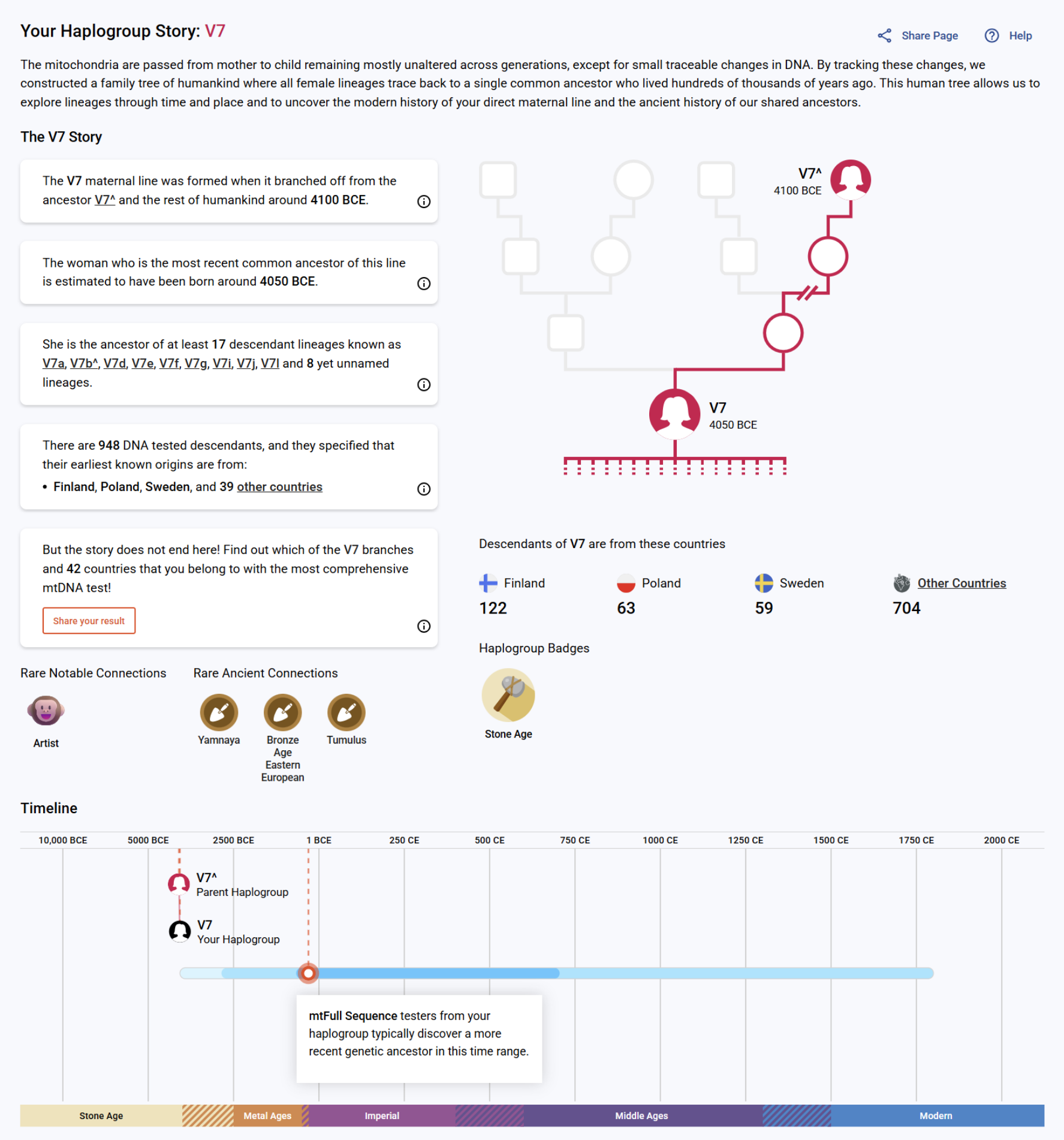
Haplogroup Story
What it shows:
The history of your direct maternal lineage, from its ancient origins to modern-day connections.
Why it’s helpful:
Provides a narrative overview of your haplogroup, helping you understand the broader story behind your maternal line.
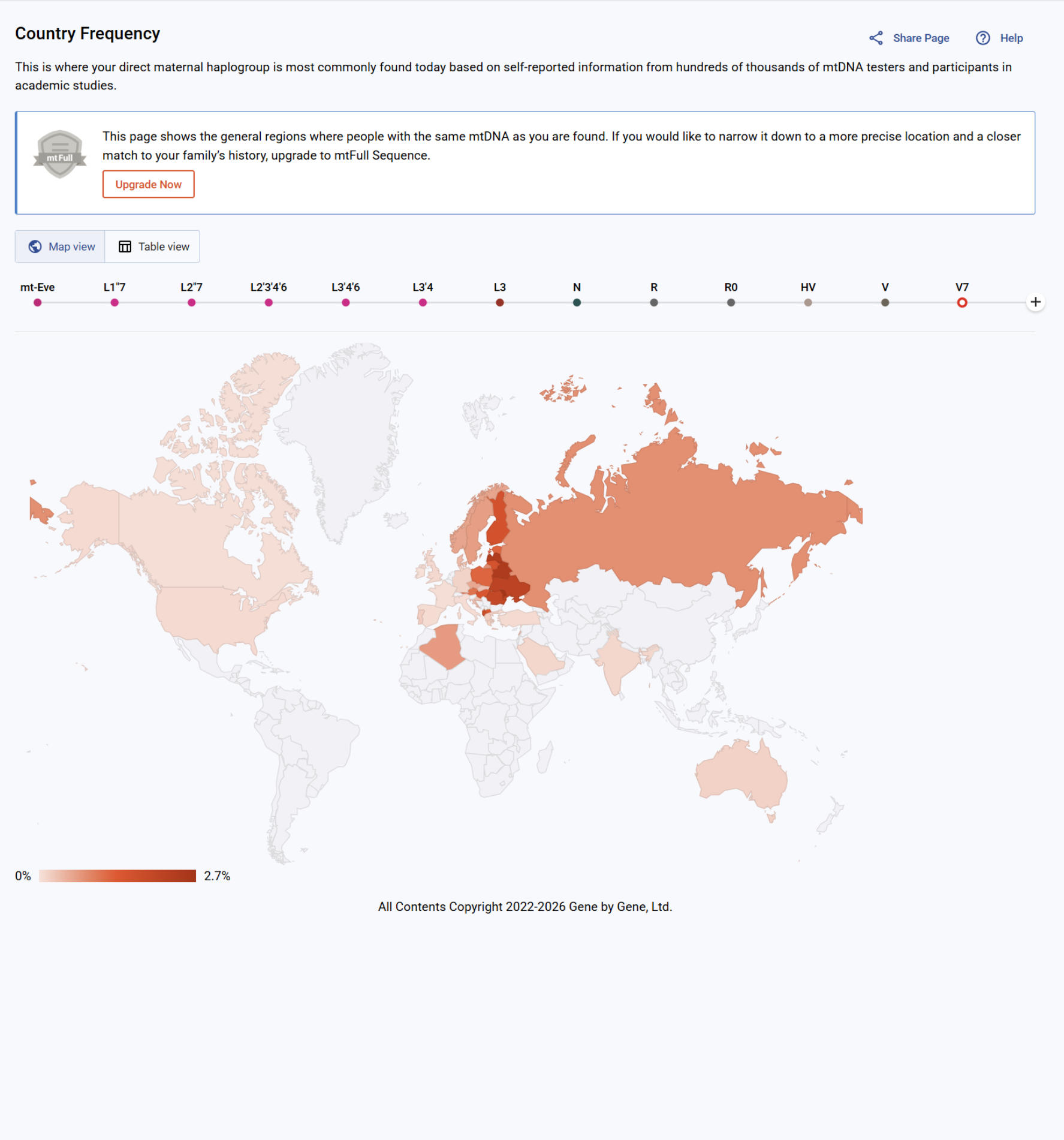
Country Frequency
What it shows:
Where your haplogroup is most commonly found today, based on tester data and academic studies.
Why it’s helpful:
Helps identify regions where your maternal lineage is most represented in the modern world.
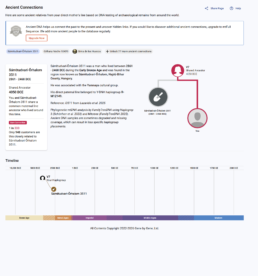
Ancient Connections
What it shows:
Ancient individuals from your maternal line, identified through DNA recovered from archaeological remains.
Why it’s helpful:
Connects your lineage to real historical individuals, bringing your ancestry into a tangible, human context.
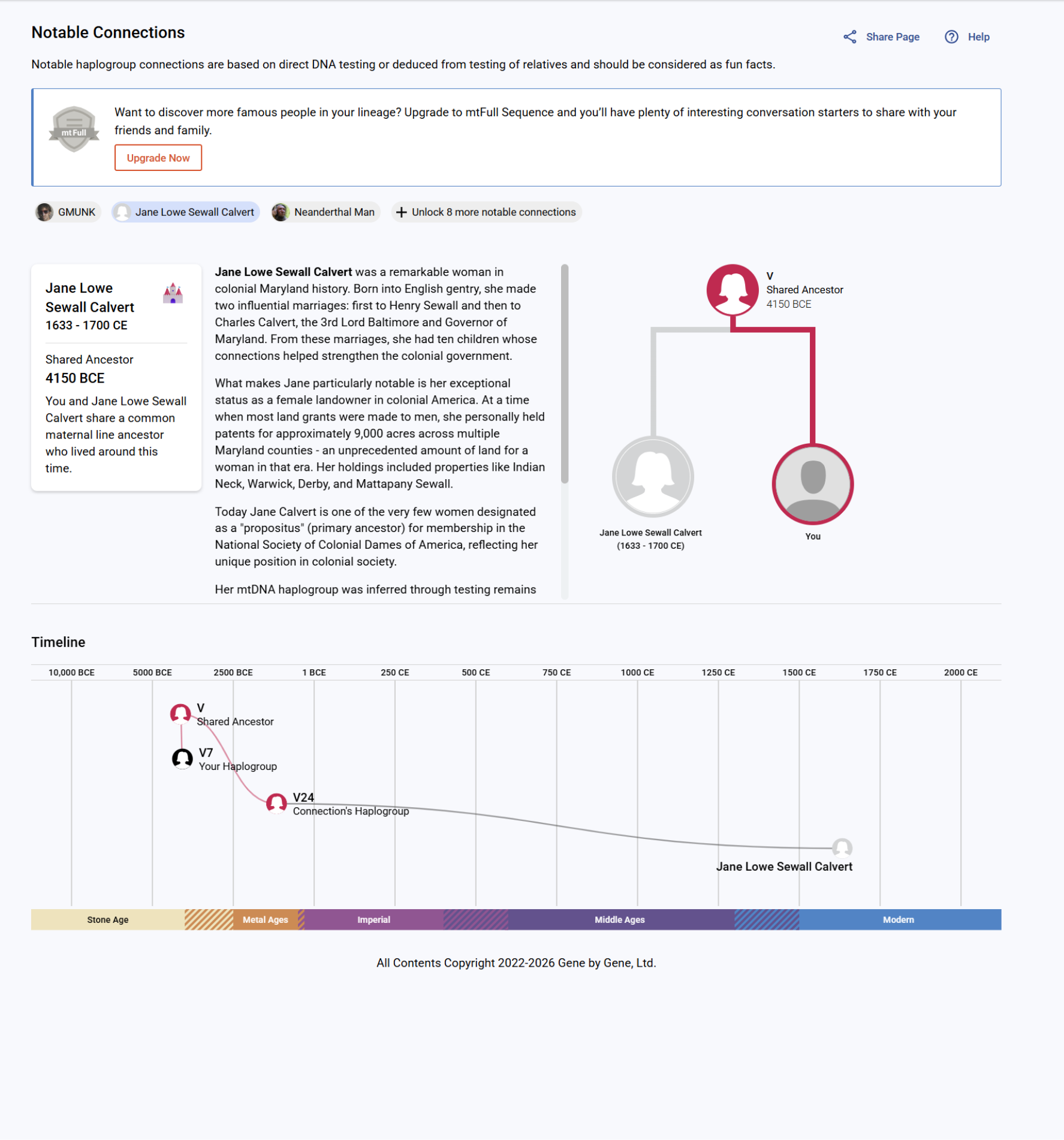
Notable Connections
What it shows:
Historical figures and notable individuals who share your haplogroup.
Why it’s helpful:
Provides engaging, recognizable connections that make your haplogroup easier to relate to and understand.
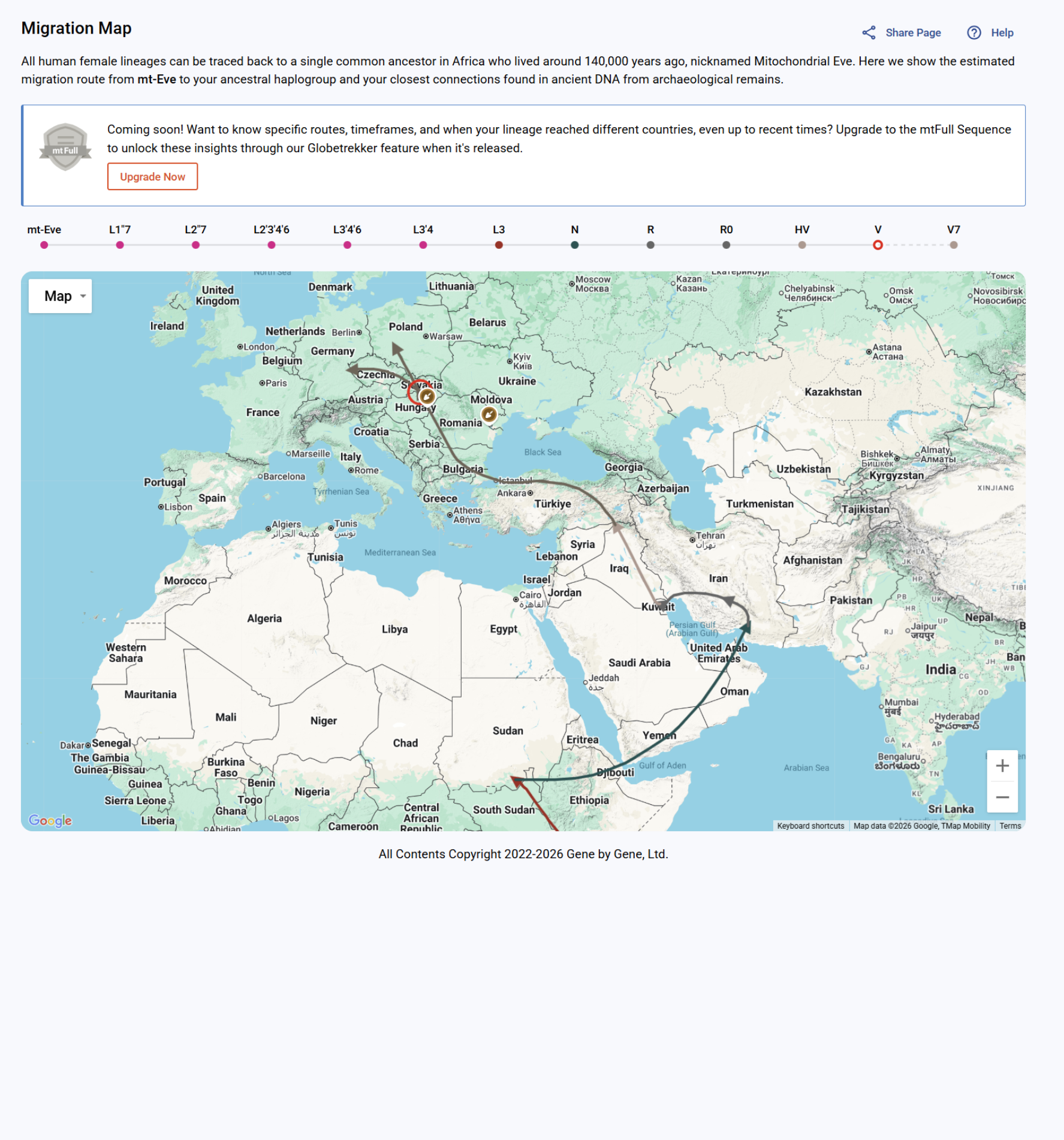
Migration Map
What it shows:
A visual path of your haplogroup’s movement from Africa to present-day locations, supported by ancient DNA.
Why it’s helpful:
Offers a deeper, more data-rich version of your migration story.
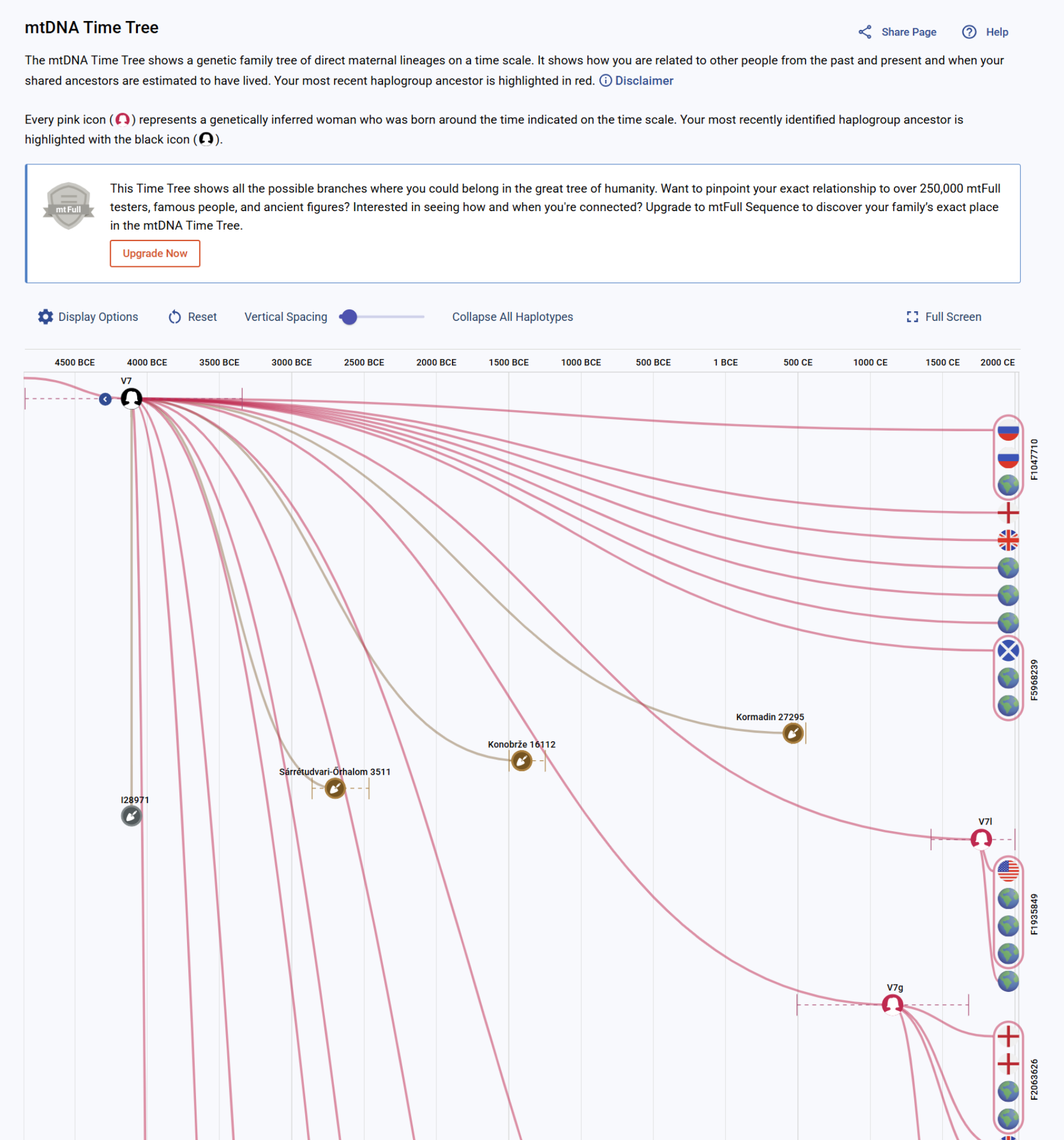
Time Tree
What it shows:
A time-scaled genetic tree showing when your maternal ancestors lived and how different branches are related.
Why it’s helpful:
Helps place your lineage within a timeline, making it easier to understand how your haplogroup developed over time.
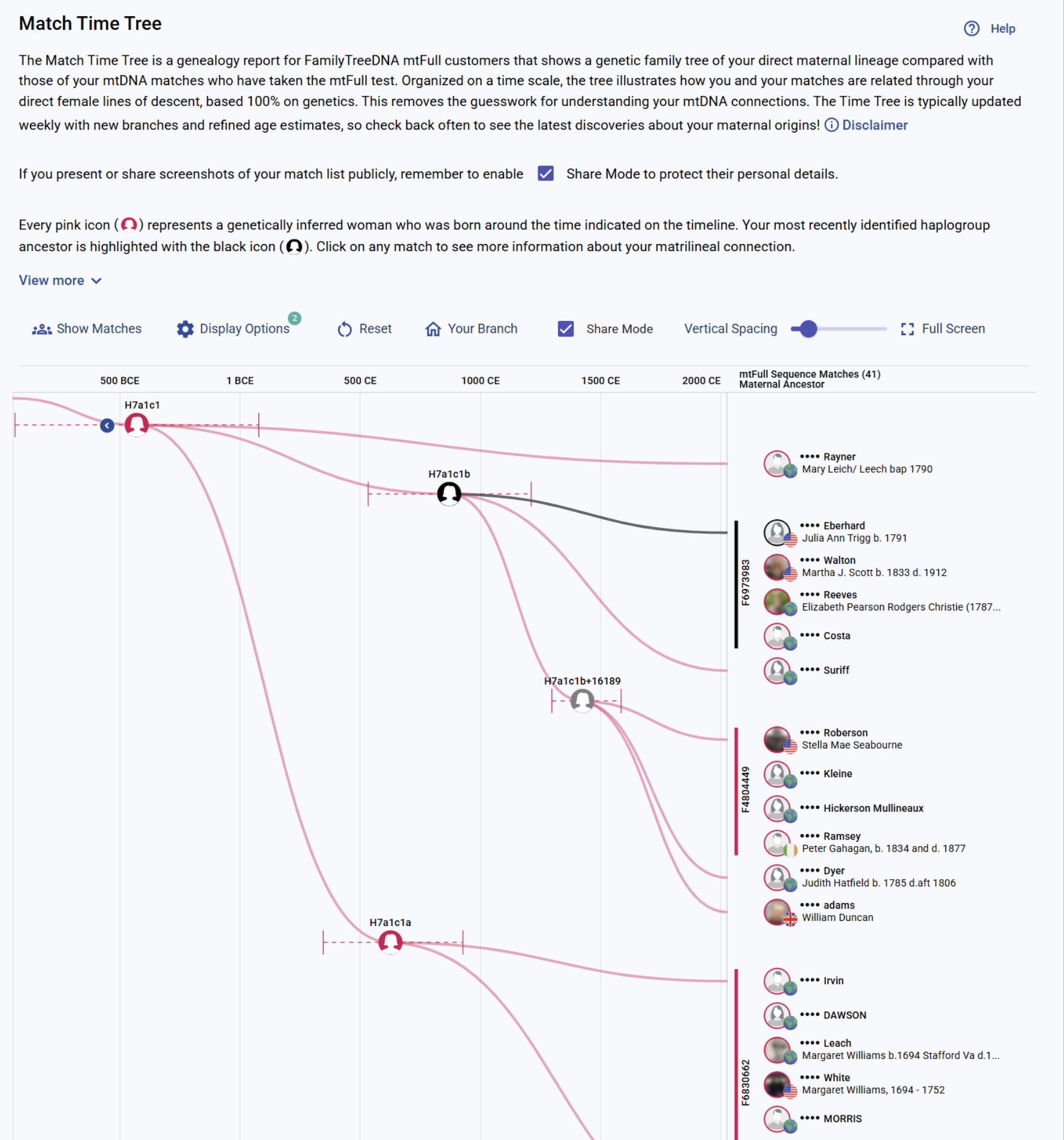
Match Time Tree (mtFull Sequence exclusive)
What it shows:
A shared genetic tree that places you and your matches within the same structure.
Why it’s helpful:
Removes much of the guesswork in understanding how you are related to your matches.
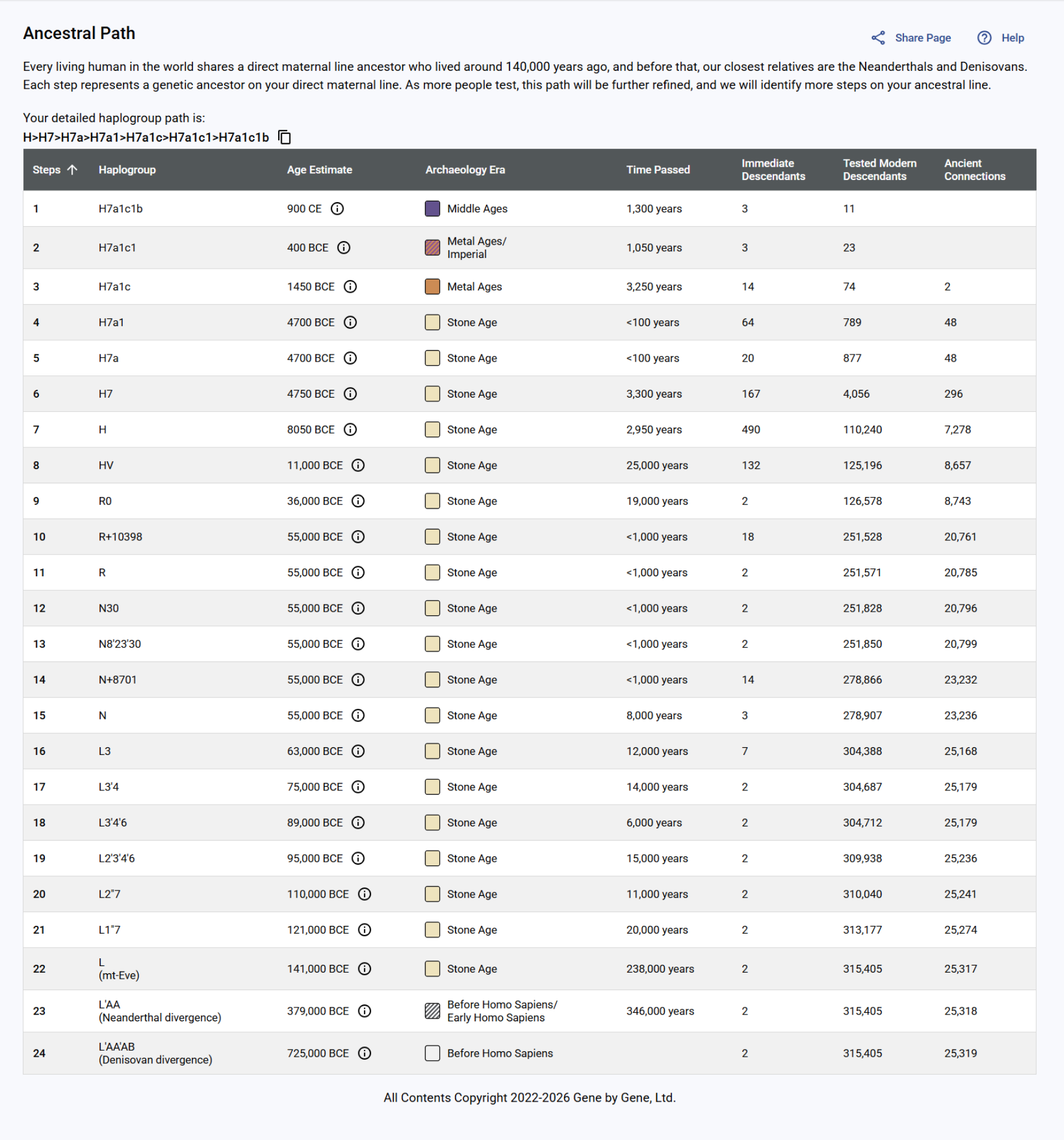
Ancestral Path
What it shows:
The step-by-step genetic path of your maternal lineage back to a common ancestor.
Why it’s helpful:
Provides a clear, visual breakdown of how your haplogroup evolved over time.
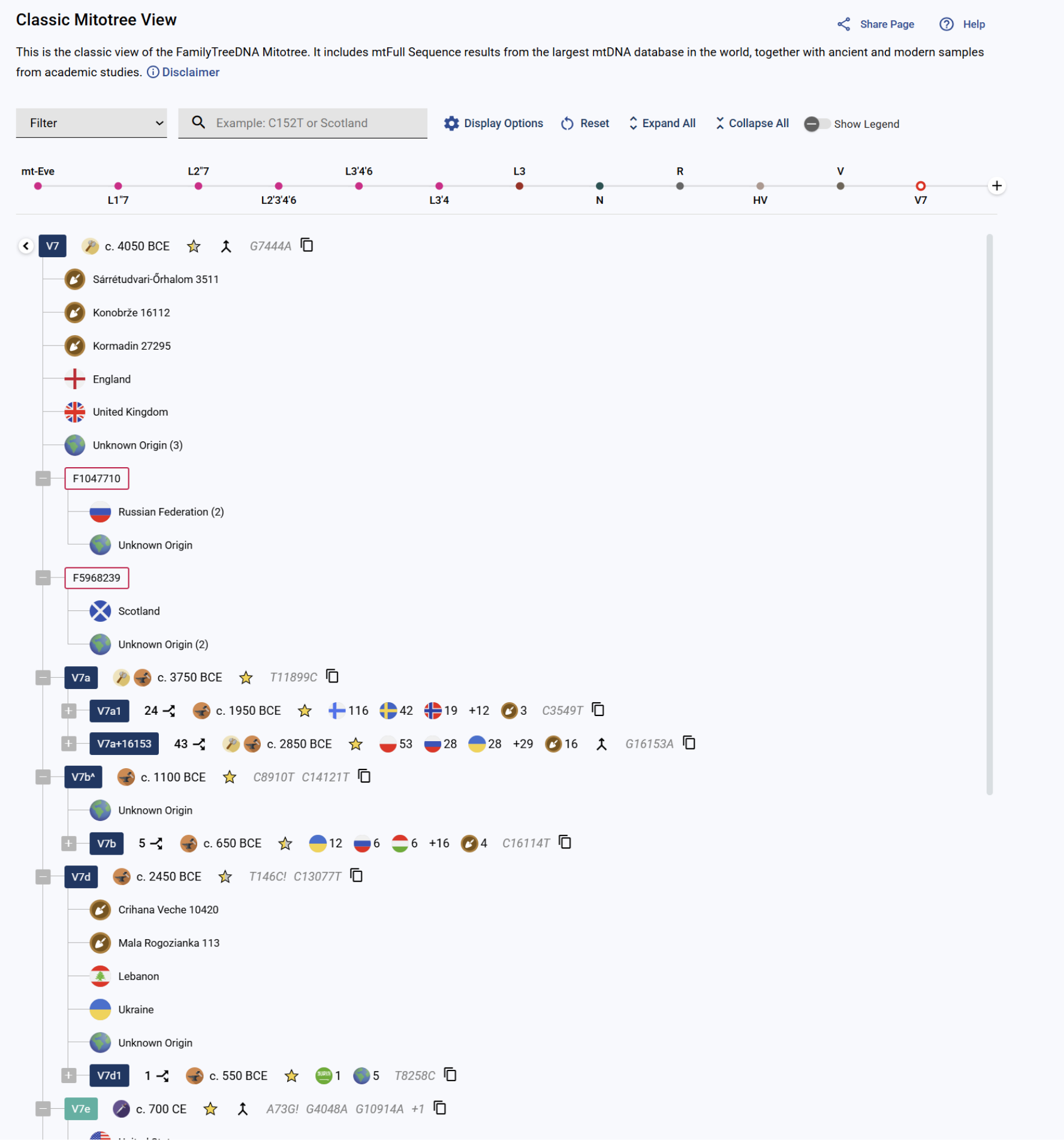
Classic Tree
What it shows:
The full mtDNA Tree of Humankind, combining modern tester data with ancient and academic samples.
Why it’s helpful:
Allows you to explore your haplogroup in the broader context of all known maternal lineages.
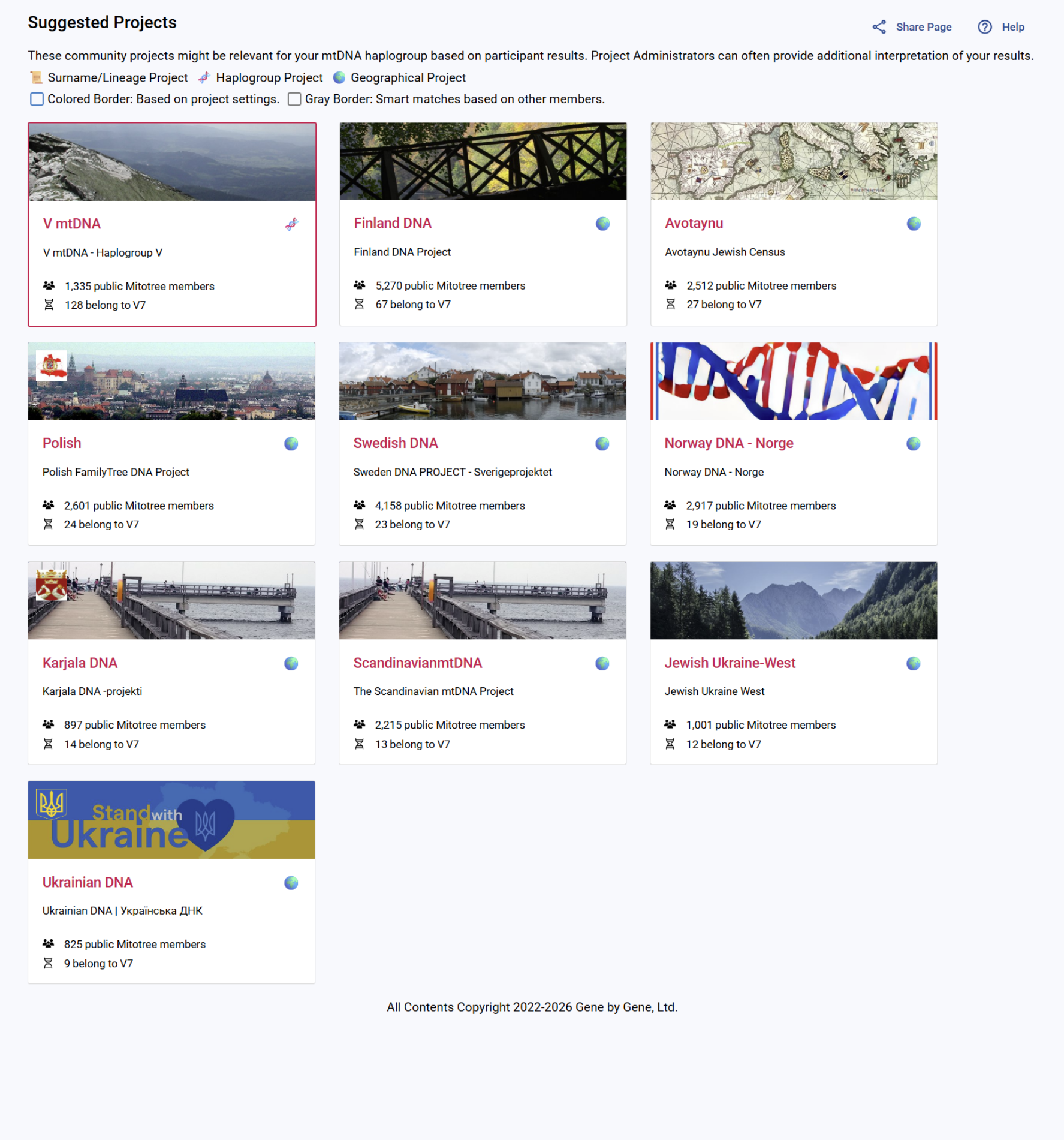
Suggested Projects
What it shows:
Genealogy projects related to your haplogroup.
Why it’s helpful:
Connects you with communities and project administrators who can help interpret your results
How to use mtDNA Discover Haplogroup Reports
To access these reports, go to your dashboard and select the “Haplogroup Reports” button.
Start with the Haplogroup Story for an overview, then explore the Time Tree and Match Time Tree to understand how your lineage connects to others. Use Country Frequency and Migration Map to explore geographic patterns, and review Ancient Connections to see how your lineage appears in historical samples.
Frequently Asked Questions
What is a maternal haplogroup?
A maternal haplogroup, also called an mtDNA haplogroup, is a genetic group that traces your direct maternal line back to a common ancestor. It helps identify your maternal ancestry and place your lineage on the mtDNA Tree of Humankind.
What do mtDNA haplogroup letters and numbers mean?
mtDNA haplogroup letters and numbers represent branches on the mtDNA Tree of Humankind. Each additional letter or number reflects a more specific branch, helping define your maternal lineage more precisely.
Why do I have so many mtDNA matches?
You may have many mtDNA matches because mitochondrial DNA changes slowly over time. This means many people can share similar mtDNA and a common maternal ancestor, even if that ancestor lived far back in history.
Can mtDNA identify specific relatives?
mtDNA test results can identify people who share your direct maternal line, but they usually cannot pinpoint specific recent relatives. Because mitochondrial DNA changes slowly, matches may share a common ancestor many generations in the past.
How far back do mtDNA haplogroups go?
mtDNA haplogroups trace your maternal ancestry back thousands of years to a common ancestor known as Mitochondrial Eve. They are most useful for understanding deep ancestry rather than recent genealogical connections.
Your mtDNA results offer a unique window into your maternal ancestry, connecting you to a lineage that stretches back thousands of years.
By understanding your haplogroup, interpreting your matches, and using your reports and tools, you can begin to uncover where your maternal line came from and how it connects to others.
Ready to take the next step in your research? Learn how to use your mtDNA results to solve genealogical questions and break through brick walls.
