By: Katy Rowe-Schurwanz
Explore the mtDNA Series
Start with the basics, then continue through the series to learn how mitochondrial DNA testing works, what your results mean, and how to use mtDNA in genealogy.
- What Is Mitochondrial DNA (mtDNA)?
- How Mitochondrial DNA Testing Works (current article)
- Understanding mtDNA Haplogroups and Your Results
Understand the mitochondrial DNA testing process, including how your DNA is sequenced, compared, and used to identify matches and haplogroups.
Mitochondrial DNA testing provides insights into your direct maternal line by examining the DNA in your mitochondria.
In this guide, you’ll learn:
- how mitochondrial DNA testing works
- what parts of your mtDNA are analyzed
- how your results are used to identify matches and determine your haplogroup
In this guide, you’ll learn:
The mtDNA Testing Process | Regions of mtDNA | Different mtDNA Test Types | mtDNA Analysis
How Does mtDNA Testing Work?
Mitochondrial DNA (mtDNA) testing works by analyzing the DNA found in your mitochondria to trace your direct maternal line. The test sequences your mitochondrial genome and compares it to reference databases to identify your haplogroup and find genetic matches.
How mtDNA is Inherited
Mitochondrial DNA (mtDNA) is passed down from mothers to their children, making mitochondrial DNA testing a powerful tool for tracing your direct maternal line.
Unlike autosomal DNA, mtDNA does not undergo recombination. This means it changes very little from generation to generation, with differences occurring only through small mutations over time.
Because of this stable inheritance pattern, mtDNA testing can trace maternal ancestry far back in time—but it follows only a single ancestral line: your mother, her mother, and so on.
What Parts of Mitochondrial DNA Are Tested?
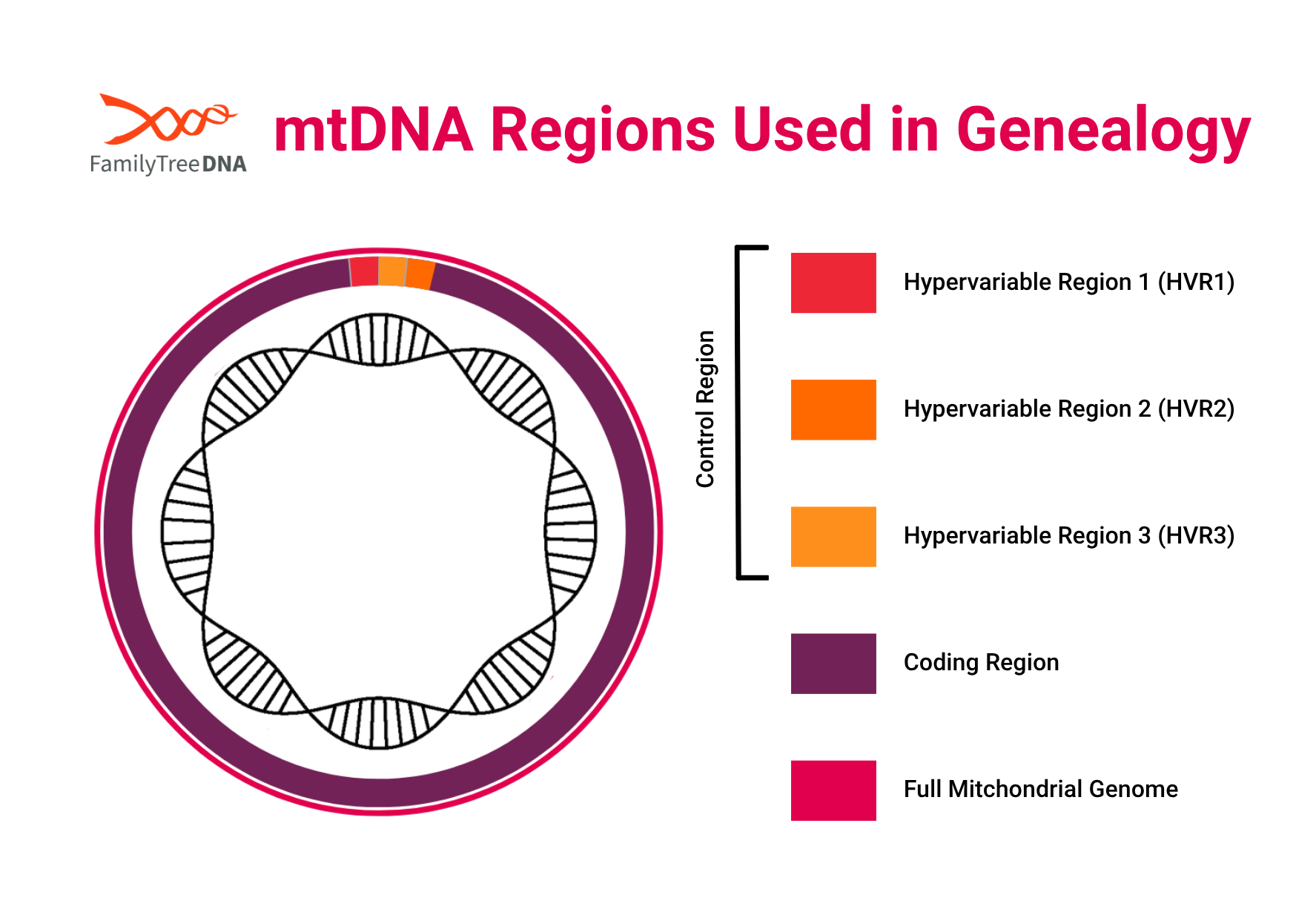
Mitochondrial DNA testing analyzes specific regions of your mitochondrial genome to trace your maternal ancestry and identify genetic matches. Understanding these regions helps explain how mtDNA testing works and why some tests provide more detailed results than others.
The mitochondrial genome is a small, circular piece of DNA made up of approximately 16,569 base pairs. It is divided into two main parts: the control region and the coding region.
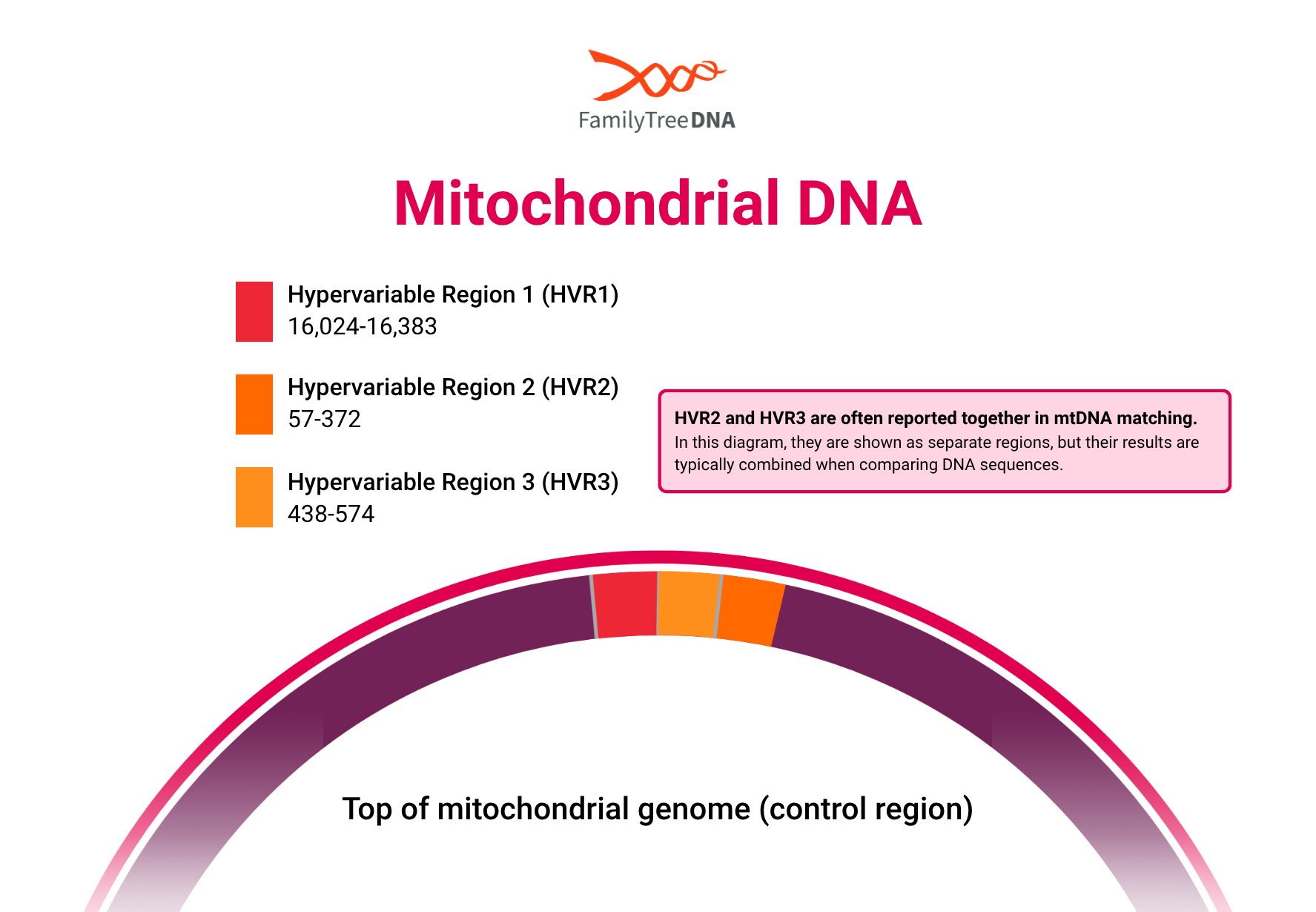
The control region, also known as the hypervariable region (HVR), contains three sections—HVR1, HVR2, and HVR3—that tend to change more frequently over time.
The coding region contains genes that support essential mitochondrial functions and typically changes more slowly.
The Control Region of Mitochondrial DNA
- Type: Non-coding DNA
- Mutation Rate: Faster
- Positions Included: Spans the end and beginning of the mitochondrial genome
- HVR1: 16,024-16,383
- HVR2: 57-372
- HVR3: 438-574
- Used For: Matching and identifying differences
- Test Coverage: Early mtDNA tests
Mitochondrial DNA testing often focuses on the control region because it changes more rapidly over time, making it useful for identifying differences between individuals.
HVR1 and HVR2 are included in most genetic genealogy tests, while HVR3 is typically analyzed only in more comprehensive tests like the mtFull Sequence. For matching purposes, HVR2 and HVR3 are often evaluated together.
The numbering of these regions reflects historical conventions used in mitochondrial DNA research. While nearby positions contain important regulatory elements, they are not typically classified as hypervariable regions used in genetic genealogy.
The Coding Region of Mitochondrial DNA
- Type: Gene-coding DNA
- Mutation Rate: Slower
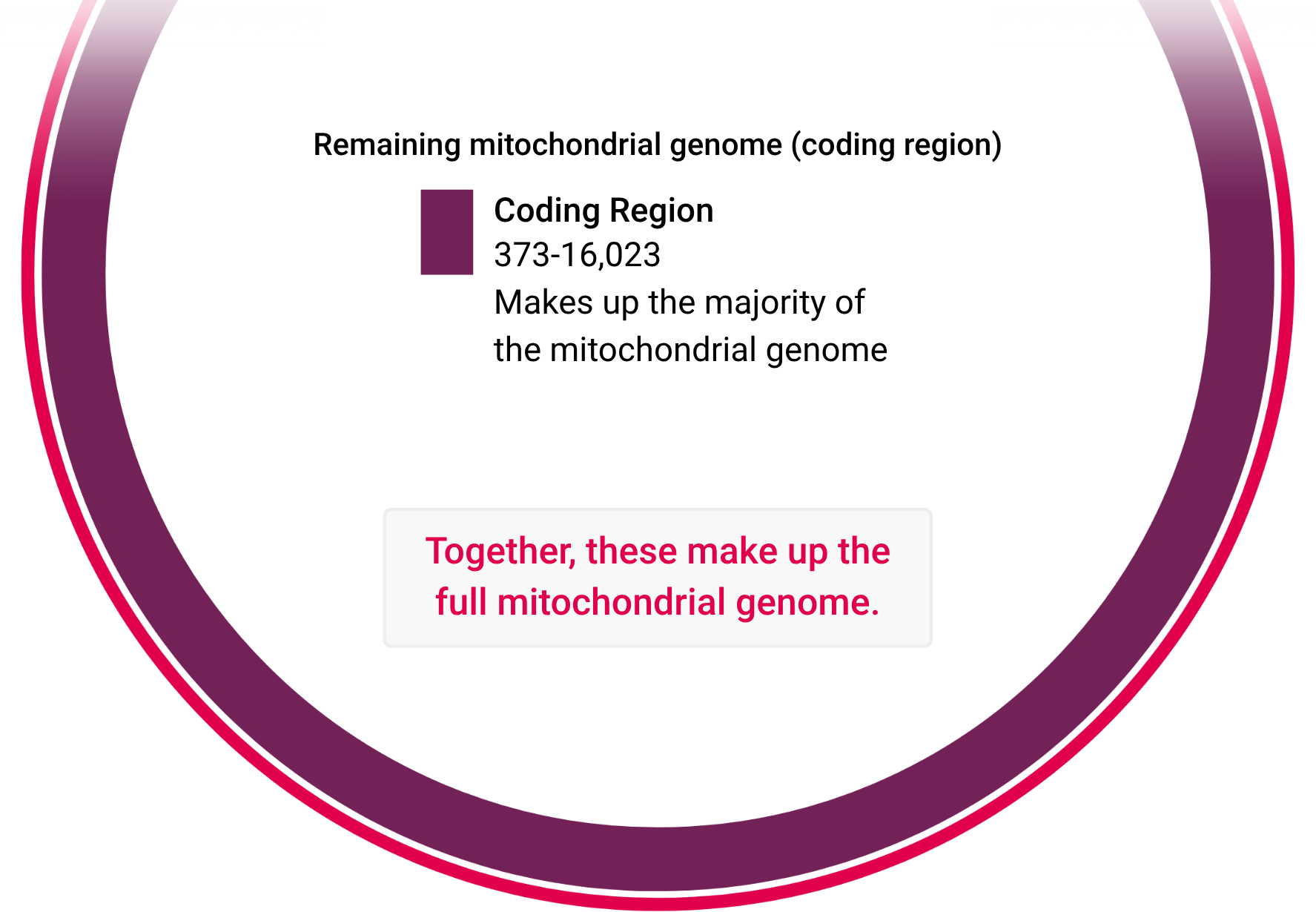
- Positions Included: 373-16,023
- Used For: Refining haplogroups
- Test Coverage: Included in full mitochondrial sequencing
The coding region is the part of your mitochondrial genome that contains genes. Because it does contain some genes, the coding region tends to be slower to mutate than the control region. While it is less useful for identifying recent differences between individuals, it provides valuable information for refining haplogroups and understanding deeper maternal ancestry.
Together, the control region and coding region make up the full mitochondrial genome analyzed in comprehensive mtDNA tests.
mtDNA Test Types Explained
Mitochondrial DNA testing has evolved over time as scientists have learned more about the structure and behavior of the mitochondrial genome. Early discoveries about how mtDNA mutates and which regions are most variable shaped the way the first genetic genealogy tests were designed.
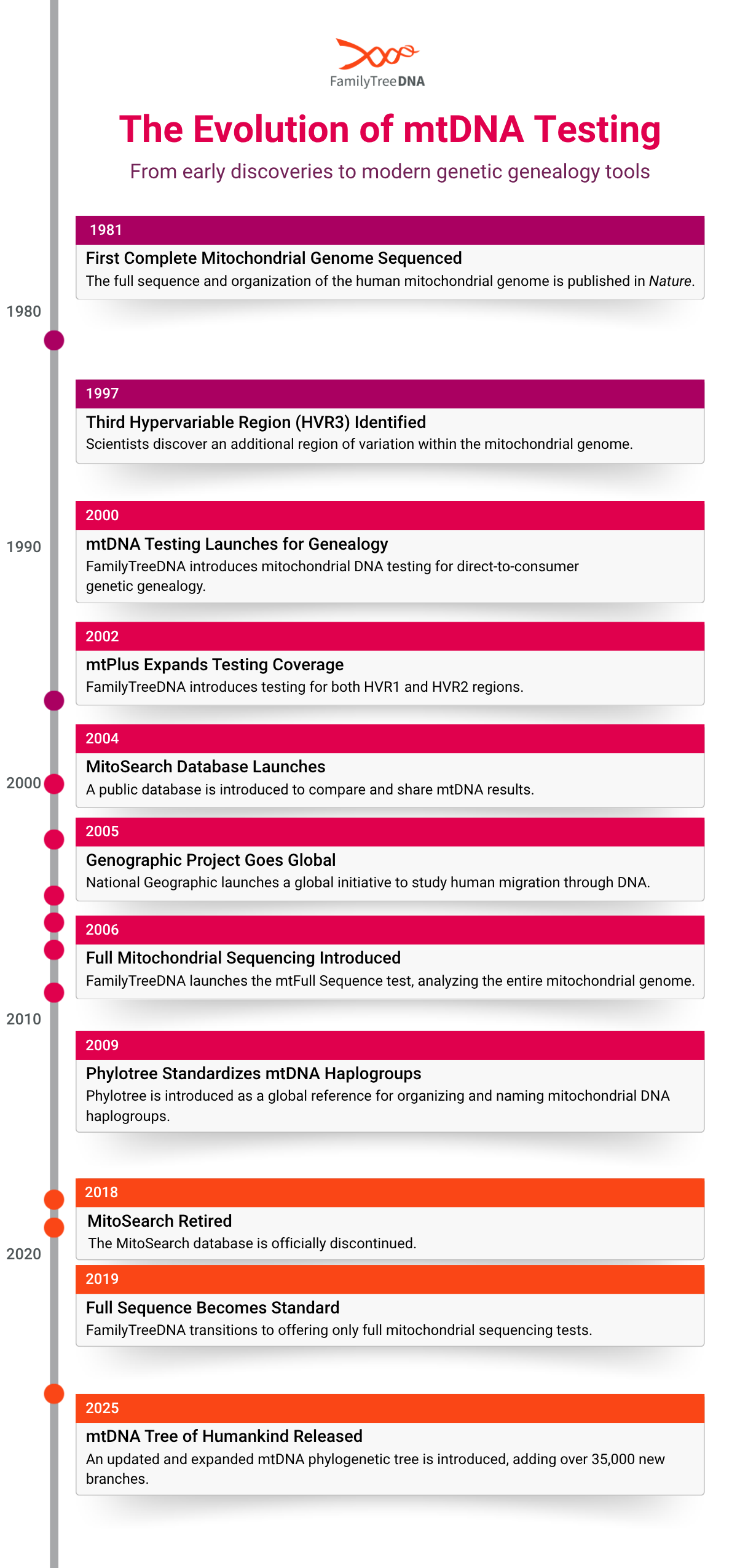
From Discovery to DNA Testing
In 1981, researchers first sequenced and organized the human mitochondrial genome, creating a complete map of its structure. This foundational work made it possible to study how mitochondrial DNA varies between individuals.
In 1997, scientists identified a third hypervariable region, expanding our understanding of where differences in mitochondrial DNA occur. Shortly after, research confirmed that these hypervariable regions mutate more rapidly than other parts of the genome, making them especially useful for distinguishing between individuals and tracing maternal ancestry.
By 2000, these discoveries made it possible to apply mitochondrial DNA analysis to genetic genealogy. That same year, FamilyTreeDNA launched one of the first direct-to-consumer mtDNA tests, focusing on HVR1. As understanding of the mitochondrial genome expanded, testing quickly evolved to include additional regions.
Early mtDNA Tests (HVR1 and HVR2)
Early mitochondrial DNA tests focused on the hypervariable regions, particularly HVR1 and later HVR2, because these areas provided the most variation for comparison.
FamilyTreeDNA expanded its initial test to include both HVR1 and HVR2 by 2002, increasing the ability to identify matches. Other companies offered similar tests, contributing to the growth of mitochondrial DNA testing in genealogy.
In 2005, the Genographic Project, launched by National Geographic in partnership with FamilyTreeDNA, helped bring mitochondrial DNA testing to a global audience. Early versions of the test could be transferred for matching, while later versions focused primarily on haplogroup assignment.
Full Mitochondrial Sequencing (mtFull Sequence)
As sequencing technology advanced, mitochondrial DNA testing expanded beyond the hypervariable regions to include the entire mitochondrial genome.
In 2006, FamilyTreeDNA introduced the mtFull Sequence test, which analyzes all regions of mitochondrial DNA, including HVR1, HVR2, HVR3, and the coding region. Because it covers the full mitochondrial genome, this test provides the most comprehensive results, including more matches, more relevant matches, and a more refined haplogroup.
How mtDNA Testing Evolved
By the end of 2019, earlier mtDNA tests that analyzed only portions of the mitochondrial genome had been phased out, with full mitochondrial sequencing becoming the standard.
As mitochondrial DNA testing grew, so did the tools and databases used to compare results. FamilyTreeDNA’s MitoSearch database, launched in 2004, provided one of the earliest platforms for sharing and comparing mtDNA data before it was retired in 2018.
Today, third-party resources such as MitoYDNA.org continue to support collaboration and data sharing within the genetic genealogy community, giving testers additional ways to explore and connect their maternal ancestry.
How mtDNA Matching Works
Mitochondrial DNA matching works by comparing your mtDNA sequence to other testers and identifying where your DNA is the same. The more closely two mtDNA sequences match, the more recent their shared maternal ancestor is likely to be.
Your mitochondrial DNA sequence is analyzed by identifying differences, or mutations, across your genome and comparing them to other testers.
Your mtDNA is also compared to reference sequences, including the revised Cambridge Reference Sequence (rCRS) and the Reconstructed Sapiens Reference Sequence (RSRS). These references provide a baseline for identifying mutations and determining your placement on the mtDNA Tree of Humankind.
Because mitochondrial DNA changes slowly over time, matches can represent shared ancestry from hundreds or even thousands of years ago. However, closer matches—those with fewer differences—are more likely to share a more recent maternal ancestor.
These results can help you explore your direct maternal line, identify potential relatives, and better understand where your matrilineal ancestors may have lived.
Matching Levels
Mitochondrial DNA matching is based on the regions of the mitochondrial genome that are compared: HVR1, HVR2, and the coding region.
- HVR1 matches compare a smaller portion of mtDNA and may reflect more distant relationships
- HVR1 + HVR2 matches provide more detail and improved resolution
- Full sequence matches (including the coding region) offer the highest level of precision
Because the mtFull Sequence test analyzes all three regions, it provides the most detailed matches available. In general, matches at higher levels—especially full sequence matches—are more likely to share a more recent common ancestor.
Frequently Asked Questions About Mitochondrial DNA Testing Process
What does mtDNA testing tell you?
mtDNA testing can identify your maternal haplogroup, provide insight into your deep maternal ancestry, and connect you with others who share your direct maternal line.
Can you take an mtDNA test at home?
Yes, mitochondrial DNA testing is done at home using a simple cheek swab. Once collected, your sample is sent to a lab for analysis.
What part of DNA is analyzed in an mtDNA test?
Mitochondrial DNA testing analyzes the DNA found in your mitochondria, focusing on regions such as HVR1, HVR2, and the coding region, depending on the test.
How accurate is mtDNA testing for ancestry?
Mitochondrial DNA testing is highly accurate for tracing your direct maternal line, but it represents only one branch of your family tree.
How far back does mtDNA go?
Mitochondrial DNA can trace your maternal ancestry back thousands of years because it changes very slowly over time.
By analyzing your mitochondrial DNA, scientists can identify mutations, compare your results to others, and trace your maternal ancestry across generations.
Although mtDNA represents only one branch of your family tree, it provides valuable insight into your maternal lineage and helps uncover connections that may not be visible through traditional research alone.
In the next part of this series, we’ll break down how to interpret your mtDNA results and use them in your genealogical research.
