
By: Courtney Eberhard
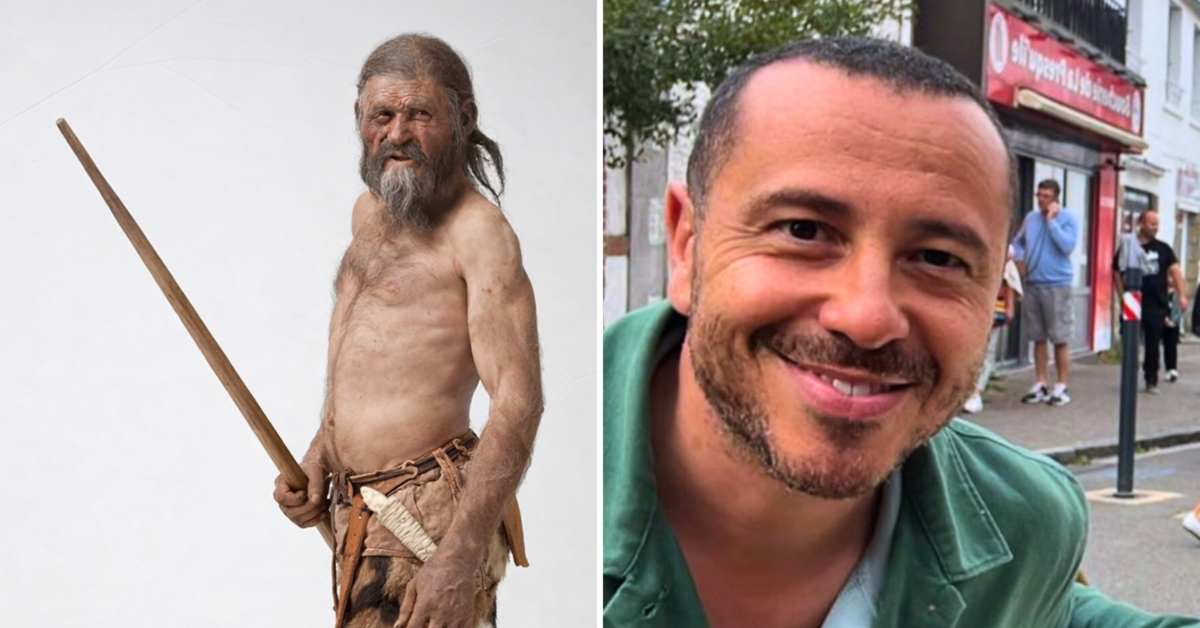
For years, scientists thought Ötzi the Iceman’s maternal line had vanished. New genetic findings reveal it still survives today.
For decades, Ötzi the Iceman has felt both astonishingly close and impossibly distant.
Discovered in 1991, frozen in a glacier high in the Ötztal Alps along the border of Italy and Austria, Ötzi is Europe’s oldest known naturally mummified human. At more than 5,000 years old, his body preserved a rare snapshot of prehistoric life. His clothing, tools, health, diet, ancestry, and even his tattoos have been studied in extraordinary detail. Those 61 tattoos are the oldest known in the world.
Yet for all we have learned about Ötzi, one part of his story seemed closed.
His maternal line.
In 2008, genetic researchers studying Ötzi’s mitochondrial DNA concluded that his direct maternal lineage was extinct. No living person appeared to share the same genetic signature. The conclusion was blunt and widely cited: it was highly unlikely that Ötzi had any living maternal relatives.
That assumption has now been overturned.
Through modern genetic genealogy, FamilyTreeDNA researchers have identified a living man whose maternal DNA traces back to the same ancient lineage as Ötzi, reconnecting a family line believed lost for millennia.
How a Modern DNA Test Connected to Ötzi the Iceman
The discovery began quietly, with a DNA test.
Heddi Abbad, a French citizen with maternal roots in northeastern Algeria, took a mitochondrial DNA test to learn more about his ancestry. Like many people who test, he hoped for context and clarity about where his family came from. He did not expect to hear from a research team.
“At first, I thought it was a joke,” Heddi said. “But when they explained the connection, I realized this was something extraordinary.”
Heddi’s mitochondrial DNA matched the same rare maternal lineage once thought to exist only in Ötzi.
What Did Ötzi the Iceman’s DNA Reveal?
Mitochondrial DNA, often called mtDNA, is passed from mother to child, generation after generation, with only occasional mutations over long stretches of time. Because of this, mtDNA provides a powerful record of direct maternal ancestry, stretching deep into the past.
Ötzi belonged to mitochondrial haplogroup K1, but with two unique mutations that made his lineage distinct. That lineage was first labeled K1ö in reference to Ötzi and later standardized as K1f. For years, no one else was known to share it.
Heddi does.
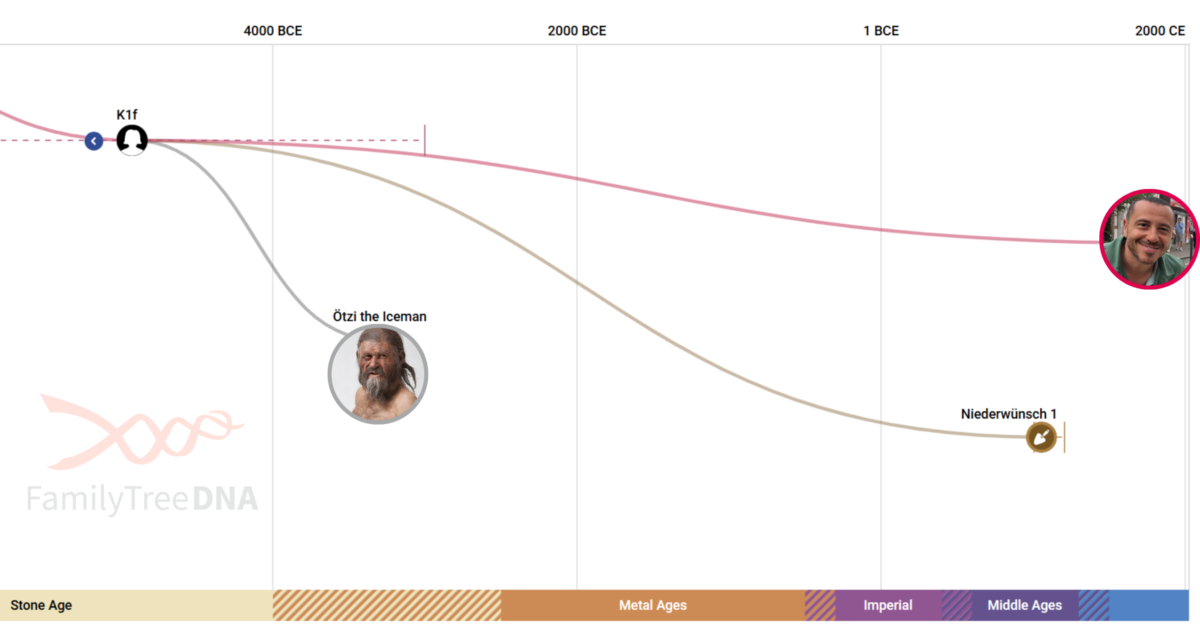
His mitochondrial DNA carries both of Ötzi’s defining mutations, along with three additional mutations that developed along his maternal line over the last several thousand years. This shows that Heddi and Ötzi shared a common maternal ancestor who lived roughly 7,000 years ago.
This does not mean that Ötzi was Heddi’s direct ancestor. Only women pass down mitochondrial DNA, so the connection points instead to a shared ancient grandmother whose maternal line quietly endured across thousands of years.
“The fact that Ötzi has no mutations that Heddi does not have tells us their maternal ancestors were relatively close in time,” explained Dr. Miguel Vilar, Genetic Anthropologist at FamilyTreeDNA. “This was not a lineage that split tens of thousands of years earlier.”
Ancient DNA Evidence of Neolithic Migration Across the Mediterranean
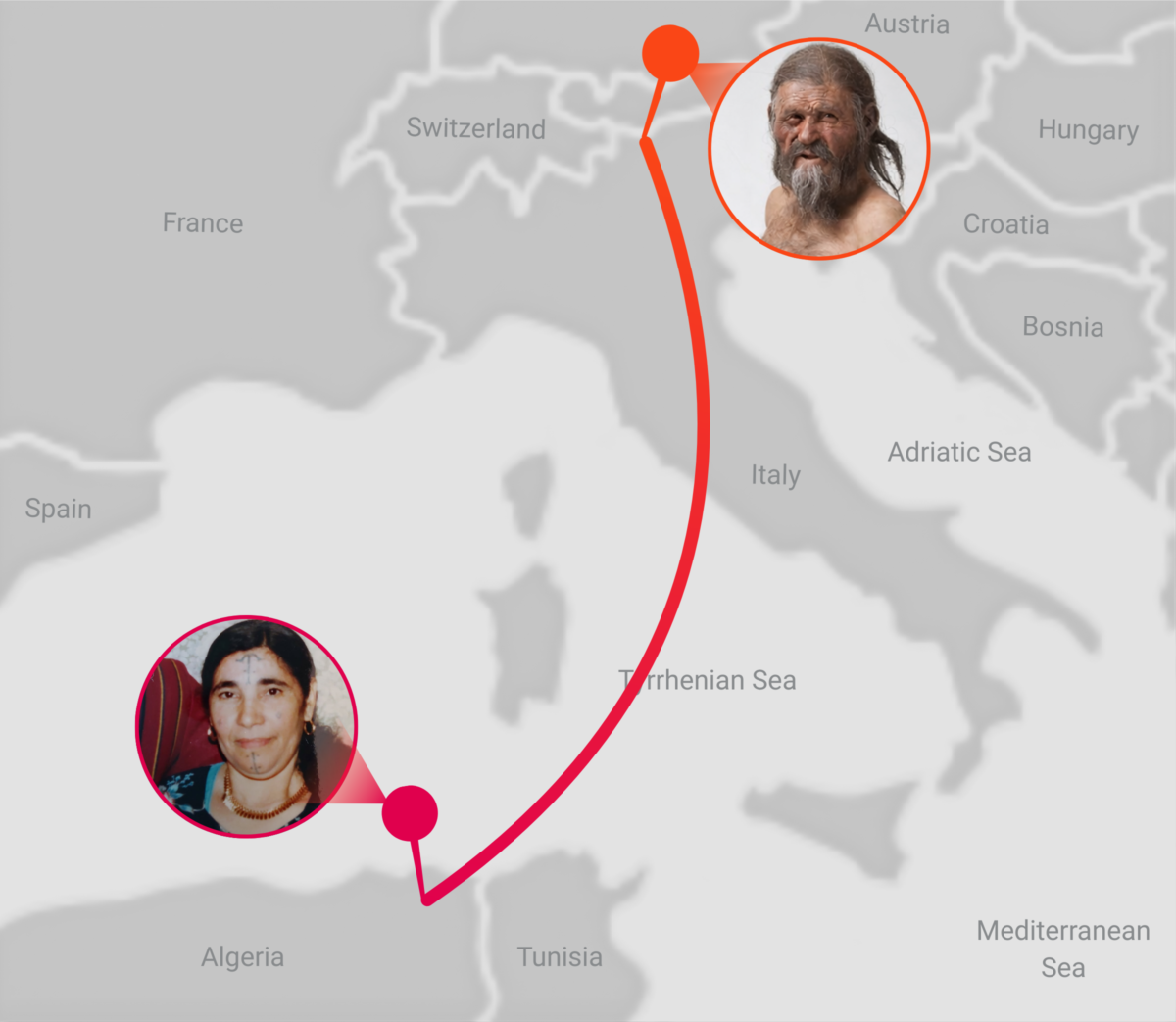
Heddi’s maternal grandmother belonged to the Shawiya Berber community of northeastern Algeria. Berber populations represent a deep and complex blend of ancient North African ancestry and ancestry from early Neolithic farmers who spread from the Near East into Europe and North Africa thousands of years ago.
This helps explain how a maternal lineage associated with a man found in the Alps could survive in North Africa.
“This is likely a second Neolithic connection between Italy and North Africa that we have identified,” said Dr. Vilar. “Similar to what we previously observed with Y chromosome haplogroup R-V88, these trans-Mediterranean links suggest early maritime movement across the region.”
In other words, prehistoric people were not isolated. They moved, migrated, and connected across regions long before written history recorded their journeys.
How Was Ötzi the Iceman’s DNA Reanalyzed in a Modern Study?
The connection between Heddi and Ötzi was uncovered during the development of FamilyTreeDNA’s mtDNA Tree of Humankind, a comprehensive maternal family tree built from the mitochondrial DNA of hundreds of thousands of testers worldwide.
Known scientifically as the Mitotree, it is the largest and most detailed mtDNA tree ever created and it continues to grow as more people test and new maternal branches are identified.
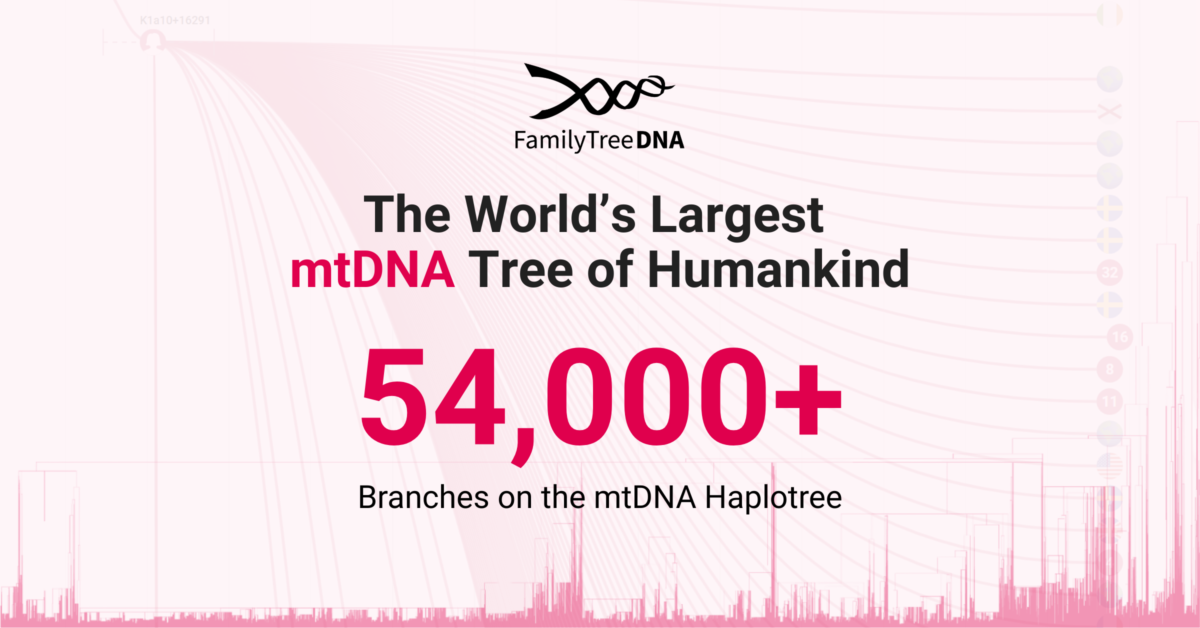
In 2022, the tree contained 5,469 distinct maternal branches. Today, that number has grown to more than 54,000.
This growth matters.
This living tree allows individuals to see, in greater detail than ever before, where their maternal line fits within the mtDNA family tree and how they are connected to one another and to more than ten thousand ancient remains.
As researchers expanded the tree, Heddi’s rare mitochondrial signature stood out.
Where Has Ötzi the Iceman’s Maternal Lineage Been Found?
Further analysis revealed that this ancient maternal line did not exist only in Ötzi and Heddi. It has also been found in archaeological remains from Mesolithic hunter-gatherers associated with the Iron Gates region of present-day Serbia, as well as medieval sites in Hungary and Germany.
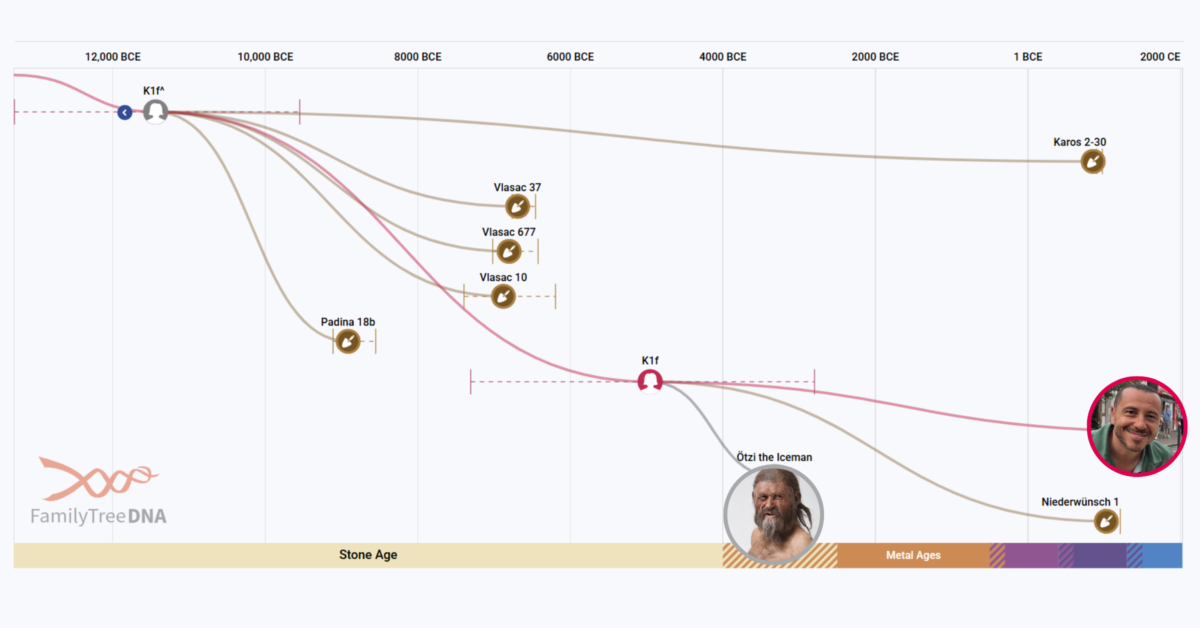
The lineage traveled widely in ancient times.
Yet today, it remains exceptionally rare. Heddi must go back roughly 20,000 years to find another living maternal relative.
This combination of ancient mobility and modern rarity helps explain why the lineage was once thought extinct and why it took a tree of this scale to rediscover it.
Why This Rare Maternal Lineage Was Once Thought Extinct
For years, Ötzi was described as a genetic outlier, a man whose maternal line ended with him. This discovery changes that narrative.
It also offers a broader reminder about ancestry and genetic genealogy. Lines do not disappear all at once. They narrow, scatter, and sometimes persist quietly in unexpected places.
“Discoveries like this remind us that human history is not static,” said Dr. Vilar. “Every new genome added to the tree has the potential to change what we think we know.”
More than 5,000 years after his death, Ötzi’s story is still evolving. And for one family in North Africa and Europe, the ancient past has become personal again.
Frequently Asked Questions
What was Ötzi the Iceman’s mtDNA haplogroup?
Ötzi the Iceman belonged to mitochondrial haplogroup K1f, a rare maternal lineage within haplogroup K. Haplogroup K is a branch of the larger mtDNA haplogroup U and has been found in both ancient and modern European populations. However, the specific subclade K1f identified in Ötzi has remained extremely rare in modern genetic databases. His mtDNA haplogroup helps trace his maternal ancestry through the female line.
Does Ötzi the Iceman have living relatives?
Yes, genetic research indicates that Ötzi the Iceman’s maternal lineage has living descendants today. While his specific mtDNA branch was once believed to be extinct, updated mitochondrial DNA analysis has identified a rare modern connection to the same maternal line. This discovery suggests that Ötzi’s maternal ancestry did not disappear but persisted at very low frequency over thousands of years. The connection was identified through comparative analysis of ancient and modern mtDNA data.
How was Ötzi’s mitochondrial DNA studied?
Ötzi’s mitochondrial DNA was extracted from preserved tissue samples and analyzed using ancient DNA sequencing techniques. Because ancient DNA is often fragmented and degraded, researchers use specialized methods to reconstruct the mitochondrial genome and compare it to modern reference databases. Updated phylogenetic analysis allows scientists to refine haplogroup placement as new mtDNA data becomes available. This reanalysis helped clarify Ötzi’s position within haplogroup K1f.
Why was Ötzi’s maternal lineage once thought extinct?
Ötzi’s maternal lineage was once thought extinct because no matching mitochondrial DNA sequences had been identified in modern genetic databases. His specific subclade, K1f, appeared only in ancient remains and was not observed in contemporary populations. As mitochondrial DNA databases expanded and sequencing methods improved, rare modern matches were identified. This showed that the lineage had survived at very low levels rather than disappearing entirely.
