By: Katy Rowe-Schurwanz
Explore the mtDNA Series
Start with the basics, then continue through the series to learn how mitochondrial DNA testing works, what your results mean, and how to use mtDNA in genealogy.
- What Is Mitochondrial DNA (mtDNA)? (current article)
- How Mitochondrial DNA Testing Works
- Understanding mtDNA Haplogroups and Your Results
Learn what mitochondrial DNA (mtDNA) is, how it’s inherited, and what it can reveal about your maternal ancestry.
Mitochondrial DNA testing focuses on a specific part of your ancestry—your direct maternal line.
Because mtDNA is passed from mothers to their children, it allows you to trace an unbroken line through your family tree, connecting you to your maternal ancestors across generations.
In this guide, you’ll learn:
What Is Mitochondrial DNA | mtDNA Inheritance | How Far Back mtDNA Goes | mtDNA Compared to Other DNA
What Is Mitochondrial DNA?
Mitochondrial DNA (mtDNA) is a type of DNA found in the mitochondria, which are structures inside your cells that produce energy. Unlike most DNA, mtDNA is passed from mothers to their children and is used in genetic genealogy to trace direct maternal ancestry.

To understand mitochondrial DNA, it helps to first understand the role of mitochondria in your cells. You may remember from biology class that the mitochondria are often called the ‘powerhouse of the cell’ because they produce the energy your cells need to function. These structures have their own small amount of DNA, separate from the DNA found in the nucleus, which makes mitochondrial DNA unique.
Like other types of DNA, mtDNA is made up of chemical building blocks called nucleotides. These nucleotides include guanine (G), adenine (A), thymine (T), and cytosine (C).
What Does mtDNA Do in the Body?
Mitochondrial DNA plays an important role in helping your cells produce energy. The mitochondria use this DNA to support the processes that generate ATP, the main source of energy your body needs to function.
Although mtDNA is much smaller than the DNA found in the nucleus—containing about 16,569 base pairs—it is essential for normal cellular activity and overall health.
Mitochondrial DNA is made up of different regions, which are analyzed in DNA testing to provide varying levels of detail about your ancestry.
Why Do Mitochondria Have Their Own DNA?
Mitochondria have their own DNA because they are thought to have originated from ancient bacteria that formed a symbiotic relationship with early multicellular organisms. Over time, these bacteria became a permanent part of cells, eventually evolving into the mitochondria found in human cells today.
Because of this origin, mitochondria retained a small, separate set of DNA that is distinct from the DNA found in the nucleus. This is why mitochondrial DNA behaves differently from other types of DNA in the body.
How Is mtDNA Inherited?
Mitochondrial DNA (mtDNA) is inherited exclusively from the mother, a pattern known as mtDNA inheritance. Both sons and daughters receive their mother’s mtDNA, but only daughters pass it on to the next generation.
Why Is mtDNA Only Inherited from the Mother?
Mitochondrial DNA has a unique inheritance pattern compared to other types of DNA. Mothers pass down their mtDNA to their children. This is due to the biological differences between egg and sperm cells during fertilization.
During reproduction, both egg cells (ova) and sperm cells contribute genetic material to the developing embryo. However, the way mitochondria are passed on differs between the two.
Mitochondrial DNA in the Ova
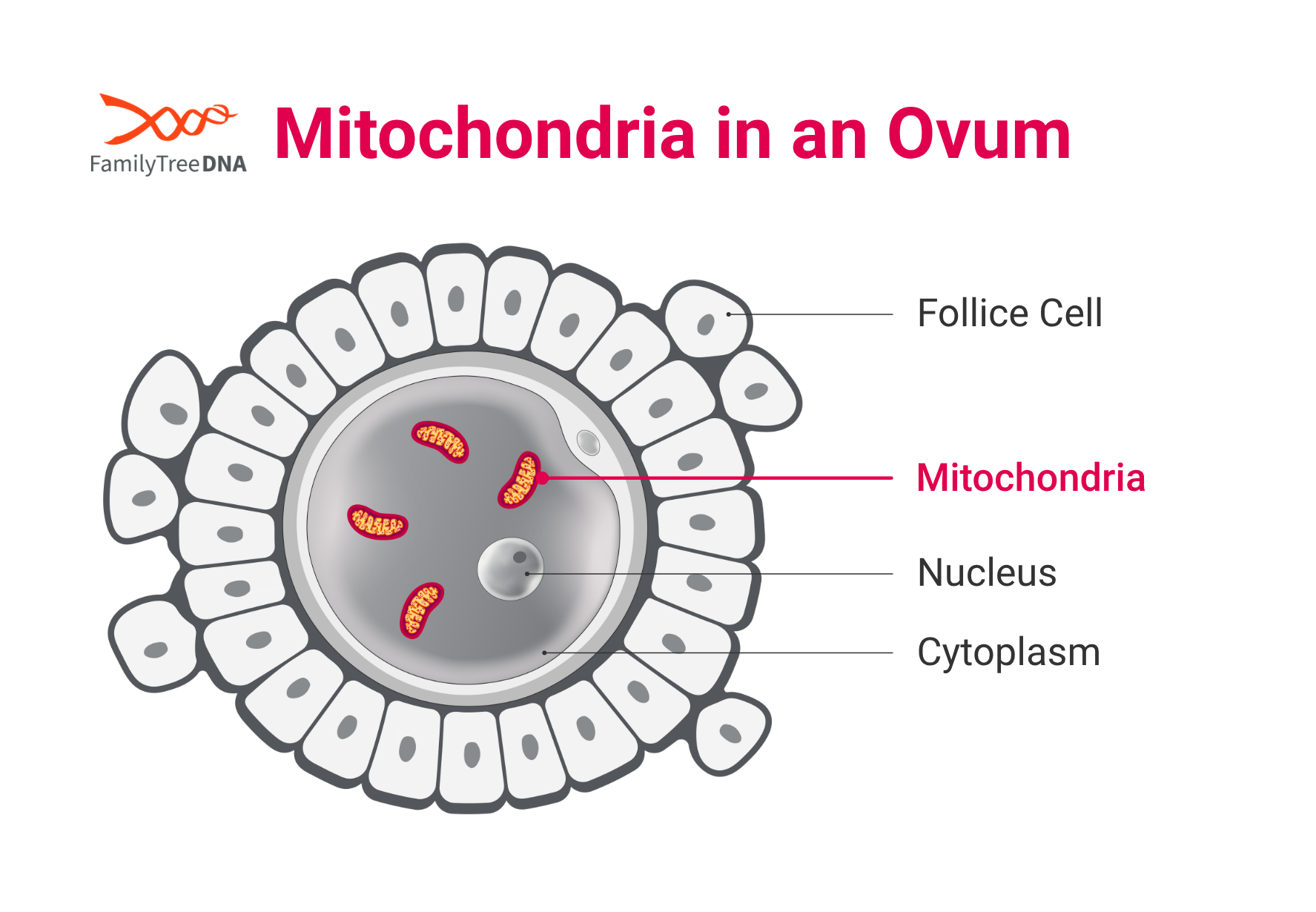
Egg cells are relatively large and contain a substantial amount of cytoplasm, which includes many mitochondria. When an egg is fertilized, these mitochondria—and their DNA—are retained in the resulting cell.
This means that the fertilized egg, or zygote, inherits its mitochondria entirely from the mother.
Mitochondrial DNA in the Sperm
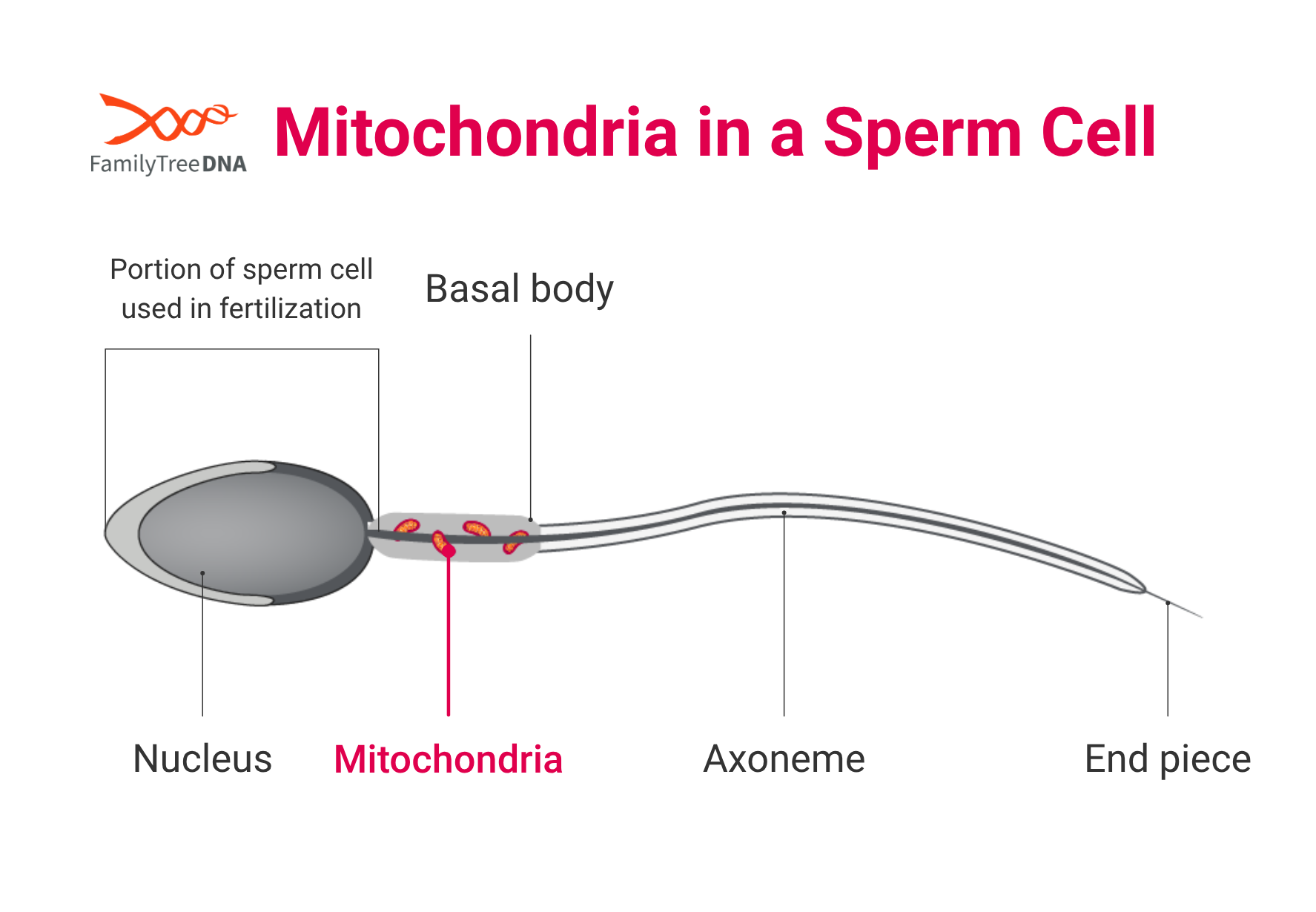
Sperm cells, in contrast, are much smaller and primarily designed to deliver nuclear DNA to the egg. While sperm do contain mitochondria, these are located in the tail and typically do not enter the egg during fertilization.
As a result, mitochondrial DNA from the father is not passed on to the child.
What Does mtDNA Inheritance Mean for Your Family Tree?
Because mtDNA is passed down only through the maternal line, it can be used to trace a direct line of ancestry from mother to child across many generations.
This creates an unbroken maternal line—your mother, her mother, her mother, and so on—extending back in time far beyond traditional records.
How Far Back Can mtDNA Go?
Mitochondrial DNA can trace your maternal ancestry back thousands of years. Because mtDNA is passed from mother to child with very few mutations over time, it remains relatively stable across many generations.
This means your mtDNA connects you not only to recent maternal ancestors, but also to a much deeper maternal lineage that can extend far beyond the reach of traditional genealogical records.
This long timeline shapes what mtDNA can—and cannot—tell you about your ancestry.
What Can mtDNA Tell You About Your Ancestry?
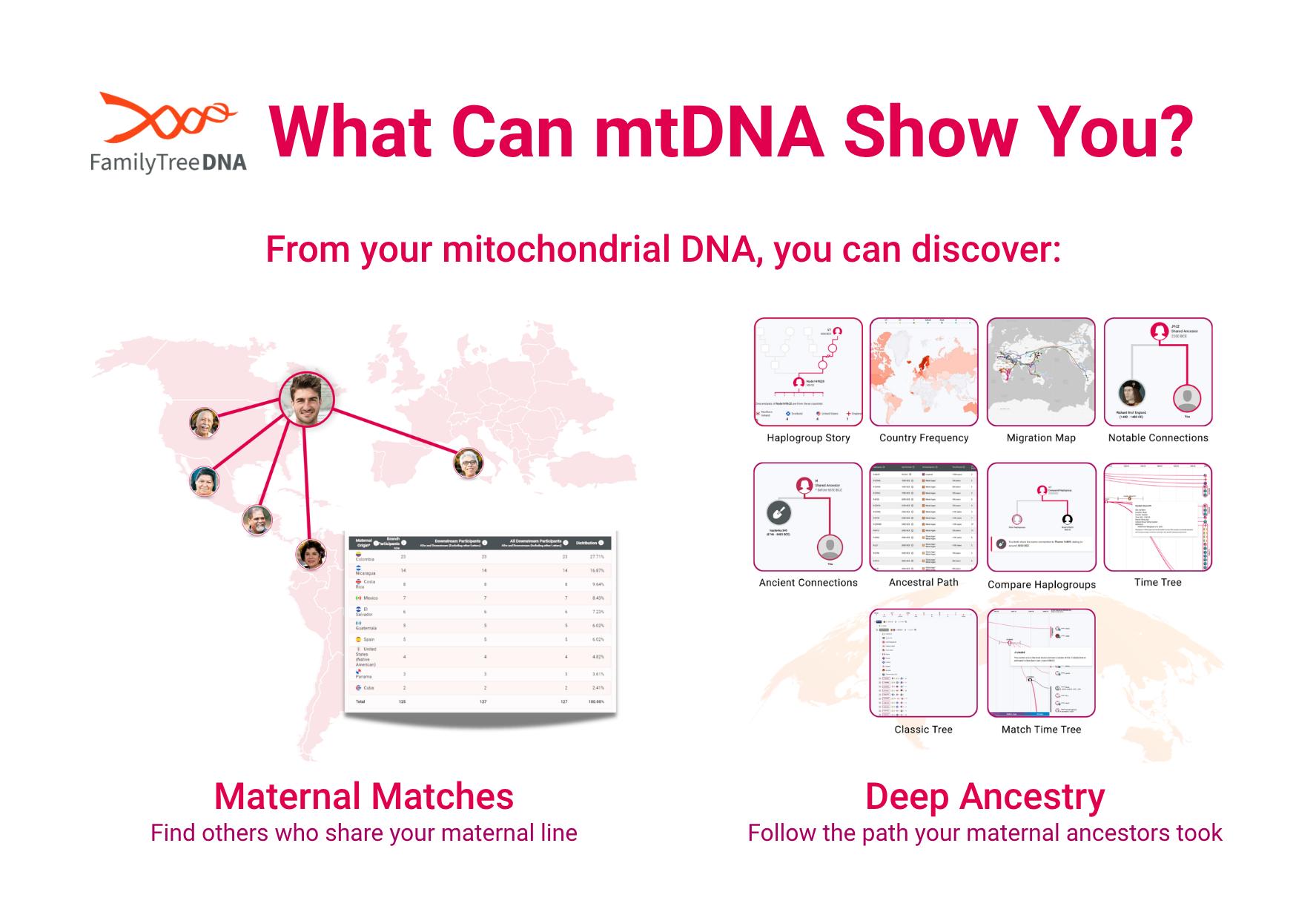
Mitochondrial DNA can provide insight into your direct maternal ancestry. Because it follows your maternal line, it allows you to trace an unbroken path through your family tree—your mother, her mother, her mother, and so on.
Through mtDNA testing, you can learn about your maternal haplogroup, which represents a branch on the mtDNA Tree of Humankind. Haplogroups can provide information about your deep ancestral origins and the ancient migrations of your maternal line.
mtDNA can also help confirm whether two individuals share a common maternal ancestor. By comparing mtDNA results, it is possible to determine whether two people share a common maternal ancestor along the same maternal line, even when traditional records are limited or unavailable.
What mtDNA Cannot Tell You?
While mitochondrial DNA offers valuable insight into your maternal lineage, it does not tell the full story of your ancestry.
Because it follows only one line—your direct maternal line—it represents just a small part of your overall family tree.
mtDNA is also less effective for identifying close relatives. Since it mutates slowly, individuals can share similar mtDNA even when their common ancestor lived far in the past.
For this reason, mtDNA is most useful when combined with other types of DNA testing to build a more complete picture of your ancestry.
What Makes mtDNA Different from Other Types of DNA?
Mitochondrial DNA is different from other types of DNA because of how it is inherited and what it can reveal about your ancestry.
is passed from mother to child and traces a single maternal line. In contrast, autosomal DNA is inherited from both parents and reflects all branches of your family tree, making it useful for finding relatives across many lines.
Y-DNA follows a similar pattern to mtDNA, but traces the direct paternal line from father to son.
Because of these differences, each type of DNA test serves a different purpose. mtDNA is best for exploring deep maternal ancestry and confirming maternal line connections, while autosomal DNA provides a broader view of your overall ancestry.
Frequently Asked Questions About Mitochondrial DNA
What is mitochondrial DNA testing?
Mitochondrial DNA (mtDNA) testing analyzes the DNA found in your mitochondria to explore your direct maternal ancestry. It compares your mtDNA to reference sequences and other testers to identify your haplogroup and potential maternal line connections.
What is mitochondrial DNA used for?
Mitochondrial DNA is used in genetic genealogy to trace maternal ancestry, confirm maternal line relationships, and explore deep ancestral origins. It can also be used in scientific and medical research to study population history and human evolution.
What is an mtDNA haplogroup?
An mtDNA haplogroup is a group of people who share a common maternal ancestor and similar mitochondrial DNA. Haplogroups represent branches on the mtDNA Tree of Humankind and can provide insight into your deep ancestral origins and migration patterns.
How does mitochondrial DNA differ from nuclear DNA?
Mitochondrial DNA differs from nuclear DNA in both location and inheritance. It is found in the mitochondria and is inherited only from the mother, while nuclear DNA is found in the nucleus and is inherited from both parents.
How accurate is mitochondrial DNA testing for ancestry?
Mitochondrial DNA testing is highly accurate for identifying your maternal haplogroup and confirming whether two individuals share a maternal line. However, because mtDNA changes slowly, it is less precise for determining recent relationships.
Mitochondrial DNA offers a unique window into your maternal ancestry, allowing you to trace a single line of your family history across generations.
While it represents just one branch of your family tree, mtDNA can provide powerful insights into your deep ancestry and help confirm connections along the maternal line when combined with other genealogical research.
In the next part of this series, we’ll explore how mitochondrial DNA testing works and what happens to your DNA after you take a test.
