By: Katy Rowe-Schurwanz
Explore the Autosomal DNA Series
Start with the basics, then continue through the series to learn how autosomal DNA works, what your results mean, and how to use them in genealogy.
Learn practical autosomal DNA tips to analyze DNA matches, identify shared ancestors, and make meaningful progress in your genealogy research.
Autosomal DNA testing provides powerful insights into your family history—but knowing how to use your results is what turns those insights into discoveries. With the right approach, you can analyze DNA matches, identify shared ancestors, and expand your family tree with confidence.
In this final part of the “Explore Your DNA” series, we’ll walk through practical autosomal DNA tips you can use to organize your matches, confirm relationships, and make meaningful progress in your genealogy research.
What Are the Best Tips for Using Autosomal DNA?
The most effective way to use autosomal DNA is to start with clear goals, test the right family members, and focus on your closest DNA matches. Combining DNA results with family trees, surnames, and tools like the Chromosome Browser helps identify shared ancestors more accurately.
Tips for Using Autosomal DNA Effectively
Autosomal DNA results can feel overwhelming at first, especially if you’re not sure where to begin. By following a clear process, you can turn your results into actionable insights and make steady progress in your research.
These autosomal DNA tips provide a step-by-step framework to help you analyze DNA matches, confirm relationships, and build your family tree.
1. Define Your DNA Testing Goals
Before you begin using autosomal DNA for genealogy, it’s important to define what you want to learn. Clear goals will shape how you analyze DNA matches and determine which tools and results to focus on.
You may be trying to identify a birth family or unknown ancestor, confirm a relationship between individuals, or learn more about your ancestral origins—such as whether you have Native American, Jewish, or other regional ancestry. These are some of the most common starting points when applying autosomal DNA tips to real research.
You may have one goal—or several—and they may evolve as you continue your DNA genealogy journey.
2. Test the Right People for Your Goals
Once you’ve defined your goals, the next step is determining who to test. Because each person inherits a unique combination of autosomal DNA, testing additional family members can help fill in gaps and provide stronger evidence for your research.
In some cases, autosomal DNA alone may not be enough to answer your question. Depending on your goal, Y-DNA or mtDNA testing may be more appropriate for tracing direct paternal or maternal lines.
3. Set Up Your Account for Success
While you’re waiting for your results, take time to prepare your account. A well-prepared profile makes it easier to analyze DNA matches and connect with relatives as soon as your results are available.
- Keep your contact information up to date.
Your name and email address are visible to your matches. Make sure your name appears how you want it displayed and that your email is current so you don’t miss important messages. - Complete your genealogy details.
Fill out the Genealogy section in your Account Settings, including Ancestral Surnames and Earliest Known Ancestors. This helps matches quickly identify shared family lines. - Link your family tree.
Connect a family tree to MyHeritage or WikiTree to add genealogical context to your DNA matches. Family trees put the genealogy in genetic genealogy—without one, you only have a list of matches with no clear way to determine how you’re related. - Join relevant Group Projects.
Group Projects connect individuals researching the same surnames, locations, or lineages. These communities can provide valuable insight and may help you break through genealogical brick walls.
4. Start with the Right Results Based on Your Goals
Once your results are ready, where you begin depends on what you’re trying to learn. Starting in the right place will help you analyze DNA matches more effectively and avoid confusion.
If your goal is to explore ancestral origins:
Start with your myOrigins results. These estimates can help you understand where your ancestors may have lived and whether you have connections to specific populations, such as Native American, Jewish, or other regional groups.
Keep in mind that autosomal DNA is inherited through random recombination, which means you may not inherit DNA from every ancestor. Not matching a specific population does not necessarily mean you don’t have ancestry from that group—it may simply be too far back or not passed down to you. Testing siblings or older relatives can sometimes reveal connections that do not appear in your results.
If your goal is to identify relatives or build your family tree:
Start with your DNA Matches. This is where you’ll find people you share DNA with, which can help you discover unknown relatives, confirm relationships, and break through genealogical brick walls.
5. Focus on Your Closest DNA Matches First
When you begin analyzing DNA matches, start with those who share the most DNA with you. Closer matches are more likely to lead to identifiable common ancestors.
Before diving in, make sure you’ve linked any known relatives to your family tree. This enables tools like Family Matching, which can help group your matches and identify which side of your family they belong to. You can also use shared family trees, Ancestral Surnames, and the Chromosome Browser to support your analysis.
Focus first on matches within closer predicted relationship ranges, such as 1st–3rd cousins or 2nd–4th cousins. These relationships are typically easier to research because the shared ancestor is more recent. More distant matches, such as 5th cousins or beyond, often require significantly more time and additional evidence to confirm.
The chart below can help you estimate which ancestor you likely share with a match based on their predicted relationship.
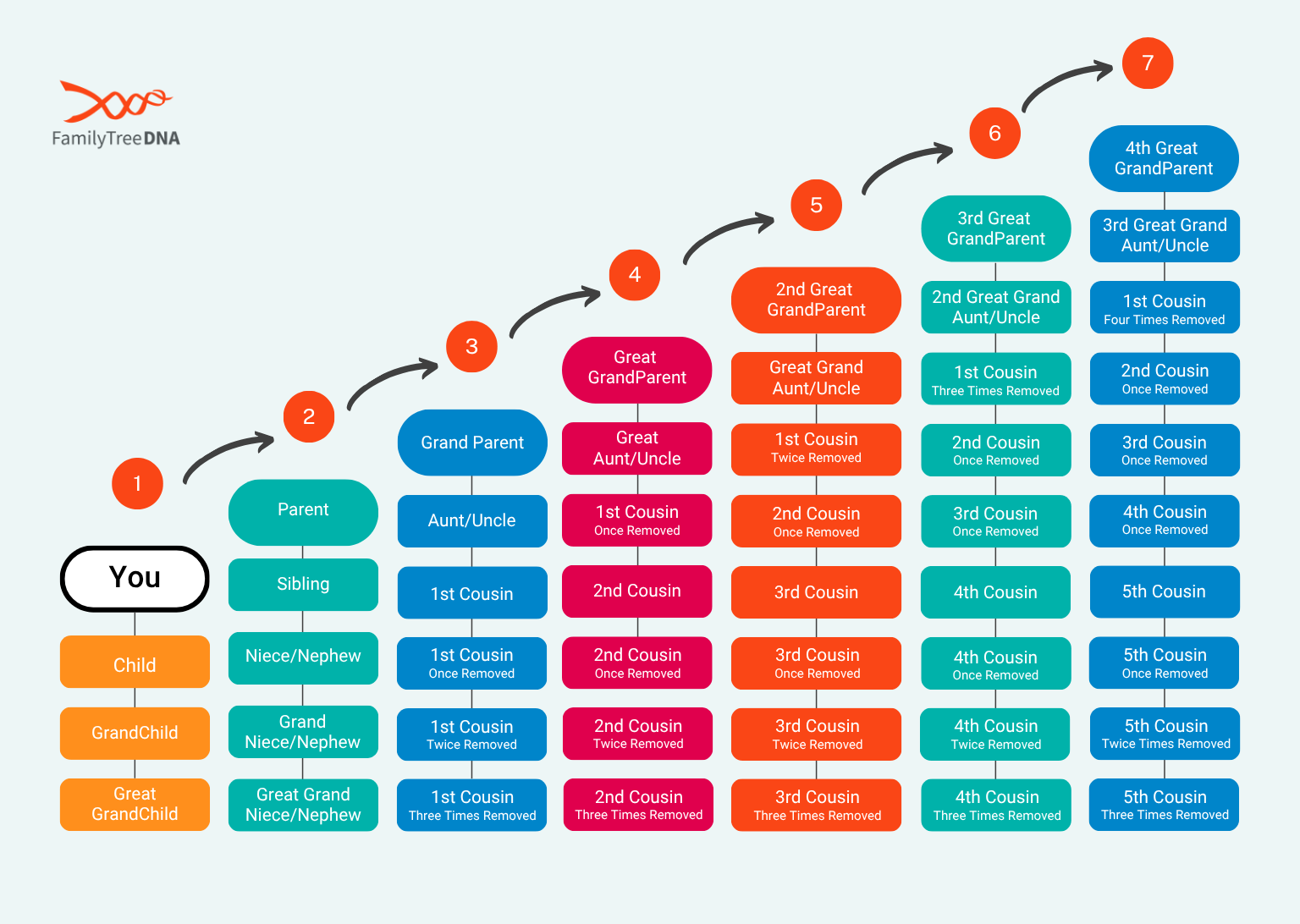
For example, 2nd cousins typically share great-grandparents, while 4th cousins share great-great-great-grandparents. This provides a useful starting point for identifying where to look in your family tree.
Keep in mind that these are estimated relationship ranges. Due to factors like random recombination, the actual relationship may be closer or more distant than predicted.
6. Use Trees, Surnames, and Tools Together
After identifying your closest matches, the next step is to combine multiple tools to find your shared ancestor.
Start by looking for matches who have entered Ancestral Surnames that match your own. Shared surnames can provide valuable clues about where your family lines may connect.
- Check their family tree.
If a match has a tree, review it to find the ancestor with the shared surname. You may be able to identify your common ancestor directly from their tree. - Confirm with additional matches.
Even if a shared ancestor appears likely, you should confirm the connection by comparing with other matches who descend from the same person. This process, often called triangulation, helps ensure you’ve identified the correct relationship—especially when multiple possible connections exist. - Reach out if information is missing.
If a match doesn’t have a tree, or you can’t find the surname or ancestor you’re researching, consider contacting them. Introduce yourself as a Family Finder match, mention the shared surname, and include details about your ancestor—such as their name, location, and time period. Ask if they have that person in their tree or who their ancestor was with that surname.
To avoid confusion, make sure your name and email match what appears in your account.
7. Contact Matches Strategically
Not all matches will have complete information, so reaching out can be an important part of your research.
When contacting a DNA match, keep your message clear and focused. Introduce yourself, mention that you are a Family Finder match, and include specific details—such as a shared surname, ancestor name, location, and time period. This helps your match quickly understand the potential connection.
Be concise, polite, and patient. Not everyone will respond right away, but a clear and thoughtful message increases your chances of receiving helpful information.
For more detailed guidance and examples, see our full guide on contacting DNA matches effectively.
8. Build and Expand from Confirmed Ancestors
Once you’ve identified a shared ancestor, expand your family tree by building down from that ancestor to your DNA match. Then, link the match to the correct person in your tree.
This process helps strengthen your research by confirming relationships and may allow additional matches to be phased automatically. As you continue linking matches to your tree, you may begin to identify more unknown relatives and uncover new connections.
Over time, this approach helps you organize DNA matches more effectively and turn individual connections into a fully developed family network.
Resources for Learning Genetic Genealogy
Learning to use autosomal DNA takes time and practice. These resources provide additional guidance, examples, and tools to help you build confidence as you analyze DNA matches and explore your family history.
Beginner-Friendly Blogs
If you’re looking to deepen your understanding of autosomal DNA and genetic genealogy, these expert-written blogs provide practical guidance, real-world examples, and step-by-step explanations.
Identifying Unknown Parents Using DNA — Roberta Estes
A detailed guide to using DNA matches, clustering, and research strategies to identify unknown parents and relatives.
First Steps After Your DNA Results — Roberta Estes
A beginner-friendly walkthrough of what to do when your DNA results are ready, including how to start analyzing your matches.
Match Groups and Triangulation — Roberta Estes
Explains how to group DNA matches and use triangulation to confirm shared ancestors with greater confidence.
Chromosome Browser Guide — Roberta Estes
A practical overview of how chromosome browsers work and how to use them to compare shared DNA segments.
Autosomal Tools at FamilyTreeDNA — Roberta Estes
Highlights key autosomal DNA tools available at FamilyTreeDNA and how they support genealogical research.
Combining Test Types — Diahan Southard
Explains how autosomal DNA, Y-DNA, and mtDNA work together to provide a more complete picture of your ancestry.
Videos & Webinars
Prefer to learn by watching? These videos and webinars walk through key autosomal DNA tools and strategies, showing how to analyze DNA matches and apply your results in real research scenarios.
Using the Family Matching Tool at FamilyTreeDNA — FamilyTreeDNA (YouTube)
Demonstrates how to use Family Matching to group your DNA matches and identify maternal and paternal connections.
Your Guide to Getting Started with DNA — Diahan Southard (Your DNA Guide / RootsTech)
A beginner-friendly introduction to DNA testing, including how to interpret results and take your first steps in genetic genealogy.
Finding Birth Family Using DNA — FamilyTreeDNA (YouTube)
Explores strategies for identifying biological relatives using DNA matches and genealogical research techniques.
Family Finder myOrigins 3.0 Explained (Part 1) — FamilyTreeDNA (YouTube)
Breaks down how ethnicity and origin estimates work and how to interpret your myOrigins results.
Understanding Family Finder DNA Matches — Diahan Southard (YouTube)
Explains how DNA matches are calculated and how to use them to build and expand your family tree.
Organize Your DNA Matches Simply and Efficiently (Free Webinar) — Diahan Southard (Your DNA Guide)
A practical webinar focused on how to organize DNA matches and identify the connections that can help solve your family history questions. Ideal for beginners who feel overwhelmed by their match list.
Recommended Books
For a deeper understanding of autosomal DNA and genetic genealogy, these books provide in-depth explanations, research strategies, and real-world case studies from leading experts in the field.
The Complete Guide to FamilyTreeDNA: Y-DNA, Mitochondrial, Autosomal, and X-DNA — Roberta Estes
A comprehensive guide to all FamilyTreeDNA test types, including detailed explanations of how to interpret results and apply them to genealogical research.
Your DNA Guide: The Book (2025 Edition: Updated and Expanded) — Diahan Southard
A beginner-friendly resource that simplifies DNA concepts and provides step-by-step guidance for using DNA in family history research.
DNA for Native American Genealogy — Roberta Estes
Focuses on how DNA testing can be used to explore and verify Native American ancestry, including common challenges and limitations.
The Family Tree Guide to DNA Testing and Genetic Genealogy (Second Edition) — Blaine T. Bettinger
One of the most widely used guides to DNA testing, covering autosomal DNA, match analysis, and core genetic genealogy techniques.
Genetic Genealogy in Practice — Blaine T. Bettinger and Debbie Parker Wayne
A hands-on workbook with exercises and case studies designed to help you apply DNA analysis techniques in real research scenarios.
Advanced Genetic Genealogy: Techniques and Case Studies — Edited by Debbie Parker Wayne
A more advanced collection of case studies and methodologies for experienced researchers looking to deepen their DNA analysis skills.
For additional recommendations, explore our guide to the best genealogy books for DNA and family history research.
Tools for DNA Analysis
In addition to built-in features, third-party tools can help you analyze DNA matches, estimate relationships, and visualize shared DNA more effectively. These tools are especially useful when working with more complex or distant DNA matches.
Shared cM Tool — DNA Painter
Estimates possible relationships based on the amount of DNA (centimorgans) you share with a match, helping you interpret match ranges more accurately.
DNA Painter Tools Suite — DNA Painter
A collection of tools for visualizing and analyzing DNA data, including chromosome mapping and segment analysis to support genetic genealogy research.
Real-Life DNA Success Stories
Autosomal DNA has helped people around the world uncover unknown relatives, reconnect with family, and solve long-standing genealogical mysteries. These real-life stories show what’s possible when DNA results are combined with research and persistence.
Holocaust Survivor’s Grandchild Rediscovers Family Through DNA — FamilyTreeDNA Blog
A powerful story of how autosomal DNA helped reconnect family members separated by historical events and lost records.
My First Autosomal DNA Success Story — Debbie Kennett
A personal account of using DNA matches to identify a previously unknown family connection and confirm relationships.
Autosomal DNA Success Stories — ISOGG Wiki
A collection of documented cases where autosomal DNA has been used to solve genealogical questions and identify shared ancestors.
Adoption Success Stories — ISOGG Wiki
Real examples of individuals using DNA testing to identify biological parents and reconnect with birth families.
A DNA NPE Success Story — Clan Irwin DNA Project
A detailed case study showing how DNA evidence helped uncover a non-paternal event (NPE) and resolve a family mystery.
Frequently asked Questions
What are the best tips for DNA genealogy?
Start with clear research goals, test the right family members, and focus on your closest DNA matches first. Combining DNA results with family trees, surnames, and tools helps you identify shared ancestors more accurately.
Why should I start with my closest DNA matches?
Closer matches share more DNA and typically connect through more recent ancestors, making them easier to research and confirm. This helps you build a strong foundation before working with more distant matches.
What if my DNA results don’t show a specific ancestry I expected?
Autosomal DNA is inherited randomly, so you may not inherit DNA from every ancestor. Testing siblings or older relatives can sometimes reveal ancestry that does not appear in your results.
Do I need a family tree to use autosomal DNA?
Yes, a family tree provides essential context for your DNA matches. Without one, it is much harder to determine how you are related to your matches.
Using autosomal DNA for genealogy is a process of discovery—one that builds over time with each new match and connection. By following these autosomal DNA tips, you can move from feeling overwhelmed to confidently analyzing DNA matches and identifying shared ancestors.
Every confirmed connection adds to your story, helping you grow your family tree and uncover the relationships that shaped your history.
