

Genes and Screams is a seasonal series linking genetic genealogy with history’s spookiest figures. Discover how DNA sheds light on mummies, vampires, witches, and ghosts across time. You can read the rest of the series here:
By: Courtney Eberhard
A 2026 study uncovered ghost DNA from two unknown human ancestors, and one of them is in every population studied, including yours.
Pop culture loves a ghost. Some rattle chains in the attic. Some move into a country house and refuse to leave (looking at you, Ghosts). Some spend eternity chasing a little yellow circle around a maze. And when there’s something strange in the neighborhood, everyone knows who to call.
But the most persistent ghosts aren’t haunting old houses. They’re haunting your genome. Scientists call it ghost DNA: genetic traces of ancient human relatives who left behind no fossils anyone can match to them and no genomes to sequence, only echoes in the DNA of people alive today.
In this chapter of Genes and Screams, we’re following those echoes. A 2026 study found DNA from not one but two ghost ancestors hiding in the human genome, and one of them shows up in every population studied. Here’s what ghost DNA is, where it came from, and why you almost certainly carry it.
Are Ghosts Real?
Short answer? Not the kind that rattle chains, but the genetic kind absolutely are.
Science has never found evidence of spirits drifting down hallways, though plenty of people have had experiences they can’t explain, and we’re not here to argue with your grandmother. In genetics, though, “ghost” is an official term.
Geneticists use it to describe a ghost population, sometimes called a ghost lineage: a group of ancient humans whose existence can be detected in DNA but who have never been matched to fossils or sequenced directly. These were real, flesh-and-blood people who lived for hundreds of thousands of years. They’re “ghosts” only because science hasn’t found their bodies yet.
They don’t haunt houses. They haunt genomes, including, almost certainly, yours.
What Is Ghost DNA?
Ghost DNA is genetic material inherited from a ghost population: an ancient group of humans who interbred with our ancestors but whose own DNA has never been found. Those long-ago encounters left pieces of their genomes behind, and those pieces have been passed down from parent to child for tens of thousands of years.
If that sounds familiar, it’s because the same thing happened with Neanderthals and Denisovans. Most people living outside Africa today carry 1 to 2 percent Neanderthal ancestry, and many people of Asian and Oceanian descent also carry Denisovan DNA. The difference is that scientists have sequenced Neanderthal and Denisovan genomes from ancient bones, so they know exactly what that DNA looks like and can spot it in living people.
Ghosts don’t come with a reference genome. Instead, geneticists look for stretches of DNA that are too old and too different to have come from modern humans, but that don’t match any archaic group anyone has ever sequenced. It’s a bit like finding a page in the family Bible written in a language no one in the family speaks. Someone put it there. You just don’t know who.
The Ghosts of West Africa
The 2026 study wasn’t the first time a ghost showed up in human DNA. In 2020, UCLA geneticists Arun Durvasula and Sriram Sankararaman analyzed genomes from four West African populations, including the Yoruba and Mende, and found that an estimated 2 to 19 percent of their ancestry traced back to an unknown archaic group.
Their model suggested this ghost population split from the human family tree as long as a million years ago, and that it interbred with the ancestors of West Africans tens of thousands of years ago, around the same time Neanderthals were mixing with humans in Eurasia. As for who these ancestors were, Sankararaman put it simply: “Not much at this stage.”
That study left a big question hanging in the air like a cold spot in an old house: was ghost DNA a West African story, or was it hiding in everyone? It would take six more years, and a whole new way of reading DNA, to find out.
What Did the 2026 Ghost DNA Study Find?
The 2026 study found that about 2 percent of the modern human genome comes from archaic relatives, and that part of it belongs to two ghost lineages no one has ever sequenced. The research team, led by Yulin Zhang and Priya Moorjani at UC Berkeley and Arjun Biddanda at Johns Hopkins University, published their findings in Science in July 2026.
To find the ghosts, they built a new method called TRACE. Instead of comparing modern DNA to ancient genomes, TRACE reconstructs the family trees hidden inside different stretches of our DNA, then looks for branches that reach back unusually far in time. As Moorjani put it, “Genealogies preserve a record of our evolutionary past.” It turns out that’s true whether your family tree goes back four generations or 800,000 years.
After applying TRACE to more than 500 modern genomes from around the world, the team found:
- About 2 percent of the human genome is archaic. That includes Neanderthal DNA, Denisovan DNA, and the two ghost lineages.
- One ghost lineage shows up in every population studied. Each person carries about 0.3 to 0.7 percent of their genome from it, less than the 1 to 2 percent Neanderthal ancestry most people outside Africa have, but several times more than their Denisovan ancestry.
- Ghost DNA hides where scientists didn’t expect it. It turned up in regions of the genome that are nearly free of Neanderthal and Denisovan DNA, regions scientists had long thought were uniquely Homo sapiens. One of them sits near FOXP2, a gene linked to speech.
- Ghost DNA may have helped us survive. Archaic segments were especially common in regions tied to immune function and metabolism, a sign that some of what our ancestors inherited may have been worth keeping.
Two Ghosts, Not One.
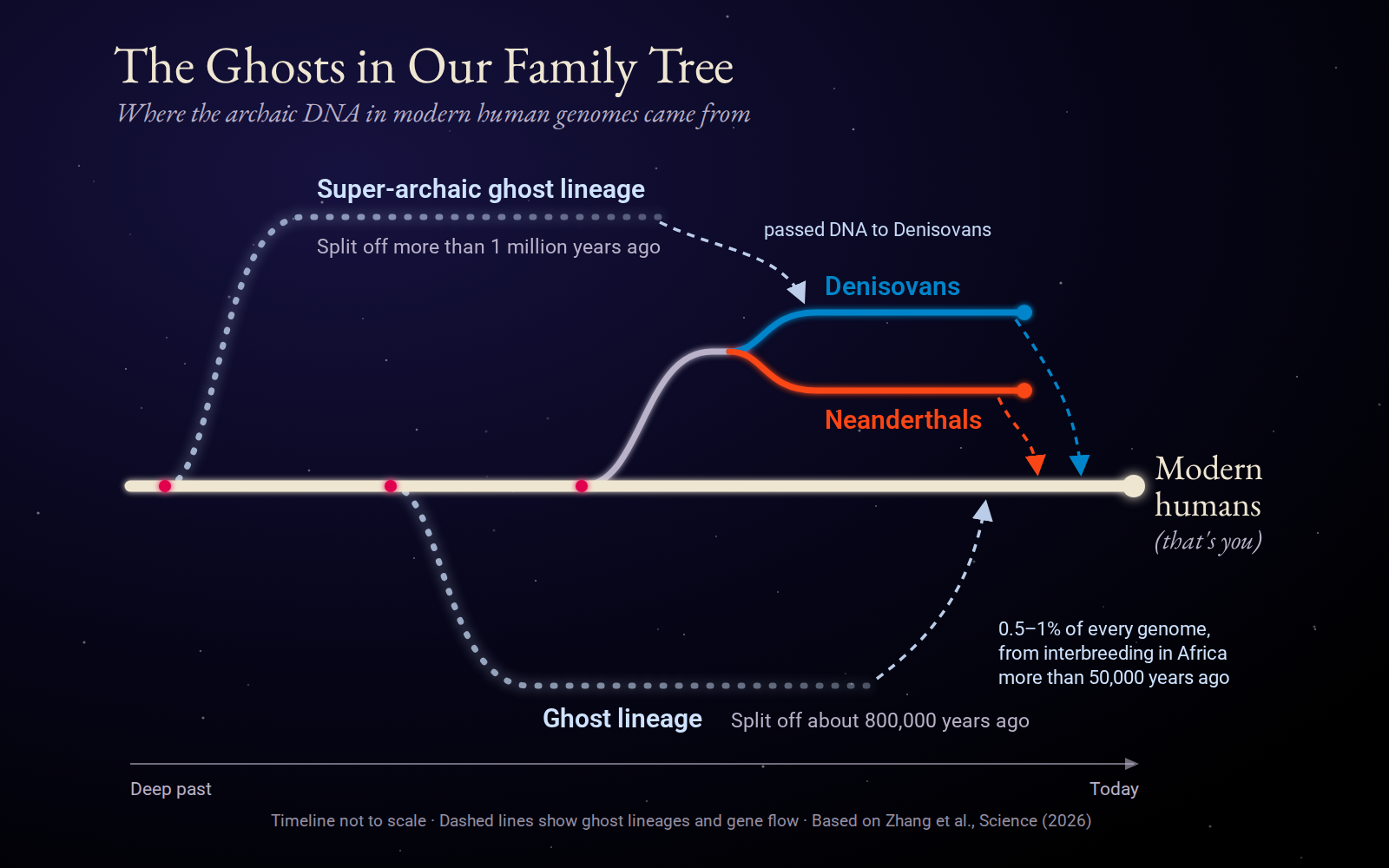
The ghost lineage. This group split from the human family tree roughly 800,000 years ago and interbred with our ancestors in Africa more than 50,000 years ago, before modern humans spread across the rest of the world. That’s why people in Africa and people outside Africa carry similar amounts of its DNA. It traveled with everyone.
The super-archaic lineage. This one is even older. It belonged to a population that lived more than a million years ago, and it never met modern humans directly. Instead, it interbred with Denisovans, who later interbred with modern humans, and a small fraction of that ancient ghost came along for the ride.
In other words, it’s a ghost hiding inside another ancestor’s DNA, a haunting within a haunting.
Who Were the Ghost Ancestors?
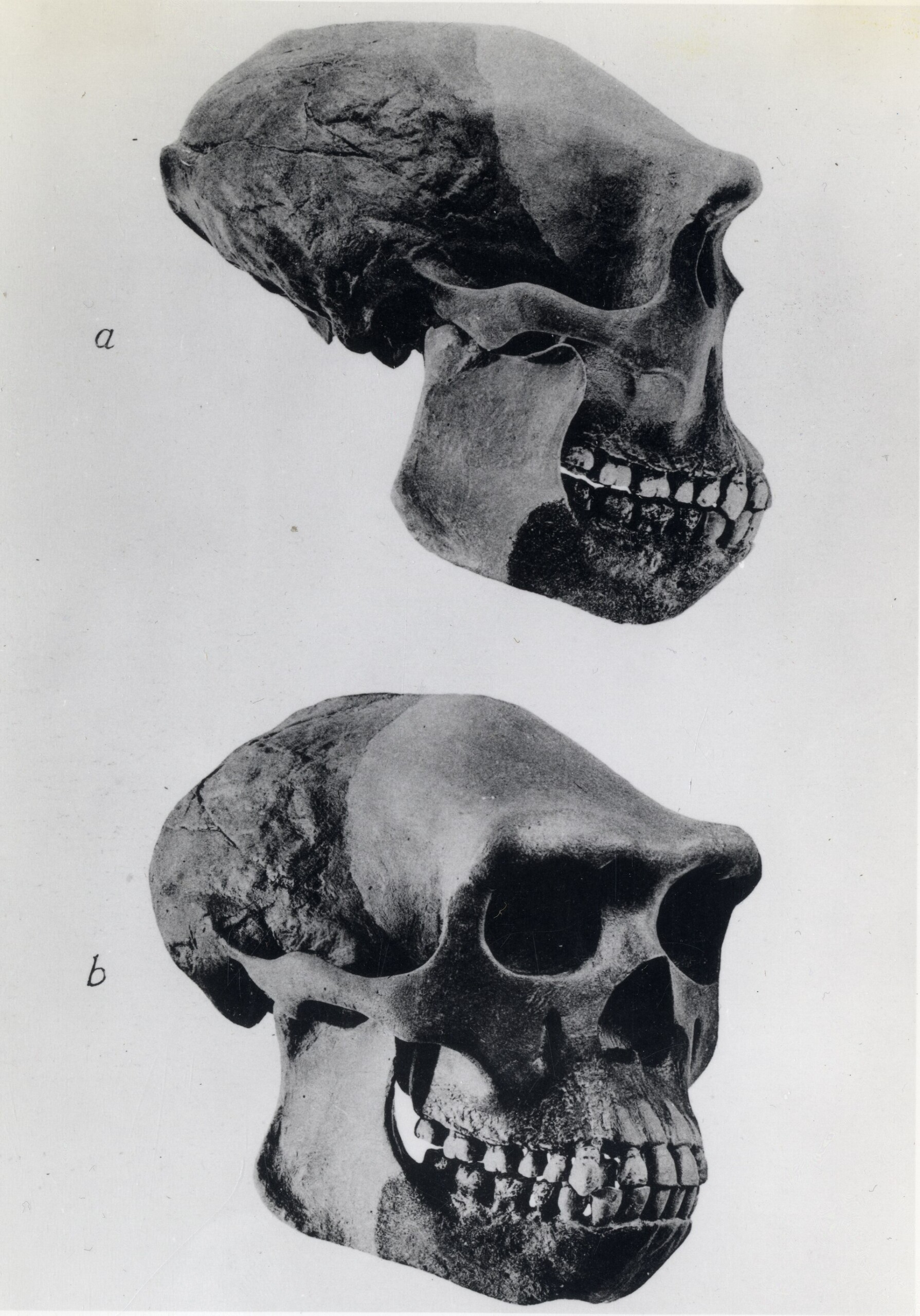
No one knows yet. The timing lines up with known groups in the fossil record: the ghost lineage overlaps with Middle Pleistocene Homo populations in Africa around 800,000 years ago, and the super-archaic lineage overlaps with Homo erectus in Eurasia around 1.8 million years ago. But overlapping in time isn’t proof. No fossil has been matched to either ghost.
Part of the problem is geography. Warm, humid climates are hard on ancient DNA, and no archaic human genome has ever been recovered from sub-Saharan Africa. So scientists are reading the ghosts’ story the only way they can, backward, through the DNA of the living.
Ghosts don’t always stay ghosts, though. When a newly found fossil finally matches a genetic signal, researchers call it “de-ghosting.” Somewhere, in a cave or a riverbank, the bones of our ghost ancestors may still be waiting to be found. Until then, they live on in the one place we know they survived: in us.
Who Has Ghost DNA?
Almost certainly, you do. The ghost lineage turned up in every population the researchers studied at about 0.5 to 1 percent of their genomes. That makes ghost DNA one of the few inheritances nearly all of humanity shares.
The super-archaic ghost is a little more selective. Because it arrived through Denisovans, it shows up most clearly in people from Oceania, whose ancestors carry the most Denisovan DNA today.
And there may be more ghosts still waiting to be found. Many populations, especially across Africa, are still underrepresented in the world’s genome databases. Moorjani hopes TRACE will pick up fainter signals from other unknown groups as those databases grow more diverse. The more of humanity that’s sequenced, the more ghosts may come out of hiding.
Most ghost stories end when someone finally sees the ghost. This one doesn’t have an ending yet. Somewhere out there are the bones of the people who left these traces behind, and somewhere inside you is the proof that they existed.
Frequently Asked Questions About Ghost DNA
What is ghost DNA?
Ghost DNA is genetic material inherited from an ancient human population that interbred with our ancestors but has never been identified through fossils or sequenced genomes. Scientists detect it as stretches of DNA that are too old and too different to come from modern humans, but that don’t match Neanderthals, Denisovans, or any other known group.
Is ghost DNA the same as Neanderthal or Denisovan DNA?
No. Neanderthal and Denisovan DNA comes from groups whose genomes scientists have sequenced from ancient remains, so their DNA can be identified directly in living people. Ghost DNA comes from groups no one has sequenced, which is why researchers can only detect them indirectly.
How much ghost DNA do humans have?
According to a 2026 study published in Science, about 2 percent of the modern human genome comes from archaic relatives. Each person carries about 0.5 to 1 percent of their genome from one ghost lineage alone, roughly as much as the Neanderthal DNA many people carry.
Is ghost DNA only found in people of African descent?
No. A 2020 study first detected ghost ancestry in West African populations, but the 2026 study found one ghost lineage in every population studied, in similar amounts inside and outside Africa. A second, older super-archaic lineage appears most clearly in people from Oceania, through ancestry inherited from Denisovans.
Where did ghost DNA come from?
The main ghost lineage split from the human family tree roughly 800,000 years ago and interbred with modern humans in Africa more than 50,000 years ago, before our ancestors spread around the world. The super-archaic lineage is even older. It lived more than a million years ago and passed its DNA to Denisovans, who later passed a small amount of it on to modern humans.
Have scientists found fossils of ghost ancestors?
Not yet. The ghost lineages’ timelines overlap with known groups like Middle Pleistocene Homo in Africa and Homo erectus in Eurasia, but no fossil has been genetically matched to either one. If a fossil is ever linked to the DNA, scientists say the lineage has been “de-ghosted.”
