By: Katy Rowe-Schurwanz
Explore the Autosomal DNA Series
Start with the basics, then continue through the series to learn how autosomal DNA works, what your results mean, and how to use them in genealogy.
- Using Autosomal DNA in Genealogical Research (current article)
- How to Upload Autosomal DNA to FamilyTreeDNA
- Tips for Using Autosomal DNA
Learn how autosomal DNA works with traditional genealogy, Y-DNA, and mtDNA to confirm relationships and uncover deeper family connections.
Autosomal DNA is a powerful tool for genealogy—but it doesn’t tell the whole story on its own.
While autosomal DNA can help you identify relatives across all branches of your family tree, understanding how those relatives are connected requires combining your DNA results with other methods. Traditional genealogy, Y-DNA, and mtDNA testing each provide a different piece of the puzzle.
By using these tools together, you can move beyond finding matches to confirming relationships, narrowing down ancestral lines, and uncovering deeper connections in your family history.
How is autosomal DNA used in genealogy?
Autosomal DNA is used in genealogy to identify relatives and confirm family connections across both maternal and paternal lines. It is most effective when combined with traditional genealogy, Y-DNA, and mtDNA to determine how those relatives are connected.
Autosomal DNA as Part of a Toolkit
Autosomal DNA is just one tool in a genealogist’s toolkit. Each type of research answers a different question, and understanding how they work together is key to building your family tree.
- Autosomal DNA: Who are my relatives?
- Traditional genealogy: How are we related?
- Y-DNA: What can I learn about my direct paternal line?
- mtDNA: What can I learn about my direct maternal line?,/li>
By combining these approaches, you can move from identifying potential connections to confirming exactly where those connections belong in your family tree.
Combining Autosomal DNA with Traditional Genealogy
Autosomal DNA can identify relatives across all branches of your family tree—but it doesn’t tell you exactly how you’re related. That’s where traditional genealogy comes in.
Confirming Family Connections Using Autosomal DNA
Autosomal DNA is one of the most powerful tools in genealogy, helping you find relatives and confirm family connections across all branches of your family tree.
DNA matches can show that you are related, but they don’t explain exactly how you’re connected.
To use autosomal DNA effectively in genealogy, you’ll need to combine your DNA matches with traditional research.
When reviewing your DNA matches, the goal is to determine which ancestor you share and how each match fits into your family tree. This often involves comparing family trees, reviewing historical records, and identifying shared surnames or locations.
Traditional genealogy provides the documented evidence needed to confirm relationships. Autosomal DNA testing for genealogy offers supporting clues through shared DNA. Together, they allow you to move from a possible connection to a confirmed one.
This process becomes especially important when multiple individuals share the same name or live in the same area. While records can help narrow down the possibilities, analyzing DNA matches for genealogy—and even testing descendants from different potential family lines—can help confirm which connection is correct.
Resolving Misattributed Parentage with Autosomal DNA
In some cases, autosomal DNA testing for genealogy can reveal unexpected relationships or help answer questions that traditional records cannot. This is often referred to as misattributed parentage—when a biological relationship differs from what is documented in a family tree.
In the genetic genealogy community, this may also be called a non-paternal event (NPE) or, more broadly, a “not parent expected” event.
In simpler cases, resolving these questions may only require identifying close DNA matches. For example, individuals searching for biological family members—such as adoptees—may be able to find answers through immediate or close matches who share a significant amount of DNA.
More complex cases require deeper analysis of DNA matches for genealogy. When matches are more distant, you’ll need to determine whether multiple individuals descend from the same ancestor and how they connect to you.
This is where grouping and comparing matches becomes essential. By identifying which matches share DNA with each other, you can begin forming clusters of related individuals. These groups can point to a shared ancestor, even if that ancestor is not yet known.
To support this analysis, several tools can be used together:
- In Common With (ICW) / Not In Common With (NICW): Filters that help you identify which DNA matches are related to each other or belong to different branches
- Family Matching: Uses known relationships to automatically assign matches to your maternal or paternal side when possible
- Chromosome Browser: Confirms shared DNA segments between matches
- Family Finder Matrix: Compares multiple matches at once to identify shared connections
By combining these tools with shared family trees and historical records, you can confirm whether a group of matches descends from the same ancestor. From there, you can identify your most recent common ancestor and resolve questions about parentage with greater confidence.
Combining Autosomal DNA with Y-DNA and mtDNA
Autosomal DNA looks across all branches of your family tree, while Y-DNA and mtDNA focus on direct paternal and maternal lines. These different inheritance patterns make them powerful tools when used together.
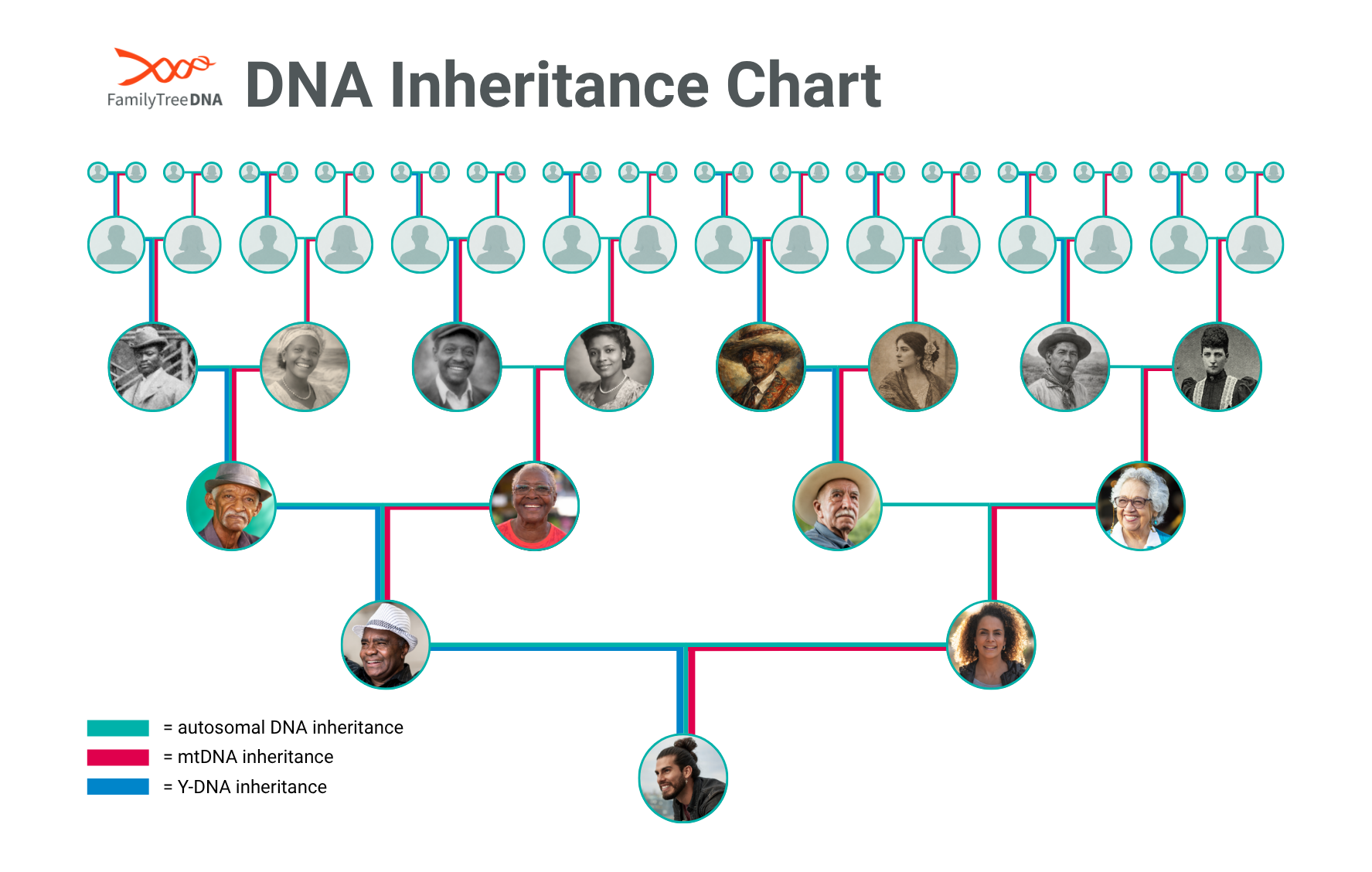
When autosomal DNA gets messy, Y-DNA simplifies things. And when maternal lines become difficult to trace through records alone, mtDNA can provide answers that traditional genealogy cannot.
Using Y-DNA to Confirm Paternal Ancestors
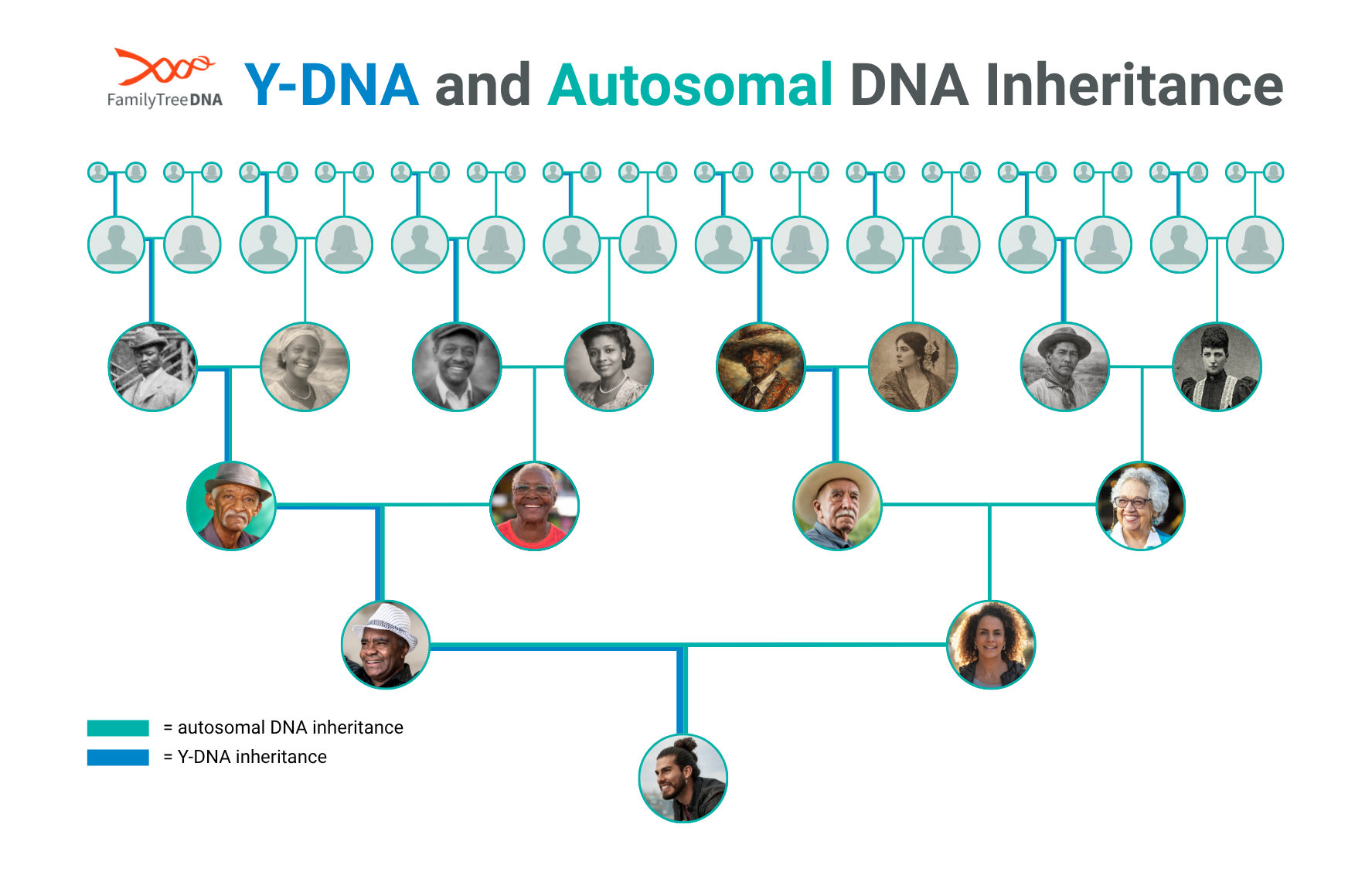
Y-DNA is especially useful for confirming direct paternal line relationships because it follows a single line of inheritance—from father to son—often aligning with surname lines. This makes it a powerful tool for cutting through ambiguity when autosomal DNA results are unclear.
When autosomal DNA matches suggest multiple possible connections, Y-DNA can help narrow the focus to your direct paternal line. If a match shares both Y-DNA and autosomal DNA with you, it may indicate that your most recent common ancestor is relatively recent and part of that direct line.
If the connection is less clear, you can use your Family Finder matches to look for patterns.
For example, you might search for matches who share surnames associated with your direct paternal line, including the surnames of spouses in that line. These patterns can help you identify which branch of your family the connection belongs to.
In cases involving unknown or misattributed parentage along the paternal line, Y-DNA can be especially valuable. By identifying matches who carry the same or related surnames—or who list those names in their ancestral information—you can begin narrowing down potential family lines and confirming your direct paternal ancestry.
Using mtDNA to Confirm Maternal Ancestors
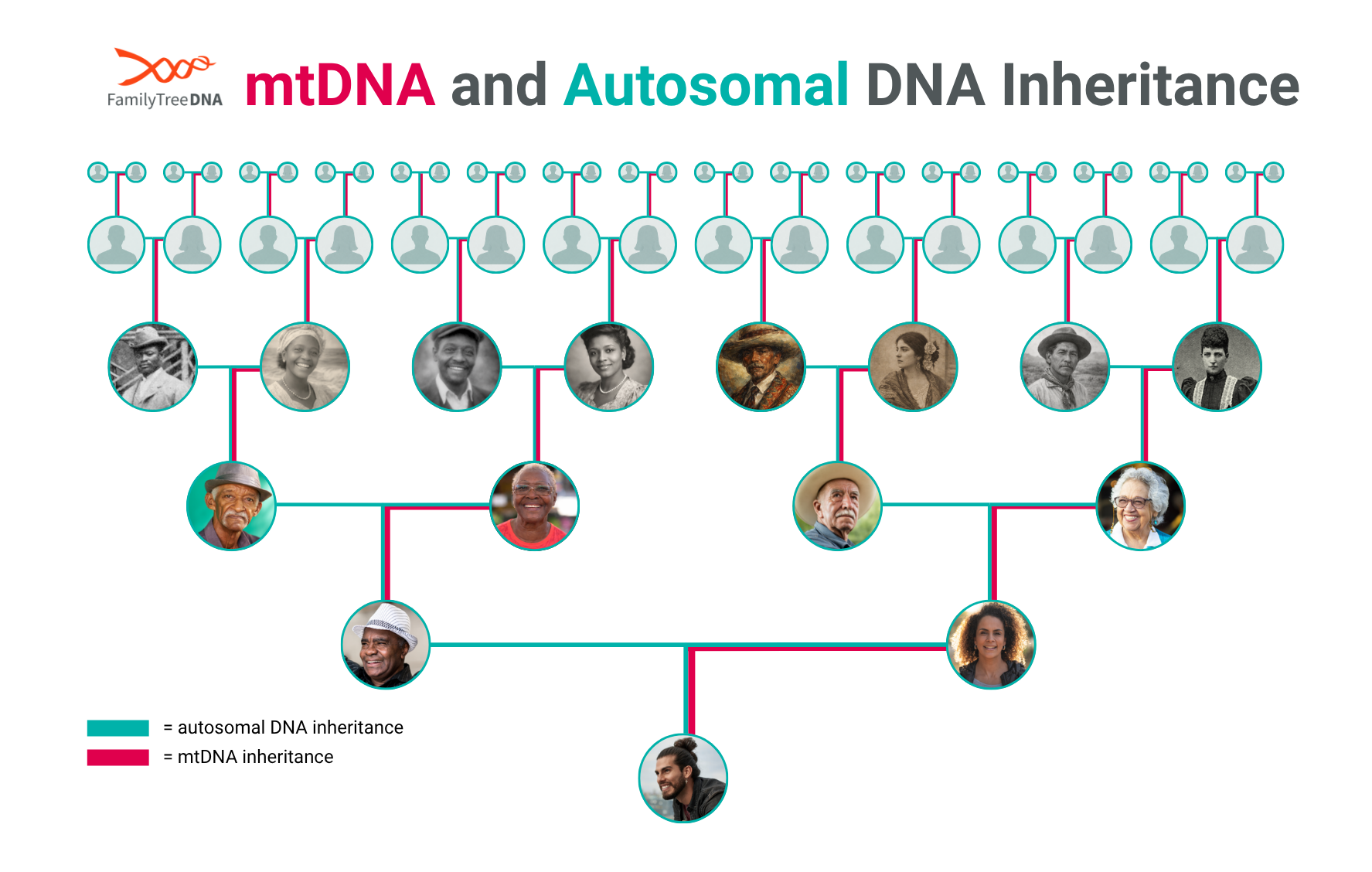
mtDNA is used to trace your direct maternal line, which is passed from mother to child across generations. Unlike Y-DNA, it does not follow traditional surname patterns, which can make maternal lines more difficult to trace using traditional genealogy alone.
When autosomal DNA matches provide limited clues about your maternal line, mtDNA can help confirm whether a connection follows your direct maternal ancestry. If a match shares both mtDNA and autosomal DNA with you, it may suggest a more recent common ancestor along that maternal line.
Because surnames often change each generation on the maternal side, you’ll need to rely more heavily on context from your Family Finder matches. This includes:
- reviewing family trees
- identifying shared locations
- looking for recurring surnames associated with both your direct maternal ancestors and their spouses
Although mtDNA typically reaches further back in time and may not always point to a recent ancestor, it can still play a critical role in confirming maternal line relationships—especially when combined with autosomal DNA and traditional research.
Leveraging the Advanced Matches Tool for Deeper Insights
The Advanced Matches tool allows you to compare your results across multiple types of DNA tests, helping you identify connections that may not be obvious when looking at each test individually.
By combining autosomal DNA with Y-DNA or mtDNA results, you can narrow down which ancestral line a match belongs to and gain deeper insight into your shared ancestry.
What is Advanced Matches?
The Advanced Matches tool lets you search for individuals who match you across more than one type of DNA test—such as both autosomal DNA (Family Finder) and Y-DNA or mtDNA.
When a match appears across multiple tests, it can indicate that your shared ancestor is on a more specific line of your family tree. For example:
- A match on both autosomal DNA and Y-DNA may suggest a connection on your direct paternal line
- A match on both autosomal DNA and mtDNA may suggest a connection on your direct maternal line
In some cases, this can point to a relatively recent common ancestor.
However, it’s important to remember that autosomal DNA reflects all of your ancestral lines. This means a match could appear across multiple tests for different reasons—for example, a closer relationship on one line and a more distant connection on another.
How to Use Advanced Matches
To use Advanced Matches, you can filter your results to identify individuals who match you on multiple tests at the same time.
This allows you to:
- Focus on matches that are more likely to be relevant to a specific ancestral line
- Reduce the number of potential connections you need to evaluate
- Identify patterns that may not be visible when reviewing each match list separately
What You’ll Find in Advanced Matches
After running an Advanced Matches search, you’ll see a table of results along with several filtering options to help you focus on the most relevant matches.
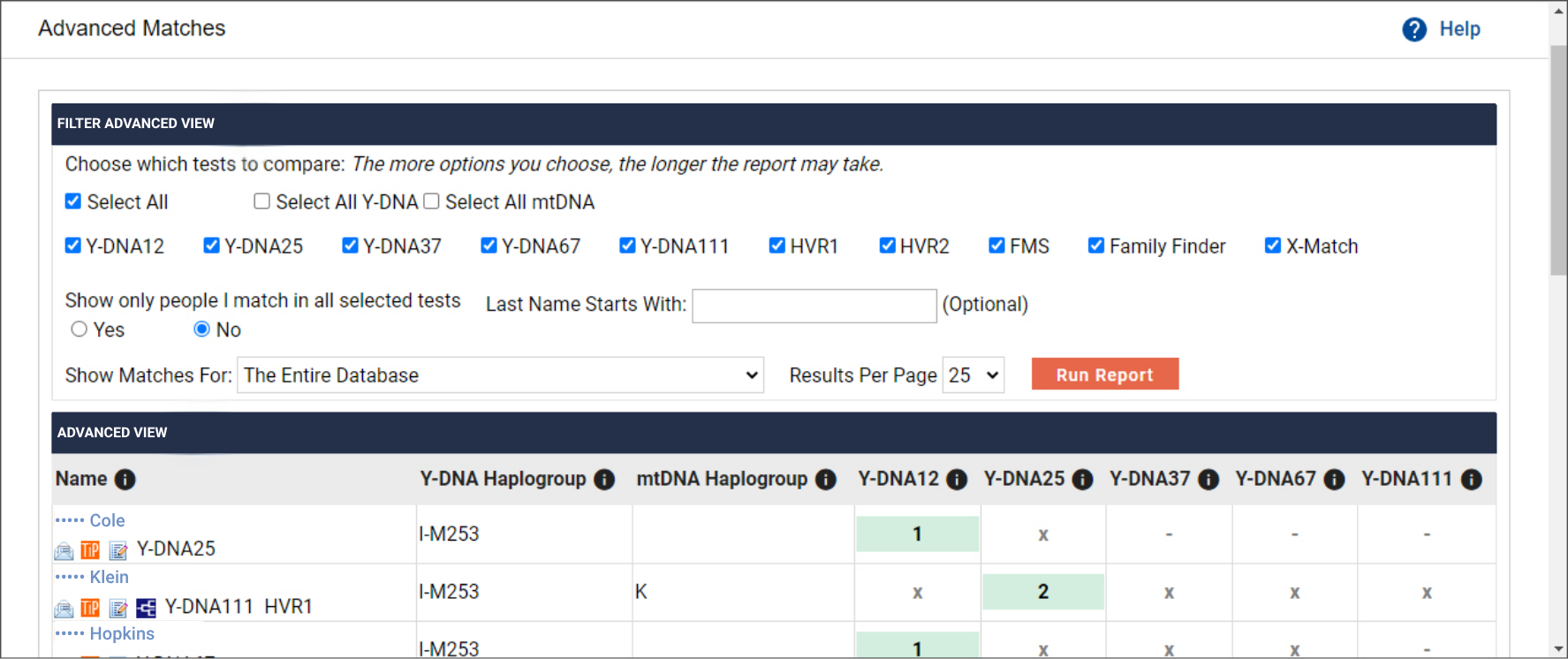
Here are the key features you’ll find on this page:
- Test Type Filters: Select which tests to compare, including Family Finder (autosomal DNA), Y-DNA, and mtDNA. Your available options depend on which tests you’ve taken.
- Match Across Multiple Tests: Filter to show only individuals who match you on all selected tests, helping you identify connections that may be more relevant to a specific ancestral line.
- Surname Filter: Narrow your results by searching for matches with specific last names, which can be especially useful when researching direct paternal or maternal lines.
- Project Filter: If you belong to a Group Project, you can choose to view matches within that project or across the entire database.
- Match List Overview: Each result includes key details such as your match’s name (or private status), available contact options, family tree links, and testing levels.
- Haplogroups: Displays Y-DNA and mtDNA haplogroups for your matches, when available, helping you identify shared direct-line ancestry.
- Genetic Distance & Relationship Range: Shows how closely you match across Y-DNA, mtDNA, or autosomal DNA, depending on the tests being compared.
After running an Advanced Matches search, you’ll see a list of individuals who meet your selected criteria. From there, you can begin reviewing their profiles, family trees, and shared match information to better understand how you may be connected.
Next Steps After Finding a Match in Advanced Matches
Finding a match across multiple tests is just the starting point. To confirm how you’re related, you’ll need to combine this information with additional analysis.
This typically involves using Family Finder tools alongside traditional genealogy research:
- Family Matching: Helps determine whether matches belong to your maternal or paternal side
- In Common With (ICW) / Not In Common With (NICW): Identifies which matches are related to each other
- Chromosome Browser: Confirms shared DNA segments between matches
- Matrix: Compares multiple matches at once to identify shared connections
By using these tools together, you can confirm whether a match identified through Advanced Matches connects to your direct paternal or maternal line. From there, you can narrow down your most recent common ancestor and better understand how that match fits into your family tree.
Recruiting Testers for Direct Line Research
Autosomal DNA can also help you identify individuals who may be strong candidates for additional testing, allowing you to expand your research into specific paternal or maternal lines.
For Y-DNA, this means finding matches who are connected to your direct paternal line—or to other paternal lines in your family tree, such as a maternal grandfather’s line. Because Y-DNA often follows surname patterns, reviewing match surnames, family trees, and existing Y-DNA haplogroups can help you identify the best candidates for testing.
For mtDNA, the approach is similar but relies less on surnames. Instead, you’ll focus on family trees, shared ancestral lines, and known maternal connections to identify individuals who descend from the direct maternal line you’re researching. As more mtDNA haplogroup data becomes available alongside autosomal results, this process will become even more effective.
By identifying and recruiting the right testers, you can extend your research beyond your own DNA results—helping you confirm direct-line ancestry, explore new branches of your family tree, and uncover connections that may not be visible through autosomal DNA alone.
Frequently asked Questions
Does autosomal DNA ever replace genealogy?
No, autosomal DNA does not replace traditional genealogy—it complements it by identifying genetic connections that must be confirmed with historical records.
Will a Y-DNA or mtDNA test help if I’ve already taken an autosomal DNA test?
Yes, Y-DNA and mtDNA tests can provide more focused insights into your direct paternal and maternal lines, helping you confirm specific ancestors and narrow down connections that autosomal DNA alone cannot resolve.
Autosomal DNA is a powerful starting point for genealogy, but it becomes even more effective when combined with traditional research, Y-DNA, and mtDNA testing.
By using these tools together, you can move beyond identifying relatives to confirming relationships, narrowing down ancestral lines, and uncovering connections that might otherwise remain hidden. Each method contributes a different piece of the puzzle—working together to give you a more complete and accurate picture of your family history.
Next, we’ll explore the autosomal DNA transfer option and how you can use existing DNA results to access Family Finder tools and expand your research.
