By: Katy Rowe-Schurwanz
Explore the Autosomal DNA Series
Start with the basics, then continue through the series to learn how autosomal DNA works, what your results mean, and how to use them in genealogy.
- What Is Autosomal DNA?
- How Autosomal DNA Testing Works
- Interpreting Your Family Finder Matches (current article)
- Understanding DNA Ethnicity and Origin Results
Your Family Finder results include more than just matches—here’s how to understand the DNA connections behind them.
Understanding your DNA matches is one of the most important steps in using autosomal DNA for genealogy. Your Family Finder results connect you with genetic relatives and provide insights into how you may be related.
In this article, you’ll learn what DNA matches are, how they are measured, and how to use tools like the Matrix and Chromosome Browser to better understand your results and build your family tree.
What Are Family Finder Results?
Family Finder results show your DNA matches—people who share segments of autosomal DNA with you, indicating a common ancestor. These matches are measured in centimorgans (cM), which help estimate how closely you are related.
Together, your matches and shared DNA data provide the foundation for exploring your family history using genetic genealogy.
What Reports Are Included in Family Finder Results?
Family Finder results are available to anyone who has taken the Family Finder autosomal DNA test or uploaded their DNA data through an autosomal transfer.
If you have transferred your DNA results to FamilyTreeDNA from another testing service, you can upload your data for free and gain access to your DNA matches and the Family Finder Matrix. Additional features, including more advanced tools, become available after unlocking your full results.
This flexible access allows you to begin exploring your DNA matches and decide how you would like to continue your research.
Family Finder includes the following reports and tools:
Matches* | Matrix* | Chromosome Browser | myOrigins** | Chromosome Painter** | ancientOrigins** | Y-DNA Haplogroup**
(* Available with autosomal transfer)
(** Covered in the next article in this series)
Understanding Your DNA Matches
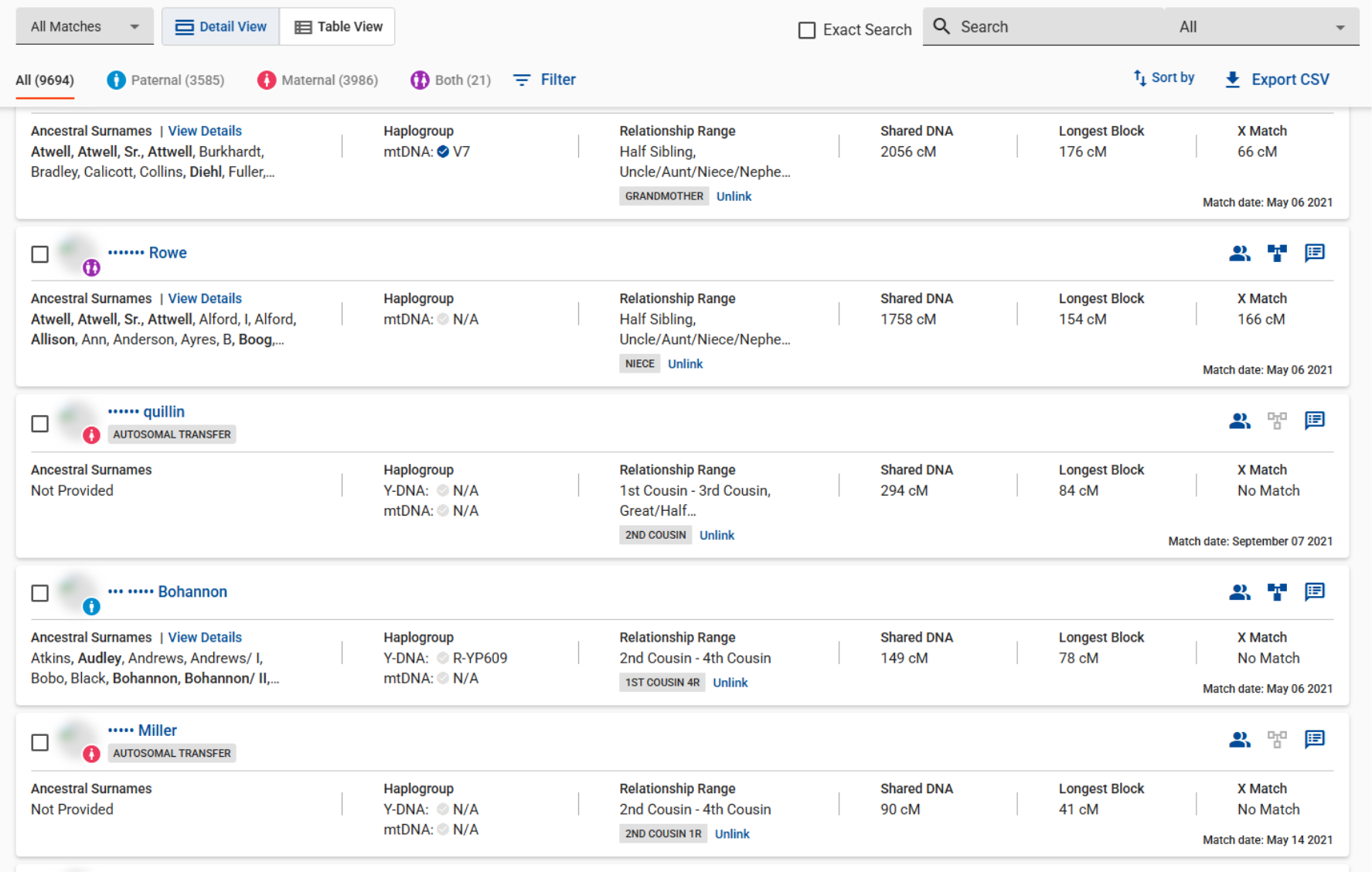
Family Finder matches are the foundation of your autosomal DNA results. These matches represent other individuals in the database who share segments of DNA with you, indicating a potential common ancestor. Understanding how these matches are identified and what they mean allows you to uncover relationships, confirm your family tree, and make new genealogical discoveries.
What is a DNA match?
We compare your autosomal DNA to everyone else who has taken the Family Finder test or uploaded autosomal DNA results to our database.
Using an algorithm that evaluates both the longest shared DNA segment and total shared centimorgans, we identify individuals who share a common ancestor with you within approximately five to six generations.
What Are Centimorgans (cM) in DNA Matches?
Centimorgans are the unit used to measure how much DNA you share with a match. The more centimorgans you share with someone, the more closely related you are likely to be.
Close relatives, like parents or siblings, share a large amount of DNA—often thousands of centimorgans—while more distant relatives share much smaller amounts. Because autosomal DNA is passed down through a process called recombination, the exact amount of shared DNA can vary, especially for distant matches. This is why DNA relationships are usually given as a range rather than a single prediction.
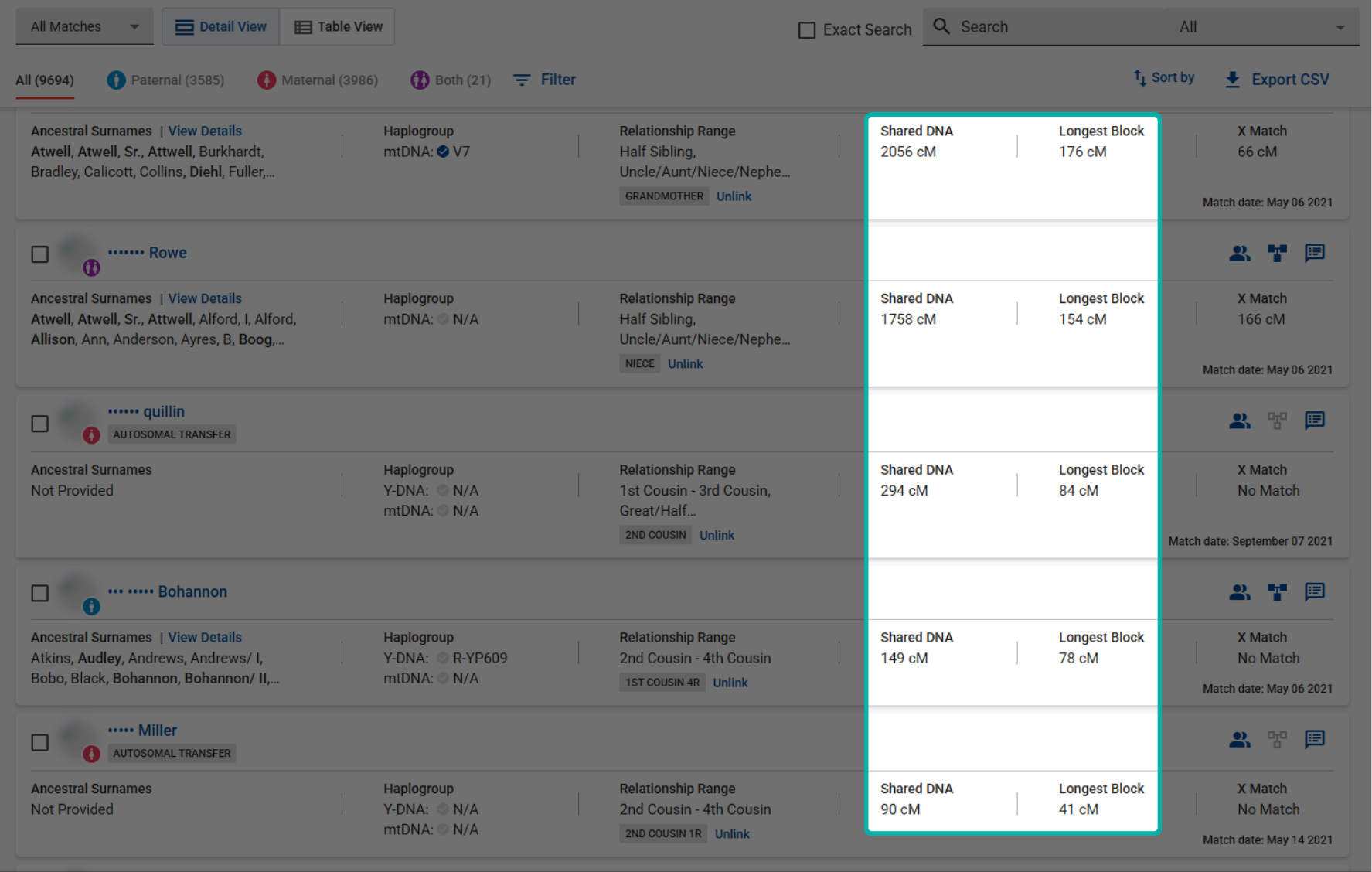
FamilyTreeDNA reports the number of centimorgans you share with each match to provide transparency into your results. While a predicted relationship offers a helpful starting point, the shared DNA measurement allows you to evaluate your matches more directly and make more informed decisions in your genealogical research.
How Are DNA Match Relationships Predicted?
The chart below, from DNA Painter’s Shared cM Project, shows the typical ranges of DNA shared between different types of relationships.
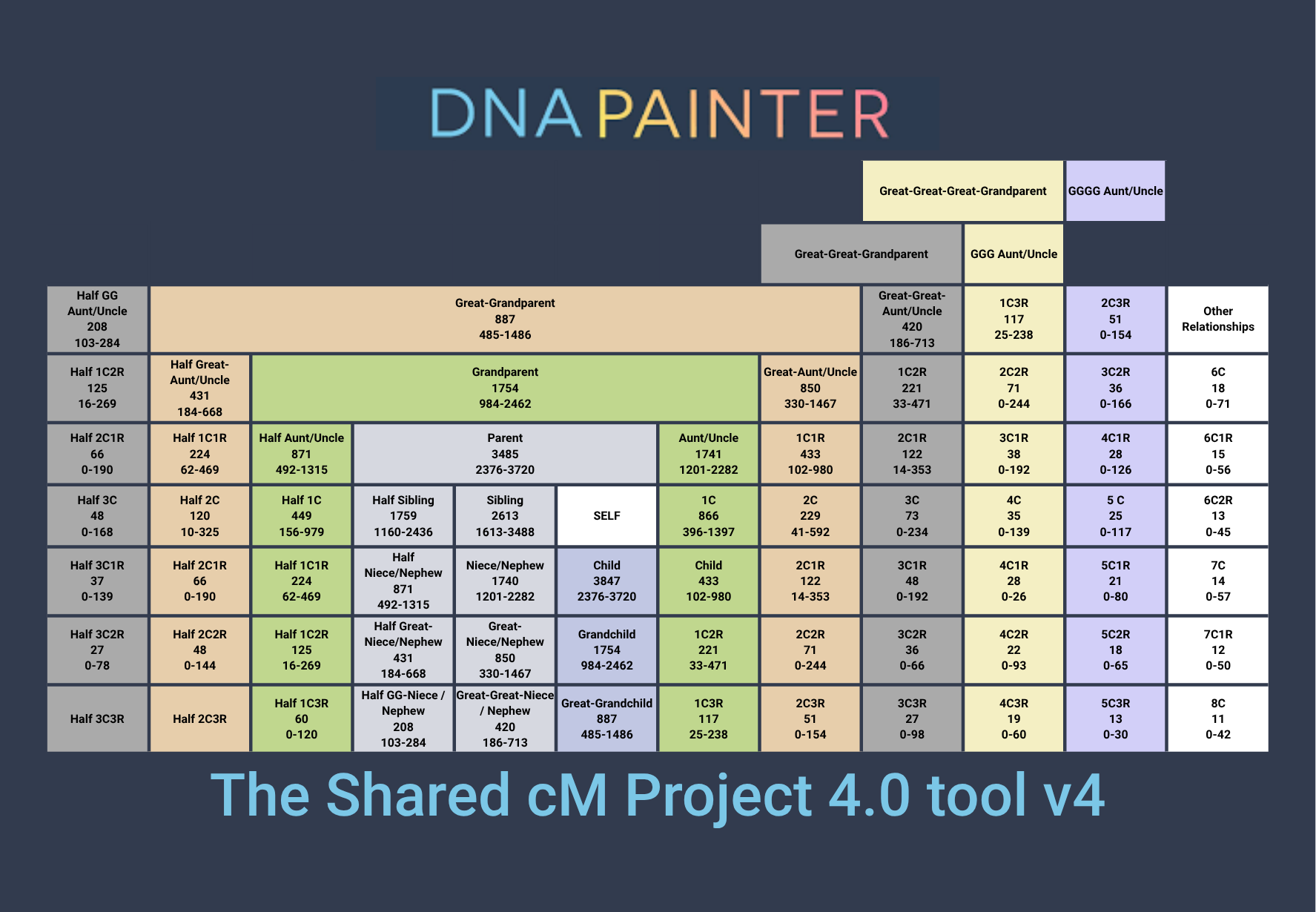
There is a typical range of DNA shared between different types of relationships. However, some relationships may share the same typical amount of DNA as other relationships.
For example, you’ll typically have the same amount of DNA with your parent as you do with your child. Similarly, relationships like grandparent, aunt or uncle, half-sibling, and niece or nephew can all fall within overlapping ranges of shared DNA.
Because of this, FamilyTreeDNA provides a predicted relationship range for each match that contains various possibilities.
Autosomal DNA is passed down by being divided in half each generation, and it undergoes random recombination as it is inherited. This means the exact amount of DNA you share with a relative can vary. As a result, your predicted relationship may sometimes appear more distant—or, in cases like endogamy or cousin marriages, closer—than the true relationship.
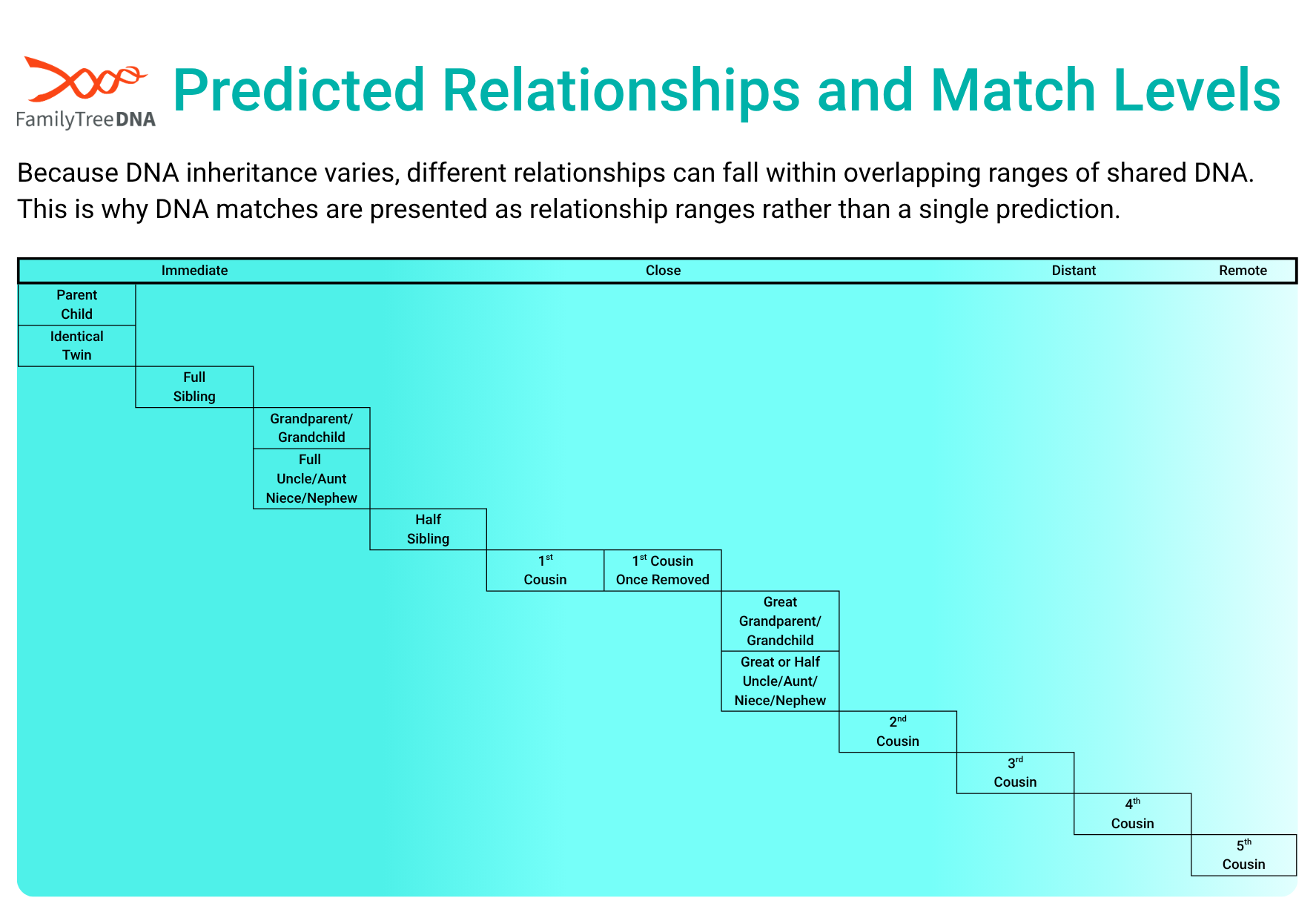
As you look at the chart above, you’ll notice that closer relatives share more DNA and fall within narrower ranges, while more distant relatives share less DNA and have wider, overlapping ranges.
The likelihood of matching a relative also decreases with each generation. You will almost always match immediate relatives, such as parents, siblings, and first cousins. You are also very likely to match second and third cousins.
However, as relationships become more distant, the chances drop significantly. You may have about a 50% chance of matching a fourth cousin, around a 10% chance of matching a fifth cousin, and less than a 2% chance of matching a sixth cousin or more distant relative.
What Is Endogamy in DNA Matches?
In some populations, people have historically married within the same community over many generations. This is known as endogamy.
This is common in populations with long histories of close-knit communities, where many individuals may share the same ancestors multiple times.
Because of this shared ancestry, individuals from these populations may share more DNA with each other than expected. As a result, relationship predictions can appear closer than they actually are.
For example, distant relatives such as 3rd to 5th cousins may be predicted as closer relationships, like 2nd to 3rd cousins.
Endogamy can also increase the likelihood of matching more distant relatives than usual, sometimes beyond the typical five to six generation range for autosomal DNA.
Identical by Descent vs Identical by Chance
Most of your DNA matches are what genetic genealogists call Identical by Descent (IBD). This means you and your match share DNA that was inherited from a common ancestor.
In other words, these matches represent real family connections and can help you discover or confirm relationships in your family tree.
Some matches, however, may be Identical by Chance (IBC). These matches share small segments of DNA with you, but not because of a recent common ancestor. Instead, the shared DNA is the result of random recombination over many generations.
In general, smaller DNA segments—especially among more distant matches—are more likely to be Identical by Chance and less useful for genealogical research.
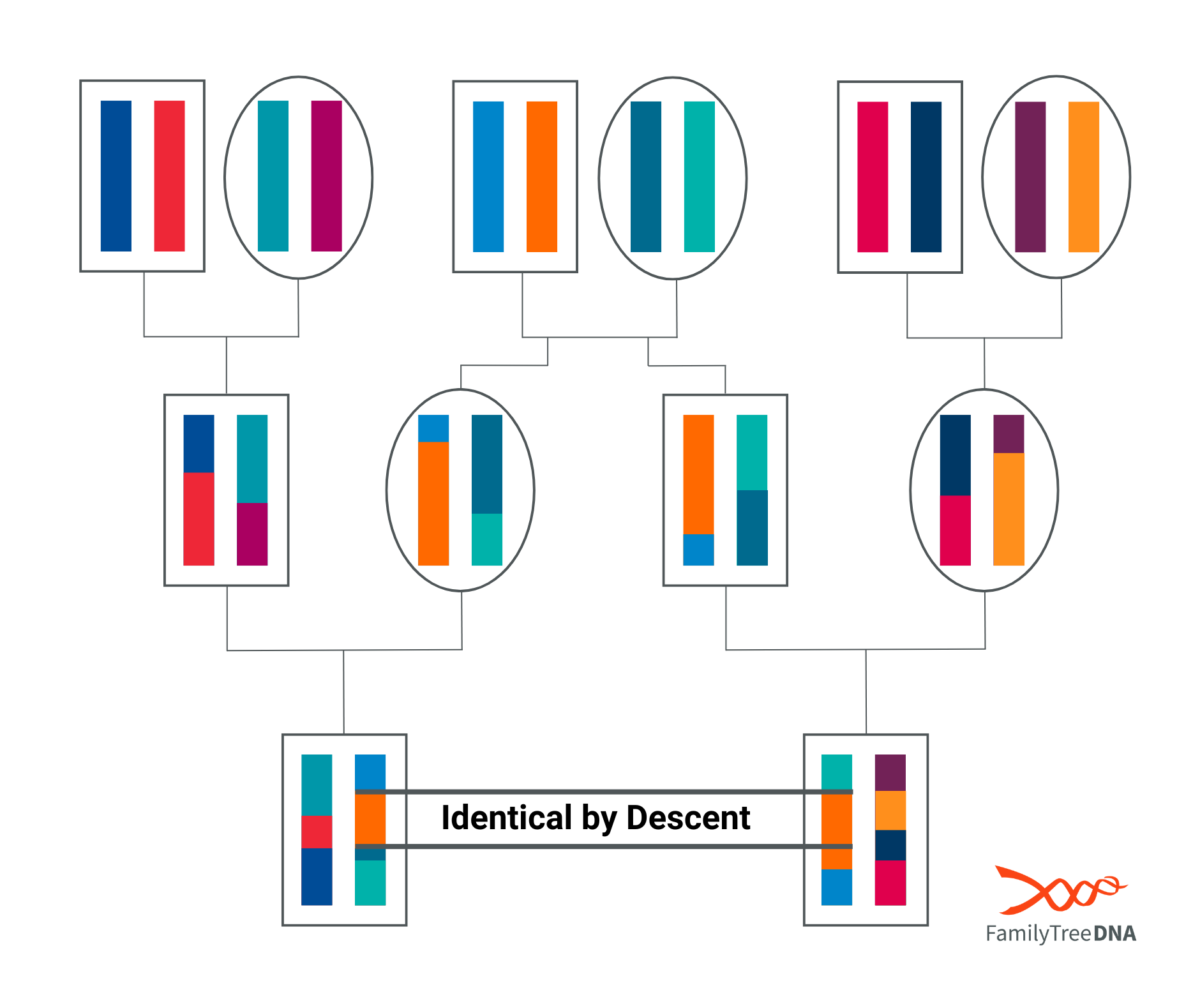
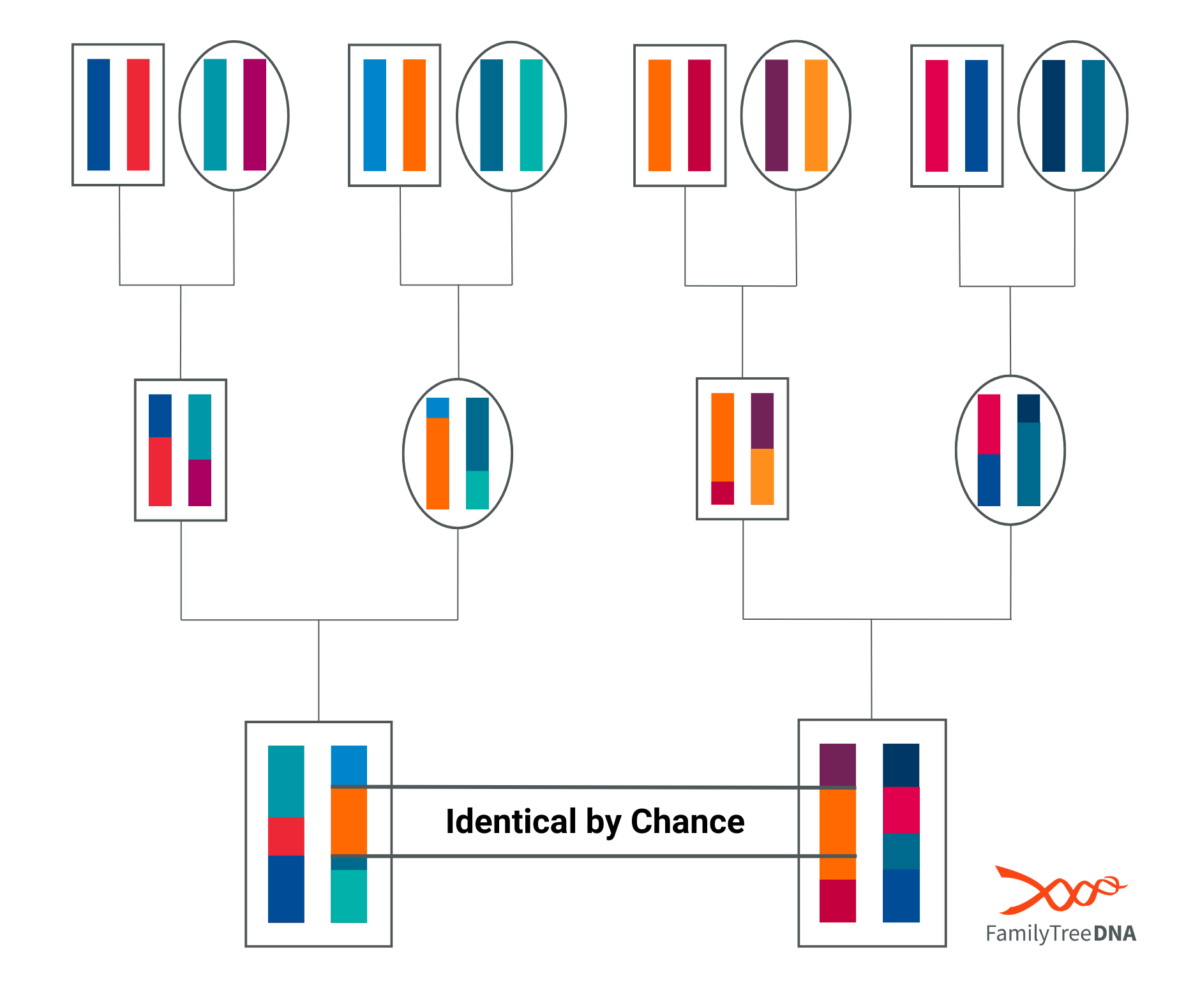
However, there are exceptions. In cases of endogamy or pedigree collapse, individuals may share DNA from multiple common ancestors. This can create patterns that appear similar to Identical by Chance, even though the matches do reflect real shared ancestry.
Testing close relatives, such as parents, can help clarify your matches. True Identical by Descent matches will also be shared with one of your parents, while Identical by Chance matches typically will not.
How to Tell Which Side of Your Family a DNA Match Is From
Once you’ve identified your DNA matches, the next step is determining how they connect to your family tree. Family Matching helps you organize your matches by identifying whether they are related to you on your maternal or paternal side.
What is Family Matching?
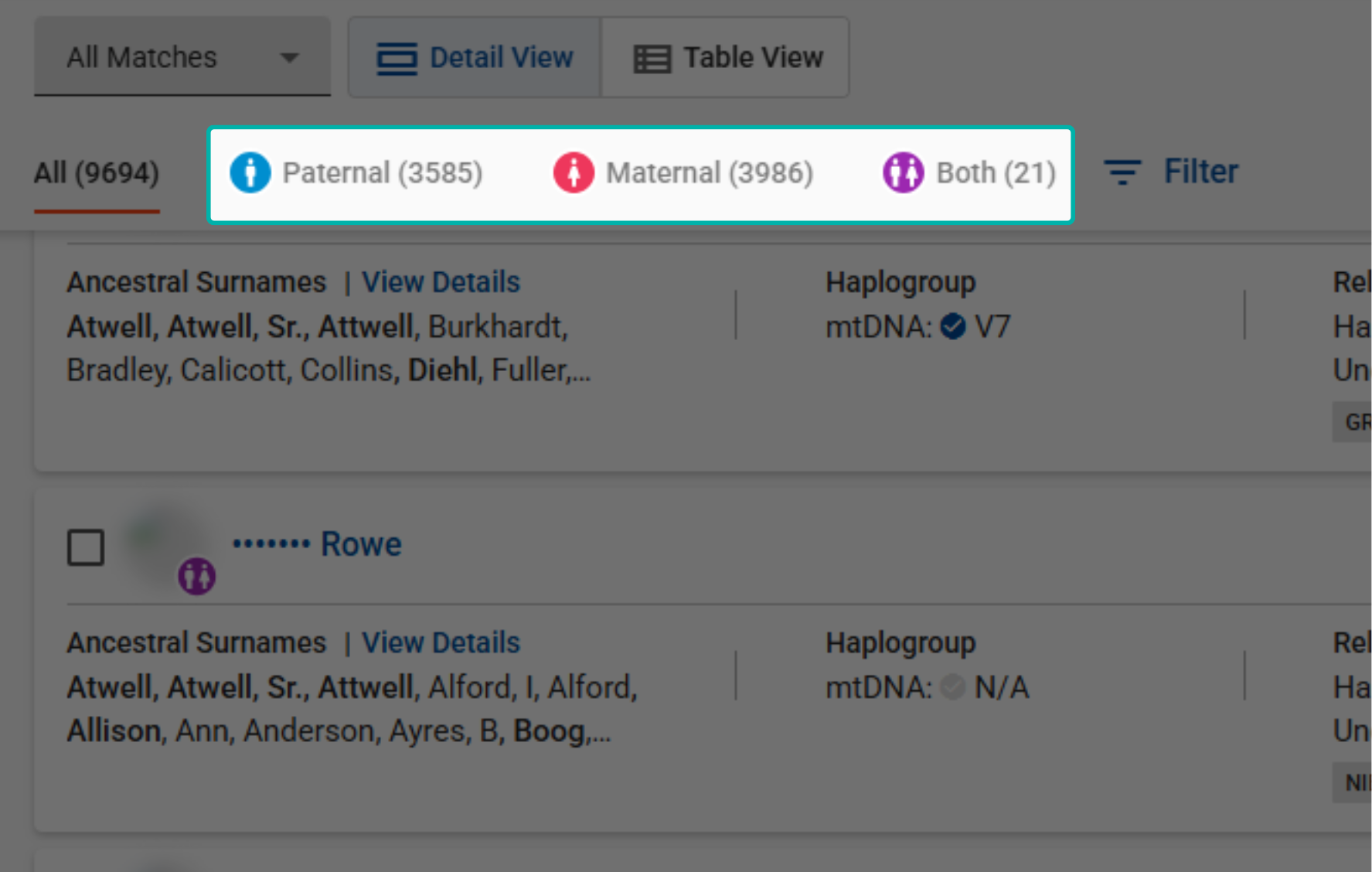
Family Matching is a tool that helps determine whether a DNA match is related to you on your paternal side, maternal side, or both.
By grouping matches based on shared DNA, Family Matching provides a clearer picture of how your matches connect to your family tree.
How Does Family Matching Work?
Family Matching works by comparing the DNA segments you share with known relatives to the segments you share with your other matches.
When you link a known relative to your family tree, FamilyTreeDNA can identify which portions of your DNA came from your mother or your father. It then compares those segments to your other matches.
If a match shares the same segment as a relative on your paternal side, they are assigned to your paternal group. If they share a segment with a maternal relative, they are assigned to your maternal group.
How to Use Family Matching
To use Family Matching, you will need to link your DNA matches to individuals in your family tree.
FamilyTreeDNA integrates with the MyHeritage family tree system, allowing you to connect your matches to specific people in your tree. Once linked, Family Matching uses those relationships to group your matches into:
- Paternal matches
- Maternal matches
- Both sides
The closer your relationship to the linked relative, the more matches will be assigned. For example, linking a parent will result in more matches being grouped than linking a more distant relative.
Why Some DNA Matches Aren’t Assigned
Not all matches will be grouped into paternal or maternal categories.
This can happen for two main reasons:
- The shared DNA segments may be too small to meet the threshold used for Family Matching
- The match may be Identical by Chance rather than Identical by Descent
Even if you have linked close relatives, some matches—especially more distant ones—may remain unassigned.
What Are X-Matches in DNA Testing?
Some of your DNA matches may be labeled as X-Matches, meaning you share at least one segment of 10 centimorgans or more on the X chromosome.
The X chromosome follows a unique inheritance pattern. Genetic males inherit their X chromosome only from their mother, while genetic females inherit one X chromosome from each parent.
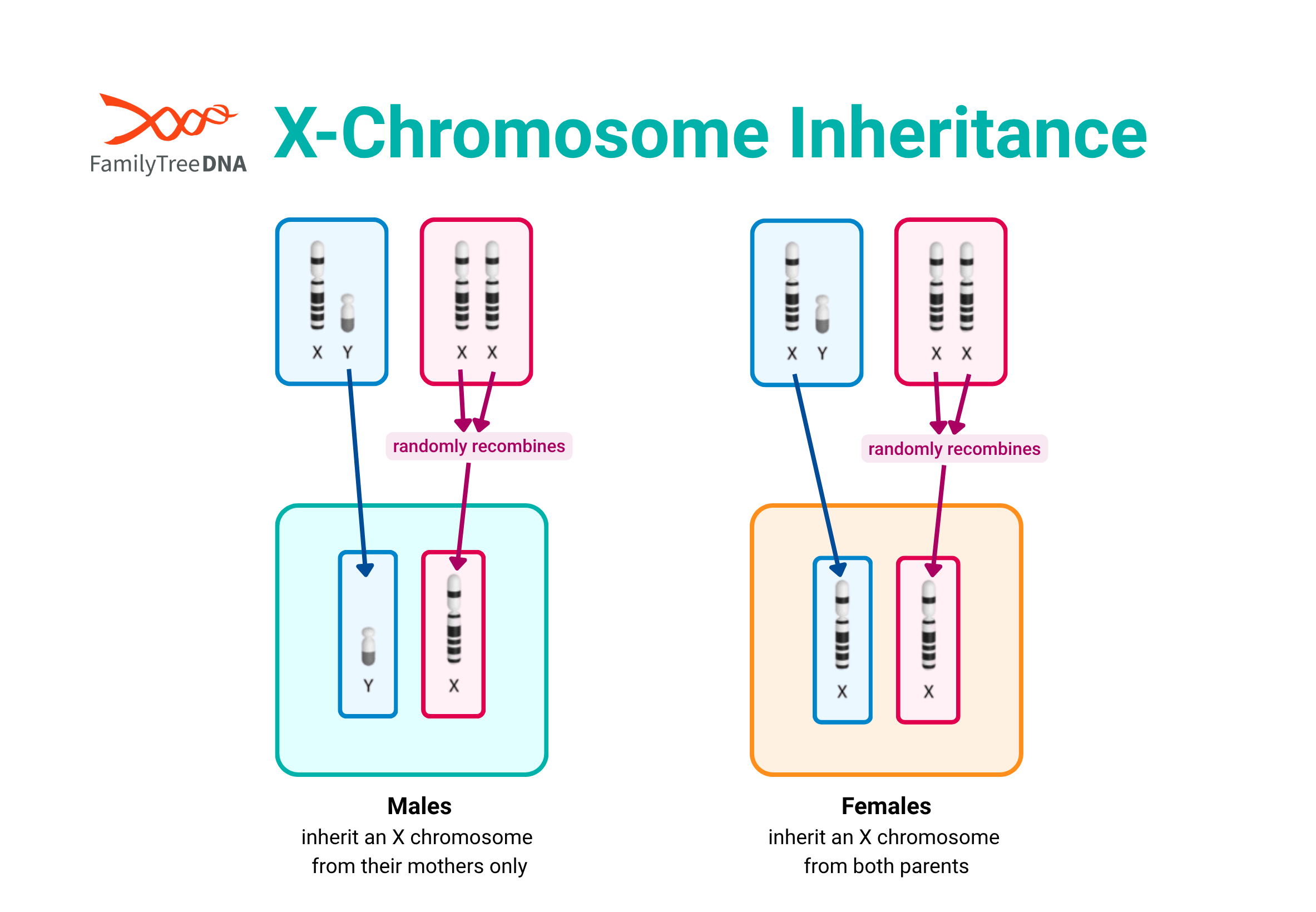
Because of this, X-DNA is passed down through fewer ancestral lines than autosomal DNA.
This makes X-Matching especially useful for narrowing down which side of your family a match may come from. In some cases, it can help you eliminate entire branches of your family tree when searching for a common ancestor.
FamilyTreeDNA includes X-Matching as part of your results to provide additional context for your DNA matches. While not every match will include shared X-DNA, when it does appear, it can be a valuable clue in your research.
For a deeper look at how X-DNA is inherited and how to use it in genealogy, see Roberta Estes’ guide, “X Marks the Spot: Inheritance of the X Chromosome”
Tools and Filters for Analyzing DNA Matches
The Matches page includes several tools to help you sort, filter, and analyze your DNA matches:
- Match Level: Filter matches by relationship range, from immediate relatives to distant cousins.
- View Options: Switch between detailed and table views depending on how much information you want to see.
- Family Matching Buckets: Group matches into paternal, maternal, or both sides based on linked relatives.
- Shared Family Trees: View your match’s family tree to identify common ancestors.
- Ancestral Surnames: Compare surnames in your trees to find potential connections.
- In Common With: See which matches you and another person share.
- Chromosome Browser Selection: Select matches to compare shared DNA segments.
- Search and Sort: Quickly find matches by name, surname, or DNA data.
- Filters: Narrow results by tree availability, test type, or new matches.
Interpreting your DNA matches involves combining multiple tools and insights. As you become more familiar with these features, you’ll be able to better understand how your matches connect to your family tree.
For a step-by-step walkthrough of how to explore your matches and use these tools together, see our guide, “How to Understand Family Finder DNA Matches”
Using the Family Finder Matrix
After reviewing your DNA matches, you may begin to notice patterns between them. The Family Finder Matrix helps you explore these connections by allowing you to compare multiple matches at once and see how they relate to each other.
What Is the Family Finder Matrix?
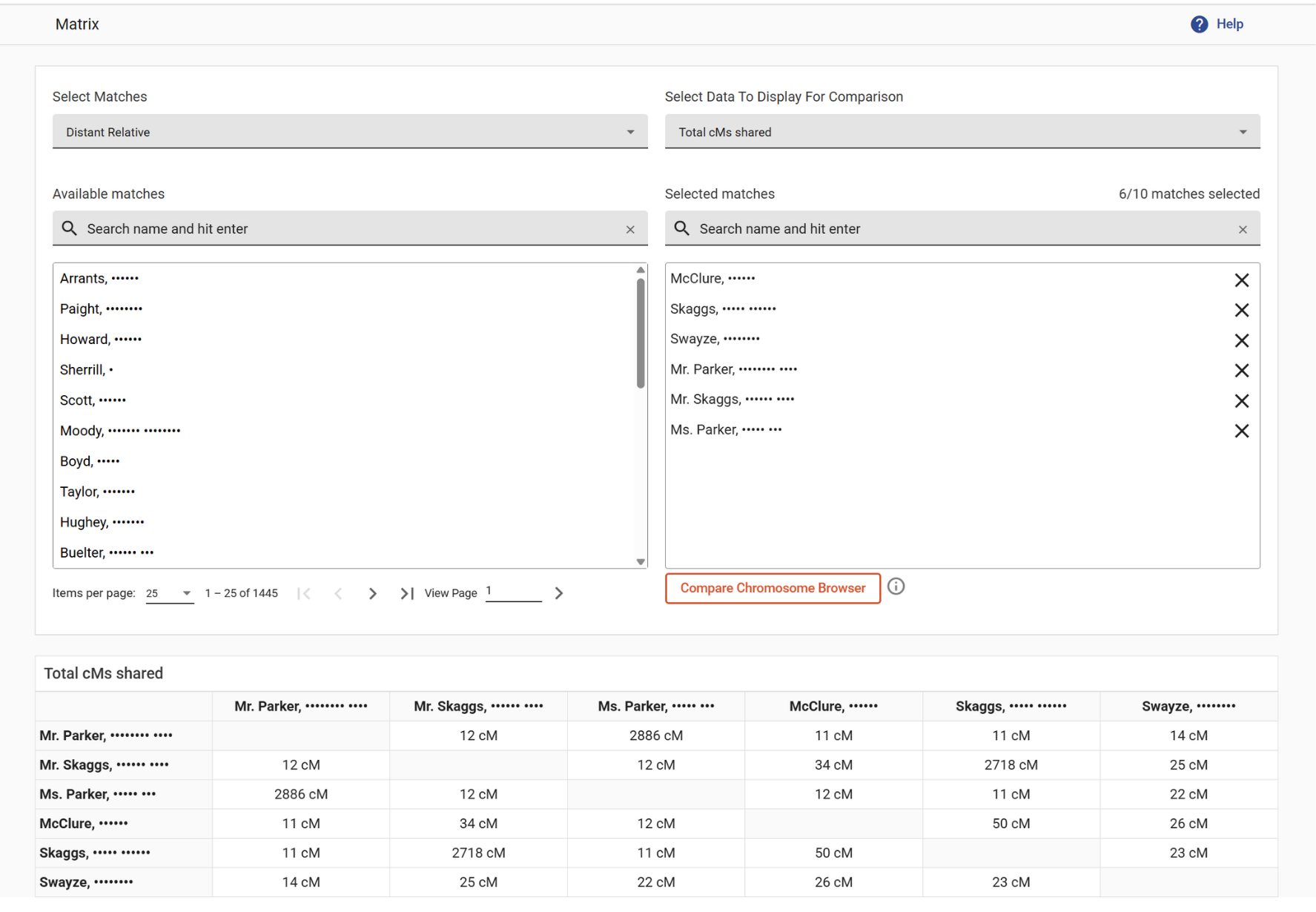
The Family Finder Matrix is a tool that allows you to compare multiple DNA matches at once to see whether they also match each other.
By selecting a group of matches, the Matrix helps you quickly identify which individuals may be part of the same genetic network.
What Does the Matrix Show?
When you select matches to compare, the Matrix displays a grid showing whether each person matches the others in the group.
A marked square indicates that two matches share DNA with each other, while an empty space indicates that they do not.
This allows you to quickly see patterns of shared matches across a group.
How to Use the Matrix to Compare DNA Matches
The Matrix is most useful when working with a group of matches you suspect may share a common ancestor.
For example, you might select several matches who:
- are assigned to the same parental side using Family Matching
- share similar surnames or family tree information
By comparing them in the Matrix, you can determine whether they also match each other, helping you identify potential match groups.
Matrix Limitations and Triangulation Explained
While the Matrix is useful for identifying groups of matches who may be related, it does have important limitations.
The Matrix shows whether your selected matches share DNA with each other, but it does not show where that DNA is located on your chromosomes. This means that even if a group of matches all match each other, they may not share the same DNA segment or the same common ancestor.
For example, some matches may be related to you through different branches of your family, or may share DNA segments that overlap but do not originate from the same ancestor. This is especially important when working with distant matches or in cases of endogamy.
The Matrix can also be helpful when working with matches that are not assigned to your maternal or paternal groups through Family Matching, allowing you to identify potential relationships that are not yet fully categorized.
To confirm whether a group of matches shares the same DNA segment—known as triangulation—you will need to use the Chromosome Browser.
Using the Chromosome Browser
The Chromosome Browser allows you to visually explore where your DNA matches align across your chromosomes, and where they overlap which can be a starting point for further analysis. This is a tool that is useful for genetic genealogists to confirm if matches share a specific common ancestor.
What is the Chromosome Browser?
The Chromosome Browser is a visualization tool that allows you to see where your DNA matches align with you across your chromosomes.
By comparing multiple matches at once, you can identify shared DNA segments and begin to understand how your matches may be related to each other and to you.
What Does the Chromosome Browser Show?
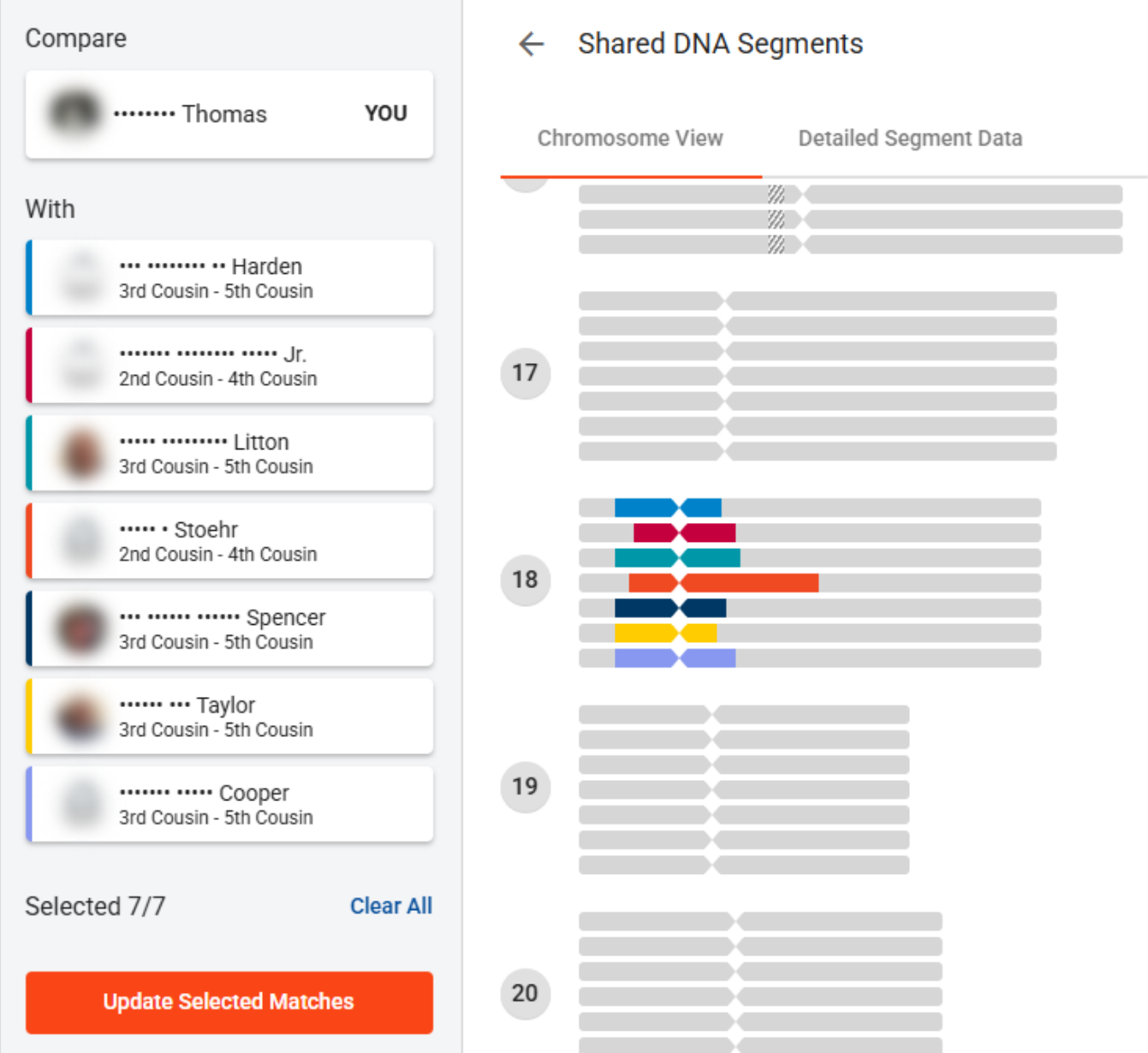
When you select matches to compare, each match is assigned a different color. Their shared DNA segments are then displayed across your chromosomes, allowing you to see where matches overlap.
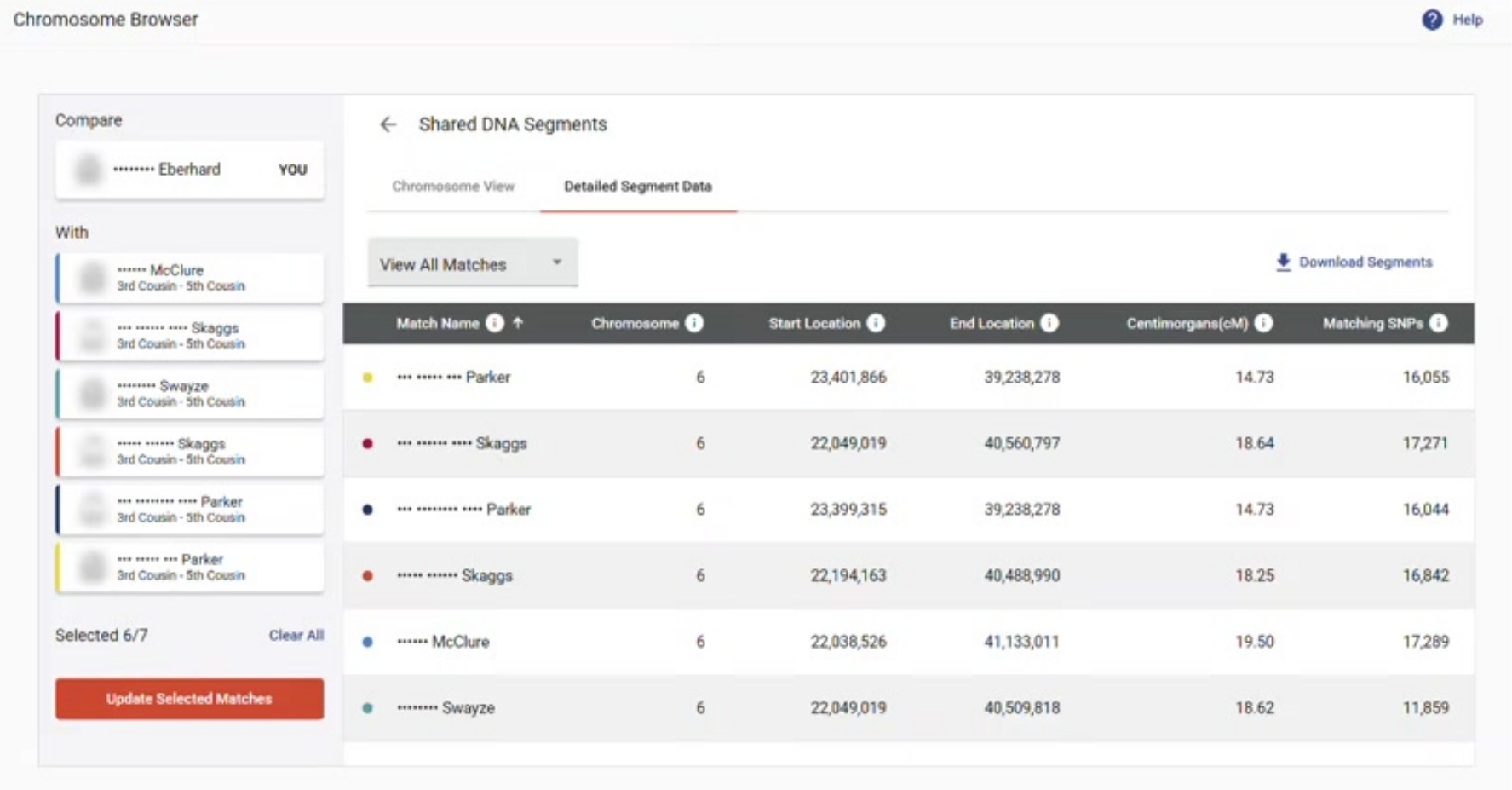
You can also view detailed segment data for each match, including the chromosome location and size of each shared segment.
How to Use the Chromosome Browser in Genetic Genealogy
The Chromosome Browser is commonly used to help identify groups of matches who may share a common ancestor.
By comparing multiple matches, you can begin to see patterns in how DNA is shared, which can support your genealogical research and help confirm relationships in your family tree.
Why Overlapping DNA Segments Are Not Triangulation
When two matches share DNA with you on the same chromosome segment, it does not necessarily mean they share that DNA with each other.
In other words, overlapping segments alone do not confirm a shared common ancestor. This is known as triangulation, and it requires additional comparison between matches.
You can learn how to confirm triangulated groups using the Chromosome Browser and the Family Finder Matrix in our Matrix update announcement.
Frequently Asked Questions About DNA Matches
What are centimorgans in DNA matches?
Centimorgans measure how much DNA you share with a match. Higher cM values generally indicate a closer relationship, while lower values suggest more distant relatives. These values are used to estimate a range of possible relationships.
What does a 22% DNA match mean?
Some DNA testing services report matches as a percentage, such as 22%, to estimate how closely two people are related. At FamilyTreeDNA, relationships are instead predicted using the total amount of shared DNA measured in centimorgans (cM), along with the longest shared DNA segment.
How do I test my X chromosome?
You don’t need a separate test. The X chromosome is included in the Family Finder autosomal DNA test. If you share at least one segment of 10 cM or more on the X chromosome with a match, it may be labeled as an X-Match.
Is the Chromosome Browser included with an autosomal transfer?
Autosomal transfers provide free access to your DNA matches and select tools, such as the Family Finder Matrix. More advanced tools, including the Chromosome Browser, become available after unlocking your full results.
How can I tell which side of my family a DNA match is from?
You can use the Family Matching tool to group your matches into maternal and paternal categories. By linking known relatives to your family tree, FamilyTreeDNA can assign matches to the correct side based on shared DNA.
Understanding your DNA matches is the foundation for interpreting your Family Finder results. By learning how shared DNA is measured, how relationships are predicted, and how to use tools like the Matrix and Chromosome Browser, you can begin to identify connections and build your family tree with confidence.
With these tools, you now have a clearer understanding of how your matches fit into your family tree and how to begin exploring your relationships.
Next, we’ll explore your ancestral populations and origins reports, including myOrigins, Chromosome Painter, and Ancient Origins, and what they reveal about your ancestral background.
