What happens when an expert builds a family tree using DNA? Roberta Estes shares how genetic genealogy uncovered surprises and solved long-standing mysteries.
Genetic genealogy isn’t just about science—it’s about stories. We sat down with Roberta Estes, a member of our Research & Development Team, to learn how DNA has shaped their family tree and what advice they have for others exploring their roots.
How DNA Shaped My Family Tree
Every family tree begins somewhere—often with stories passed down through generations, handwritten notes, or memories shared at the kitchen table. For Roberta Estes, that starting point grew into a lifelong pursuit of discovery, fueled by both traditional genealogy and the early adoption of DNA testing.
What does your own family tree look like?
Today, my family tree includes thousands of people, but it didn’t start out that way. I’ve been building it, person by person, for years.
Like everyone, I began with what my family members knew. I recorded the family information, as much as they remembered, by hand on Family Group Sheets, but those memories only reached back a couple of generations.
Later, when I realized I needed help keeping track of families and people, I began using computer software and researching local records to expand my tree, adding ancestors, and learning about their lives.
Since then, my tree has blossomed and sometimes reaches back many generations. That said, I face frustrating brick walls which I continue to work on and look forward to solving. DNA has helped me break through several!
How did DNA testing influence the way you built or expanded it?
I began my own personal journey with DNA testing 25 years ago by testing my own mitochondrial DNA which descends from my mother’s matrilineal line. Soon, I realized that I needed more answers than my own DNA could provide.
The Estes family, my paternal line, had many questions about heritage and ancestors that could potentially be answered by Y-DNA testing, but as a female, I don’t carry a Y chromosome. I recruited male Estes family members to take Y-DNA tests. One thing was for sure, those pesky questions hadn’t been answered by traditional genealogical research due to missing and unavailable records.
Over the past 20+ years, we’ve constructed an Estes family tree enhanced by genetics that provides resolution to many long-standing questions about relationships and descent.
Family Tree Discoveries and Surprising DNA Results
DNA testing often answers questions researchers didn’t even know to ask. For Roberta Estes, it has revealed unexpected connections, clarified long-standing mysteries, and uncovered family stories that traditional records alone could never fully explain.
Who is the most interesting ancestor you’ve uncovered in your family tree?
That’s a tough question because they are ALL so interesting. My favorite ancestor is probably the one I’m working on at the time, unless they are being “difficult.” Although, I seem to always be saying, “I had no idea…” about some juicy tidbit unearthed about an ancestor. That’s the beauty of continuing our research.
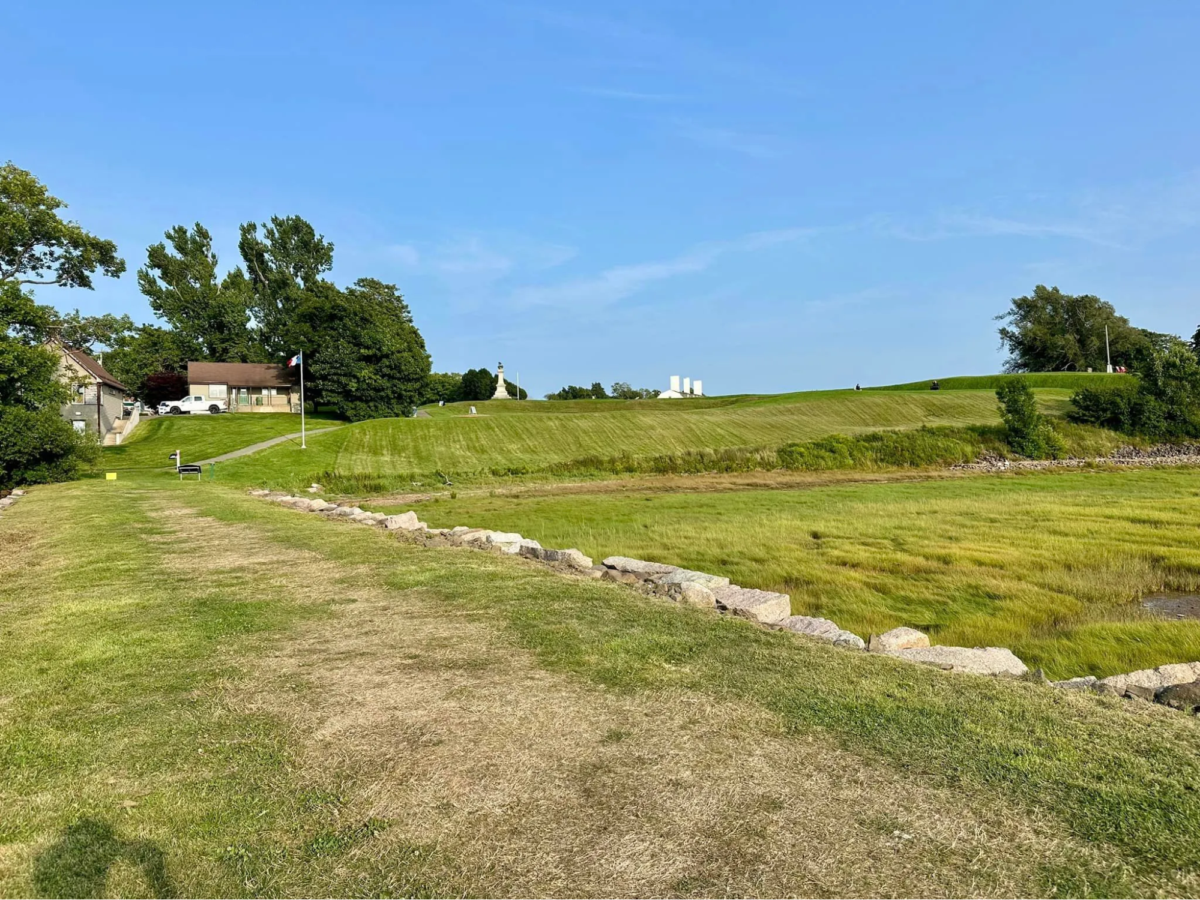
Recently, I discovered that my ancestor, Jean Blanchard, originally owned the land in Annapolis Royal, Nova Scotia, where the wharf I visited in 2024 would one day stand. The Acadians were expelled from Nova Scotia in 1755, being forced to board ships by walking down the wharf that stood on Jean’s original land – including his own grandchildren.
Hopefully, one day, Blanchard Y-DNA results will connect us with Jean Blanchard’s family in France.
The great news about DNA testing is that it’s evergreen and continues to work every day in the background for us.
What’s the biggest surprise DNA revealed about your family tree?
If it’s the truth you’re after, sometimes disproof IS proof.
On my father’s side of the family, thanks to DNA testing, we discovered that my ancestor, Phebe Crumley, who was supposed to be “100%” Cherokee was not Native American at all. Phebe’s mitochondrial DNA test shows that her direct matrilineal line is European haplogroup, J1c2c5.
If any doubt remains, Discover’s Ancient Connections show that she is related to burials from 4,500 years ago in Sweden, Hungary, Poland, Norway, and England. Her matrilineal line is definitely NOT Native American, but is fascinating.
Using both genealogy research and DNA testing, Phebe’s father’s Y-DNA is shown to be of European origin too. In fact, I’ve identified and obtained Y-DNA and mitochondrial DNA (mtDNA) tests for 14 of her 16 great-great-grandparents.
I’m currently using the matches from one of those mtDNA tests to identify her missing set of great-great-grandparents – and I’m getting close. I have it narrowed to Quaker congregations in Pennsylvania and New Jersey. I am searching for the common link between what we know about William Crumley’s wife, affectionately known as “H2a1ay1,” her haplogroup, until we discover her name, and her two Quaker matches. H2a1ay1 was found with William Crumley (the second) in Frederick County, VA, in the Quaker congregation, in the late 1700s.
I was surprised to learn that Phebe Crumley was not Native since absolutely everyone on that side of the family was certain that she was. I’ve since discovered that sometimes when ancestors aren’t known, people assume that they “must be Native,” which started a cascade of generational information that was eventually presented as fact.
Conversely, on my mother’s side, I accidentally discovered that one of my ancestors, Marie Charlotte Bonnevie, 8 generations back in my tree, carried a Native American haplogroup. Further research located her Native ancestor, another two generations back in time, born about 1680 in Acadia (Nova Scotia), along with fascinating historical records.
Was there a “brick wall” in your family tree that DNA helped you break through?
Aside from my Native American ancestors, both Y-DNA and mtDNA tests have been responsible for identifying and confirming several ancestors.
A mitochondrial DNA match to a tester descended from Phebe Crumley, born in March 1818, provided a triple-whammy.
First, it proved which of two women was her mother. That alone was a huge win that we had never been able to solve using any records, but it was only the beginning.
By positively identifying her mother, we also accidentally proved that her father was not the William Crumley who remarried in October 1817. It was another William Crumley, his father, by the same name, living in the same county. Phebe was conceived about June of 1817. If Phoebe’s father had remarried in October, that would have meant that her mother had already died, and she could not be a mitochondrial DNA match to descendants of both her older sister, born in April of 1817, and her younger sister, born in April of 1820. All three of those women carried the same mitochondrial DNA.
Then, a few months later, a match to that same mitochondrial DNA tester provided the missing information required to provide Phebe’s grandmother, also named Phebe, born about 1748, with a birth surname – Cole – along with her family.
One test, three wins.
On the Y-DNA side, as families moved to new frontiers, it’s sometimes difficult, if not impossible, to tie them back to their original family. My John R. Estes, born about 1787, was first found in Claiborne County, TN, by 1830, but where did he come from? John Estes is a common name.
Y-DNA testing of John’s descendants and other Estes males identified a specific genetic marker, called a haplogroup, specific to the Moses Estes lineage out of Halifax County, VA. We had long suspected that John R. Estes was the son of George Estes, the grandson of Moses Estes, born in 1711, but the Big Y-700 DNA test confirmed John’s lineage and his descent from Moses, not one of the other Estes males found in that region.
Additional Y-DNA tests through the Estes DNA Project confirmed that the Estes line descends from Robert Estes, born about 1555, in Kent, England.
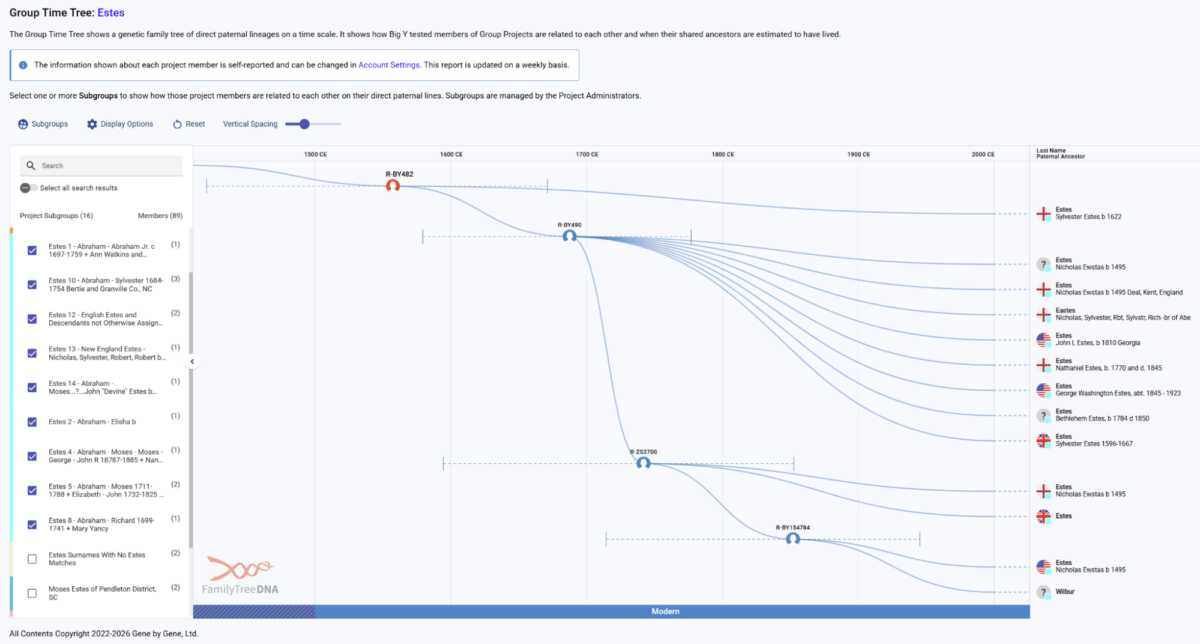
Interestingly, using Discover, one of the Ancient Connection matches is to a burial at Cliff’s End Farm dating from about 4500 years ago, just 20 miles or so up the road from Deal, in Kent, where Y-DNA tests, combined with genealogical records, confirms that the Virginia and Massachusetts Estes families originated.
Thanks to Y-DNA testing, we knew where in England to dig for more records, and found them, including marriage and baptismal records.
A long-standing myth in the Estes research community states that the male Estes line descends from the d’Este family in Italy in the 1400s, but the discovery of a haplogroup match close by in Kent suggests otherwise.
Often, DNA tests suggest where to search for additional record documentation. The two working together are a powerful force.
In genealogy, negative evidence, disproving something, is equally as important as confirmation. Y-DNA and mtDNA, sometimes combined with autosomal testing, has the potential to lay old myths to rest, or confirm them as reality.
Building a Strong Family Tree With DNA and Records
DNA doesn’t replace historical records—it enhances them. When combined thoughtfully, genetic evidence and documentary research can reveal connections that might otherwise remain hidden, especially when records are incomplete or missing altogether.
How do you combine DNA evidence with historical records in your family tree?
When you find a known ancestor in a location, but you have no idea where they came from, DNA testing can be invaluable. Using autosomal DNA, linking known relatives to your tree so that FamilyTreeDNA can assign matches as either paternal or maternal, and viewing shared matches and their trees can provide important clues as to common ancestors.
Y-DNA and mitochondrial DNA, when available, can provide the same types of information about one, specific, direct line – both recently and reaching far back in time. Using different types of DNA together can provide hints as to a direct connection with Y-DNA, and how distantly two people might be related using Family Finder.
In one of my family lines, a male took both the Y-DNA and Family Finder test. His ancestor was born about 1800 and was first found in Alabama near no other men by the same surname, leaving us with no paper trail clues. The Y-DNA test connected him with a specific ancestral lineage in Maryland.
That allowed us to narrow his ancestor to one or two men who disappeared in Maryland around that same time. Then, using autosomal DNA, we searched for matches to the wives lines of those two men. We found several matches and shared matches to one of the wives, and none to the other, so we used multiple tools, and multiple methodologies to identify the ancestors of the Alabama man.
What challenges do you face when verifying connections in your tree?
Every connection has the potential to be incorrect. I’d much rather saw a branch off than continue to bark up the wrong tree. DNA sharpens the view, helping us focus, and can correct misinformation and misconceptions. Sometimes, the records aren’t wrong, but adoptions and other situations occurred that we are unaware of today.
One of my ancestors adopted his stepfather’s surname – a loving gesture at the time when everyone was aware, but confounding to us generations later. Without DNA testing, we would never have known.
I always view each ancestor with a dose of healthy skepticism. I always strive to verify what I think I know, if possible.
We’ve used both Y-DNA and mtDNA to prove, and disprove that people share a common lineage.
In one recent situation, we tested multiple descendants of a man I’ll call John who was born about 1797. The descendants of one of John’s sons, Harry, carry a Y-DNA subclade of haplogroup I-M253. Descendants of another of John’s sons, Steve, carry haplogroup R-FT70812. These are clearly completely different haplogroups, on different branches of the haplotree separated by thousands of years. These two men cannot both be sons of the same man.
What do we do, especially given that both sons are identified as such during John’s lifetime? Their Y-DNA should be the same, or nearly so.
Looking at Y-DNA matches, Steve’s descendant matches other men with John’s surname and from that lineage. Harry’s descendant matches a known name in the community. Early marriage records do not exist for clarification, and neither Harry or Steve are the oldest or youngest sons.
In order to clarify the situation, as a tiebreaker to determine John’s actual haplogroup, we needed to test descendants of another son of John, but couldn’t find a candidate.
Since that’s not possible, we need to test descendants of multiple sons of both Harry and Steve to confirm their haplogroup. So far, that hasn’t been possible either, BUT, both men match descendants of John’s wife, Mary, so we know she’s the mother. Steve, who carries John’s surname, also matches descendants of John’s parents. So far, Harry does not, BUT, it’s a fairly close knit community, with families living along a river flanked by mountains for generations, meaning due to intermarriage, it’s difficult to tell how Harry’s tester is related to all of his matches.
What we still need to determine is whether Harry’s father is or is not John. Did the genetic break in the paternal lineage occur someplace downstream in Harry’s line – between Harry and the tester, or was Harry not John’s son. Even if we are able to determine THAT Harry was not John’s son, without some type of information, we cannot determine why – and conclusions should never be jumped to. They are sometimes cliffs.
Due to undocumented situations, and with a high mortality rate before modern medicine, it’s not unusual for one couple to be raising someone else’s child, often of another family member. We can’t go back in time, but DNA can.
Which DNA tools do you find most helpful for mapping your family tree?
I use all three types of tests, including X-matching that’s included at FamilyTreeDNA with the Family Finder test. X-DNA has a unique inheritance path that is sometimes VERY useful.
I link known matches to their profile card in my tree, which allows FamilyTreeDNA, using triangulation, to assign other matches as maternal or paternal matches, or both.
I paint my known Family Finder matches to DNAPainter in order to identify which segments descend from which ancestors. Conversely, when I have an unknown match, since I’ve identified segments to ancestors, I can tell how a new match is related to me, even when they don’t provide a tree.
Thankfully, FamilyTreeDNA provides chromosome segment match information.
Expert Advice for Building Your Family Tree With DNA
Getting started with DNA testing can feel overwhelming, especially when you’re balancing family stories, paper records, and new genetic evidence. With decades of experience, Roberta shares practical guidance for navigating DNA results with confidence—and using them responsibly to strengthen your family tree.
What advice would you give someone just starting their family tree with DNA?
You have a paper tree, and a genetic one. Hopefully they will be the same, but that’s the benefit of DNA testing. You will be able to identify and confirm ancestors, or, sometimes, disprove them, refining your tree.
Learn as much as possible about how to interpret DNA test results, and how to use them properly.
Use Discover for both Y-DNA and mtDNA results, both your own and your ancestors.
Utilize your vendors’ Help Center and their blog articles.
You can also subscribe to www.dnaexplain.com, which is free and keyword searchable. I’ve written more than 1800 articles in 13+ years.
What common misconceptions about family trees and DNA testing would you clear up?
Neither are flawless. Trees, even with the best documentation, can absolutely be wrong, because we don’t know what actually happened back then. DNA, on the other hand, when not interpreted correctly, can lead to incorrect conclusions. Both need to be evaluated as pieces of evidence. If a conflict seems to arise, we need to ask ourselves what steps can be taken to resolve conflicting information and turn evidence into confirmation.
How do you make sure your family tree research stays reliable?
I maintain my primary family tree on my desktop computer, including images.
I don’t want my information to die with me, so I have uploaded my tree to multiple locations. MyHeritage, which is subscription based, FamilySearch, which is a one-world tree that sometimes contains long-standing errors and can be changed by anyone, and WikiTree. WikiTree is also a one-world tree, but I have found community collaboration to be more successful in eliminating repeated bad information from being added into trees. WikiTree also facilitates DNA information connected to individual testers.
My legacy contribution is found in my 52 Ancestors series on my blog, where, each week, I select one ancestor and write extensively about them in narrative format, including sources and links.
The Future of Family Trees and Genetic Genealogy
Genetic genealogy has transformed the way people explore their ancestry, opening doors that were once closed to all but the most persistent researchers. As DNA databases grow and tools become more powerful, the possibilities for future discoveries continue to expand.
If you could go back, what advice would you give yourself when you started your family tree?
I would have recorded the sources for everything, including who told me the information, when, and where. I would also have taken more photographs of everything – people, places, documents, etc.
Additionally, I would also record locations and records where I searched for ancestors and DIDN’T find anything, including whether I researched only for that specific ancestor, or if I searched for the surname more generally. This would keep me from replowing the same field years later – or wondering where I found something.
I would also save emails as Word documents so they can be filed and searched more reliably.
How do you see genetic genealogy changing the way people build family trees in the future?
Today, people can begin with more information and don’t have to be entirely reliant on remembered family information or family histories available only in local libraries.
Future researchers will also be able to much more easily verify their connectivity to others using all three types of DNA tests. Commercial databases continue to grow and are already irreplaceable resources.
Closing Thoughts
Your family tree has more branches than you might realize. Start uncovering them with FamilyTreeDNA testing and see where DNA can take your story.

Want to Read More From Roberta Estes?
Check out the other blogs Roberta has written for FamilyTreeDNA.