Explore how DNA testing and genetic genealogy helped Jim Brewster build his family tree, uncover surprising connections, and share expert insights for tracing your own ancestry.
Genetic genealogy isn’t just about science—it’s about stories. We sat down with Jim Brewster, Education Coordinator for FamilyTreeDNA, to learn how DNA has shaped their family tree and what advice they have for others exploring their roots.
How DNA Shaped My Family Tree
For Jim Brewster, family history didn’t come neatly packaged in records or charts—it came in competing stories, strong opinions, and a lot of unanswered questions. With each side of the family telling a different version of the past, he quickly realized that uncovering the truth would take more than listening. It would take research—and eventually, DNA.
What does your own family tree look like?
My family is pretty geographically spread out, with cousins, aunts, and uncles scattered from East Texas to Hawaii, and many places in between. My immediate family was also pretty isolated growing up, so I didn’t meet many of my extended family until I was a young adult.
My family is quite opinionated, and talking to any given branch results in a very different picture of how all the branches wound up where they are. Each is also quite adamant that their version of family history is the only correct one.
That meant that every time I met a new-to-me branch of the family, I got a radically different description of the tree. The oral histories related to me were often quite entertaining, but piecing together any sort of coherent genealogy from all of this was somewhat difficult.
I did what anyone with a knack for research and puzzle-solving would do, and started looking at the paper trail. From that, I learned that our apparent familial wanderlust was not a new phenomenon. Just about everyone, in every generation, decided to move to some place new. Usually to escape the place they were from.
To answer the question, “What does my family tree look like?”, it’s less a tree and more like an artist’s interpretation of a series of branches that all tried to move away from each other. Of course, if you asked anyone else in my family, their opinion would be different. Rest assured, though, that my opinion is the only correct one.
How did DNA testing influence the way you built or expanded it?
A year or so into my genealogical journey, I discovered FamilyTreeDNA. It fit my new interest in family history and my newly minted degree in anthropology. I was hired as a customer service representative and thrown into the deep end of genetic genealogy. It was less of a learning curve and more of a learning cliff.
I quickly found that learning the hows and whys of genetic genealogy fascinated me even more than untangling my tree-like collection of branches did. It shifted my focus from a direct backward trek through the pedigree to seeing how all the living branches compared at the genetic level.
Since starting with FamilyTreeDNA in 2014, I have focused on learning as much as I could to understand how inheritance works on a fundamental genetic level. The science behind the tests is what I find most interesting. I have gotten most of my aunts, uncles, and first cousins tested, as well as several second cousins. I use these results all the time for hands-on learning as well as explaining advanced concepts in my role as Education Coordinator.
Family Tree Discoveries and Surprising DNA Results
What started as curiosity quickly turned into confirmation—and in some cases, complexity. Through DNA testing, Jim Brewster not only verified parts of his family story but also uncovered unique genetic relationships that challenged traditional expectations of how families connect.
Who is the most interesting ancestor you’ve uncovered in your family tree?
With the last name Brewster, I have often been asked if I am related to Mayflower pilgrim William Brewster. Well, that or Punky Brewster. Or Brewster’s Millions. Or occasionally Mortimer Brewster from Arsenic and Old Lace.
By the way, if you haven’t seen any of those, put this article on hold while you go watch some life-changing cinema.
But I digress. I basically just always went with it. Like, yeah, probably William Brewster I guess. I made my yearly hand turkey in elementary school, but that was about it. Once I got into the field of genealogy, I quickly encountered that question more and more.
“I dunno, probably,” wasn’t going to cut it as a satisfactory answer to most people.
This became especially apparent when the General Society of Mayflower Descendants approached FamilyTreeDNA to propose creating a Mayflower Badge akin to the existing Cohen, Western Atlantic, and Niall of the Nine Hostages badges. The CEO, Bennett Greenspan, tasked me with coordinating the effort, in large part due to my name.
That pretty much settled it, and I finally confirmed that lineage. My line does, in fact, hail from that famous voyage. I worked with the admins of the Mayflower Project to identify direct patrilineal descendants of male pilgrims and direct matrilineal descendants of female pilgrims. From there, we normalized the probable STR signatures for male pilgrims up to a 67 marker level. We also identified mtDNA haplogroups. The result was the Mayflower Descendant Badge. It was especially exciting since my own DNA results were included in the project.
What’s the biggest surprise DNA revealed about your family tree?
DNA has actually confirmed what I already knew or suspected about my ancestry, so no surprises there. I do have an interesting mix of living relatives, though, who make for some interesting DNA case studies.
For example, my mom’s brother and sister married a set of Hawaiian siblings. The result is children who are first double cousins to each other, since they all share the same set of grandparents. Here is an abbreviated match list for one of my first cousins, Kai:
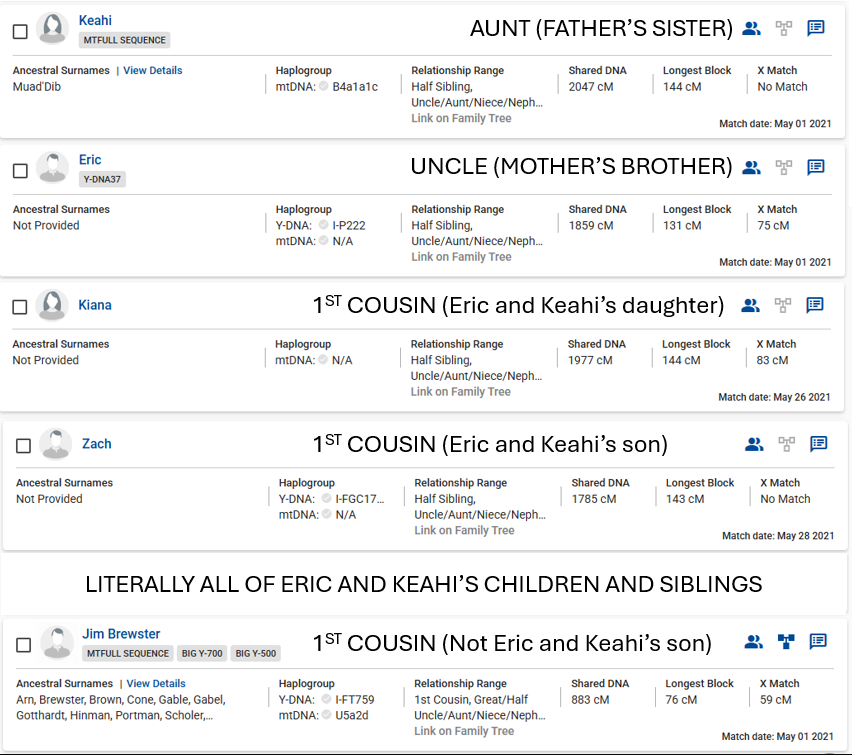
There are several interesting things to note here. First, all the children of Eric and Keahi share almost as much DNA with Kai as they do with Eric and Keahi. Typically, aunts and uncles share more DNA than first cousins would, but in this case they are all in the same range. In fact they are interspersed, with some cousins sharing more DNA than aunts or vice versa.
Way down the list you start to see the rest of us European first cousins, and even then, there are a few Hawaiian cousins who appear closer than we do. The stark contrast between this and the rest of the Europeans in the family makes it easy to identify large stretches of related DNA and to map out genetic inheritance.
Was there a “brick wall” in your family tree that DNA helped you break through?
No, which is a bummer, because I have always wanted to burst through a brick wall yelling “Ohhhhh Yeeeaah!” and offer sugary beverages to all the newly found cousins.
When I first dove into this field, I kept hearing buzzwords like heteroplasmies, inversions, deletions, and infinite alleles, and it was all Greek to me. I was determined to understand what all this meant so I could discuss it competently.
How exactly are marker values determined? What actually are marker values for that matter? How does DNA inheritance actually work? Why did the chicken cross the road?
These questions and more led me to delve into the why of DNA. In my opinion, understanding how genetic inheritance and mutation work on a fundamental level is crucial to making the most use of DNA results.
The problem is that this can become quite technical, and it quickly becomes confusing for many people, including myself. I went down many a DNA research rabbit hole. I made friends with the lab staff and got them to patiently explain concepts to me. I soaked up all the technical knowledge I could.
Since my focus has shifted to the more technical aspect of the genetic genealogical realm, I mostly enjoy working with people to understand these concepts and apply them to their own research. As a project administrator, I primarily work with other admins to help interpret what results actually mean, so they can spread their wings and fly.
Building a Strong Family Tree With DNA and Records
For Jim, the most meaningful breakthroughs don’t happen in isolation. They happen at the intersection of DNA results, historical records, and collaboration. By combining these tools, he’s been able to help others uncover origins they never expected—and rethink what they thought they knew.
How do you combine DNA evidence with historical records in your family tree?
I worked extensively with a member of the McAllister project, Bill McAllister, who was eager to understand his Big Y results. Bill’s brick wall was in 1750s Virginia. McAllister lore and the family story assumed a descent from Somerled in Kintyre, Scotland, but no records supported this. Most McAllisters herald from this region, so it made sense.
Over the course of 2024, we went on a learning journey together as Bill uncovered a completely different origin in Southern Ireland. It represented a totally unique branch of Clan McAllister, geographically isolated from any others. I sure hope he was wearing a helmet when he found out, because it blew his mind.
This has led to a larger discussion of what constitutes a “true” McAllister. I am not a McAllister by blood, and I don’t have a firm grasp of the genealogy. What I do have is a knowledge of the results, so I can help confirm or disconfirm theories based on result analysis.
This ongoing work is an example of how collaborations between experts in related, but separate areas can uncover hidden gems and yes, smash through brick walls.
I wasn’t there in person when Bill finally broke through the wall, but I like to imagine he shouted “Ohhhhh Yeeeaah!” and toasted with a sugary beverage.
What challenges do you face when verifying connections in your tree?
When it comes to trees, I actually really like making connections on the haplotree. The Y-DNA tree is an elegant, dynamic map full of sciency things and terms that I love. Why do I love them? They involve using lots of fancy words, and the fancier the words I use, the cooler everyone thinks I am. At least I think it works that way.
To me, the Y-DNA haplotree is the genetic equivalent of a topographic survey map. Just like a topographic map, it can be understood on many levels. Basic information can be understood by just glancing at the map, even if all the things in the margins are meaningless to you.
A topographic map might not mean much at first, but as you start to learn the coordinate system, scale, elevation, and more, you gain a better understanding of the terrain the map represents. The map itself hasn’t changed at all, but your understanding has. Your increased knowledge lets you get so much more out of what you already have.
It’s the same with Y-DNA. Special mutations, ancient DNA, time estimates, and more all add extra layers of complexity to what can be understood through testing.
In my initial draft of this Q&A, I actually started rambling quite a lot on this question, but then I realized I was going into “Teacher Mode” as my boss and mentor, Janine Cloud, calls it. I definitely have a habit of geeking out on things, and I tend to ramble a lot with zero regard for the vacant stares I sometimes get.
For me, the biggest challenge, and the biggest reward, has been understanding matches at a deep, fundamental level. For example, not just knowing that I share centimorgans and blocks with someone, but what those units of measurement are, and how they are determined.
Which DNA tools do you find most helpful for mapping your family tree?
I often get asked, “What is the best DNA test?” To that I answer, “It depends on the job.” Just like the tools in your workshop, one test might be ideally suited to one task, but useless for another. The workshop of a woodworker would be quite useless to a blacksmith, and a fully furnished tailor’s shop does a fisherman little good. Is one set of tools better than another? No. They are just different.
To go back to the map analogy, different views of the same area can provide information in different ways. For the work I did with Bill McAllister, the Block Tree was invaluable. It allowed us to view equivalent blocks and identify large splits in the tree. The Time Tree helped us better visualize when and where those splits occurred. The non-matching variants report in Big Y helped us correlate specific SNPs to specific ancestors within a generation or two.
I work primarily with Y-DNA, so the Y-DNA tools I mentioned above are my personal favorites, but Y-DNA tools are not suited for every situation. If Y-DNA will not help to solve your particular mystery, a different set would be of more use to you.
Expert Advice for Building Your Family Tree With DNA
As genetic genealogy continues to evolve, so does the way people build and understand their family trees. Jim reflects on how DNA testing is shaping the future of ancestry research—and what that means for both beginners and experienced genealogists alike.
What advice would you give someone just starting their family tree with DNA?
Turn back now. Save yourself, while there’s still time. Genetic genealogy grabbed me and it won’t let me go. It’ll happen to you too.
Just kidding. I would tell them the same thing my high school English teacher told me:
When you come across a word you don’t understand, don’t just skip over it and keep reading; stop and look it up. It will give richer depth to anything you read now and in the future.
Come across a term you don’t know while viewing your results? Take a moment to pause and look it up. You don’t need to become an expert on it. The general concept or idea will do. Then go back to your results. Now that you have at least a general idea of what the term means, your results are suddenly more meaningful.
I actually find it a tad odd whenever I get referred to as an expert. It’s not like I went to Expert School to get a degree in Expertology. All I did was stop and look stuff up whenever I had an “I wonder why X does Y?” sort of thought. Do that for long enough, and anyone can be an expert.
Also, patience. Rome wasn’t built in a day. You’re not going to learn this all overnight, and that’s okay. Like a favorite book, you can come back to it again and again. As your vocabulary and knowledge grow, you will get more out of it with each re-read.
What common misconceptions about family trees and DNA testing would you clear up?
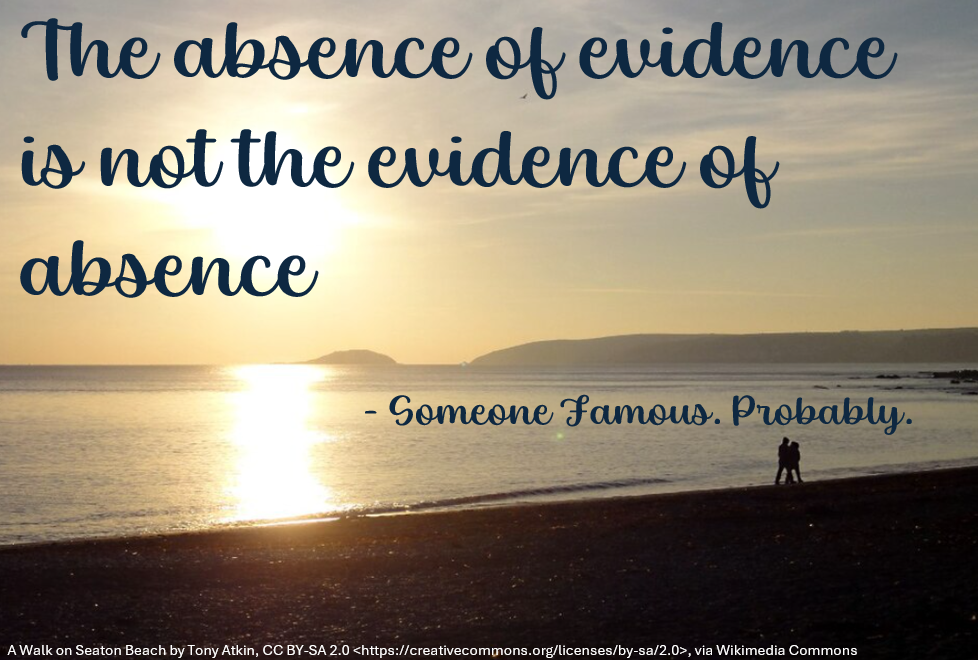
The absence of evidence is not the evidence of absence. People often take a DNA test in order to prove that they have a certain ancestry, and are disappointed when the results do not confirm it. I find this most commonly with ethnicity reports.
One common example is Native American ancestry. If someone has a family story of a Native American ancestor, they may understandably want to take a test to prove it. But DNA is not the strict ½, ¼, ⅛ pedigree separation seen in traditional trees.
There are any number of reasons why any given ancestor’s DNA did not make it through the generations to the present day. Just because your results may not show your Native American ancestry does not mean it does not exist because genetic inheritance is not nearly as cut-and-dried as some people may think.
See what you made me do there, question? Here I am going back into Teacher Mode. Anyway, the absence of evidence is not the evidence of absence. Has a nice ring to it. It could be a motivational poster or something.
How do you make sure your family tree research stays reliable?
Base your hypotheses on facts, not wishcasting. If you come into testing (or genealogy in general) with a preconceived notion of what is and is not true, then you will lean towards selection bias. You may start to pick only lines of evidence that support what you want the answer to be, and ignore ones that do not.
Speaking of lines of evidence. Cite your sources yo. Everyone knows someone who does abysmal research and draws conclusions that elicit responses like “Bless your heart.” and “That is not how any of this works.” Don’t be that person. Friends don’t let friends leave things undocumented. If future evidence comes along that contradicts previous assumptions, don’t run from it or dismiss it out of hand, but compare it to what you know.
The Future of Family Trees and Genetic Genealogy
Looking back on his own journey, Jim sees how far genetic genealogy has come—and where it’s headed next. As DNA tools become more advanced and accessible, the future of family history is becoming more detailed, more accurate, and more connected than ever before.
If you could go back, what advice would you give yourself when you started your family tree?
I have a long track record of ignoring good advice and learning lessons the hard way at pretty much every opportunity, so I doubt past-Jim would listen to anything present-Jim has to say. But, for the sake of the question, I would tell myself to focus on the story.
Finding birth and death dates and places is all well and good, but it makes for a rather dry monologue to look at. Who were these people? What was life like for them? What were their hopes and dreams? You might not get as many ancestors, but you’ll get stories that breathe life into your work.
One golden example is a woman my wife was researching as part of her research on the St. Louis World’s Fair. Her employer died, so she stole her checkbook and started forging checks. Before she had a chance to get caught, she slapped on a fake mustache and fled cross-country, funded by more forged checks.
That is waaaaaayy more interesting than saying “She was born in St. Louis and died in California.” Okay, well, the fake mustache part might be a bit of an embellishment, but otherwise that is exactly how it happened. If all you want is a collection of facts, then ignore the dash, but do so at the peril of missing all the juicy bits.
How do you see genetic genealogy changing the way people build family trees in the future?
I imagine more and more people adding confirmed genetic heritage to confirmed ancestry. In the McAllister project I administer, I see that happening already. Integrating tools like migration maps, match trees, and phylogenetic trees seamlessly into other lines of evidence. One can confirm hypotheses or dismiss faulty lines of evidence. Just like a skilled craftsman, the more tools one masters, the more interesting work one can produce.
Closing Thoughts
Your family tree has more branches than you might realize. Start uncovering them with FamilyTreeDNA testing and see where DNA can take your story.
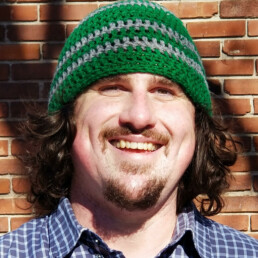
Want to Read More From Jim Brewster?
Check out the other blogs Jim has written for FamilyTreeDNA.