By Paul Heinegg and Ayo Heinegg Magwood
The 1870 brick wall isn’t the end of your family’s story. This guide walks you through the records, research strategies, and DNA tools that can take you further back.
Tracing African American ancestry beyond the “1870 brick wall” is challenging but not impossible. This term refers to the difficulty of tracing the lineage of formerly enslaved families beyond the 1870 Census, which was the first official record to document most formerly enslaved persons by name.
Similar to forensic investigators, family researchers must creatively “triangulate” direct and indirect evidence from multiple sources to reach defensible conclusions about their family history.
Part one of this blog article covered strategies for tracing your family “Up to the 1870 brick wall.” In Part two, we will help you trace them “Beyond the 1870 brick wall.”
All examples come from our upcoming genealogy journal article, “Tracing an African American Family Lineage from the 17th to the 20th Century: The Kee Family of Northampton County, NC,” forthcoming in The Genealogist. In this article, we traced the enslaved family lineage of our mother-in-law and grandmother back to the mid-1600s.
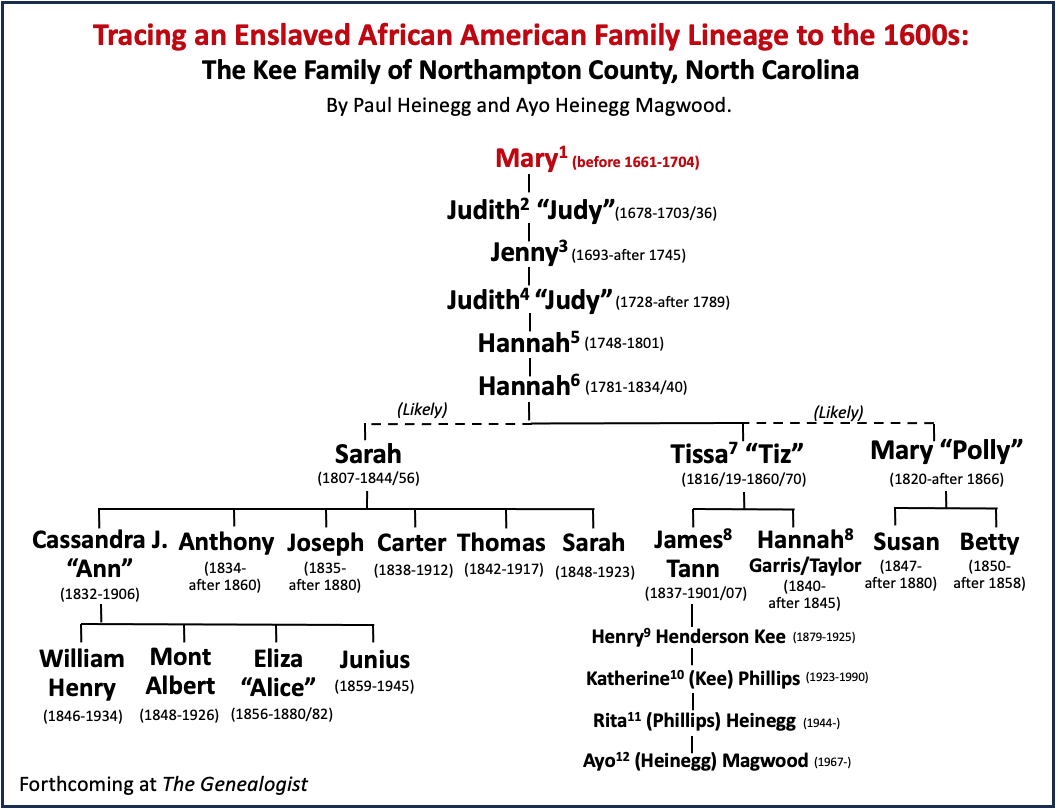
Table of Contents
General Recommendations
Before diving into strategies and records, these foundational practices will set you up for more effective and accurate research.
Embrace the Genealogical Proof Method
Effective genealogists use a systematic, evidence-based approach to researching family history.
Evaluate your sources carefully. This means evaluating sources for their credibility, relevance, and reliability, and cross-referencing information from multiple sources to ensure it is accurate and consistent.
Document everything. It also requires thoroughly documenting your sources and reasoning, keeping detailed records, and clearly explaining your conclusions. These practices help create an ongoing process of review and revision, which is key to the genealogical proof method.
Stay open to new findings. Just like other fields, genealogy evolves as new evidence comes to light and research is revisited.
Collaborate with other descendants. Collaborating openly with other descendants will help create more accurate and complete family histories over time.
Use Both Ancestry.com and FamilySearch.org
Each platform has its own databases and indexing methods, so using both can greatly improve your chances of finding records. We often switch between the two to make the most of their unique features.
Ancestry.com is better for searching indexed records. This includes most records after 1870 and many probate files from the 18th and 19th centuries.
FamilySearch excels at pre-1870 research. FamilySearch’s extensive Catalog and its powerful “Full-Text Search” are especially useful for searching pre-1870 records. You can now access much of this information online that was previously only available through microfilm at archives. FamilySearch’s Catalog lets you systematically review records like probate files for a specific surname, though its advanced tools can be less user-friendly than Ancestry.com.
FamilySearch also features a unified, collaborative wiki family tree that supports the genealogical proof method. As explained in this video, a unified wiki tree allows multiple descendants to share, collaborate, and verify each other’s research, embodying the peer-review aspect of the genealogical proof method. Substantiating your claims with well-attached sources and notes on your reasoning will greatly reduce the chances of your trees being altered by others.
Some genealogists prefer using Ancestry.com for their private family trees. However, we find FamilySearch preferable because it lets you search records from both FamilySearch and Ancestry.com, while Ancestry.com does not. You might want to maintain your trees on both platforms to take advantage of their respective strengths.
Regardless of which platform you use, we recommend using FamilySearch to find “starter” family trees for enslaver families. While we verify and add records to these existing trees for accuracy, starting with these trees is far more efficient than building from scratch.
Learn How to Use FamilySearch’s Catalog and Full-Text Search
Mastering FamilySearch’s Catalog and other advanced features can be challenging but is crucial for researching the genealogy of enslaved persons.
Start with these FamilySearch video tutorials to build your skills:
Develop Your Historical Manuscript Reading Skills
Reading handwritten manuscripts from the 18th and 19th centuries can be challenging but is essential for researching the genealogy of enslaved persons.
Expect a learning curve. Mastering this skill may take months of persistent practice, but it will open the door to thousands of records and take your research to the next level.
Use context clues to decode difficult handwriting. One helpful technique is to compare an unreadable letter in a difficult-to-read word with a similar letter found in another legible word within the same manuscript. It is akin to cracking a code.
Start with this resource. The DoHistory blog article, “How to Read 18th Century British-American Writing,” provides useful tips and strategies.
Maintain Realistic Expectations
According to FamilySearch’s wiki “Quick Guide to African American Records,” even professional researchers are successful in identifying an ancestor in records of the enslaved only about 50 percent of the time.
Success involves a combination of skill, persistence, and a significant amount of happenstance and luck. Ask yourself:
- Did your ancestor remarry after county marriage certificates began noting the parents of the bride and groom?
- Did they pass away after the county started issuing death certificates?
- Were they bequeathed to an heir, typically documented in a will or probate record, or sold to a slave trader, who often kept no records?
- Did your ancestor’s enslaver pass away before 1865? If so, did the will and probate records identify your ancestor by name, and provide information about their parents?
Understanding Historical Context
Before diving into strategies and sources, it’s helpful to first consider some historical context and data to gain a broader understanding of the structure of slaveholding and slave trading.
Understanding Domestic Slave Trade Patterns: Tracing Geographical Origins
Researching the origins of enslaved families in the West and Deep South often requires tracing their ancestors back to the Chesapeake states of Virginia, Maryland, and Delaware.
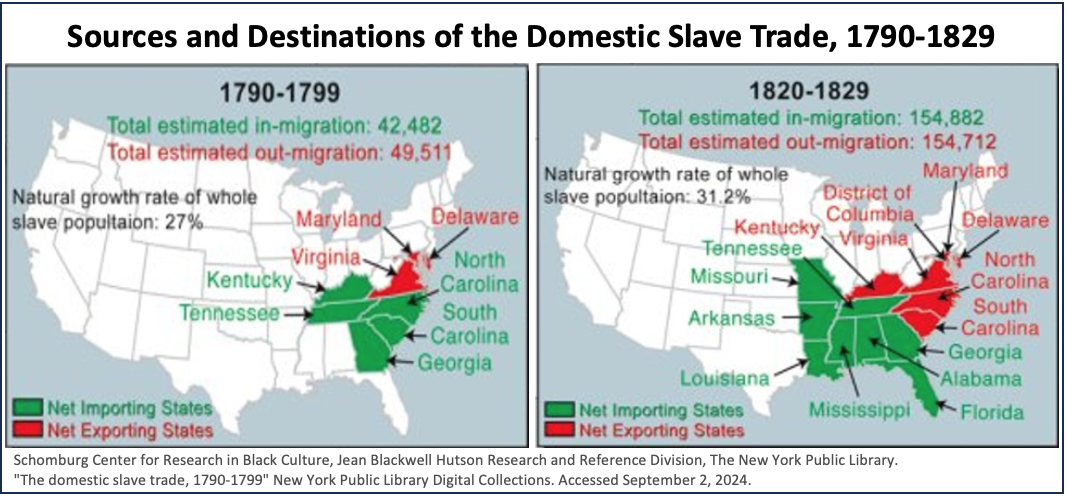
Between 1790 and 1859, over 250,600 enslaved people were forcibly moved from the Chesapeake to settler areas in the West and Deep South. About 60% of them were “sold down South” or “sold down the river” in the domestic slave trade, sometimes referred to as “the Second Middle Passage.”
The remaining 40% were transported by their enslavers when the latter migrated to frontier areas in search of affordable land and more profitable crops (Tadman, 1977, p. 99). As fertile land grew scarce, the sons of both planters and smaller farmers began migrating south and west, taking with them the enslaved individuals they had inherited. According to Dr. Dee Parmer Woodtor (Finding a Place Called Home, p. 264), “because these early settlers tended to travel in groups, they frequently named their places of settlement after their areas of origin.”
Starting around 1790, enslavers from Virginia, Maryland, and Delaware migrated into North Carolina, South Carolina, Georgia, Kentucky, and Tennessee as these states were settled and eventually joined the Union (see map). After the international slave trade was banned in 1808, a booming domestic slave trade—often referred to as the “second middle passage”—rapidly expanded to meet the demand of settlers in these new frontier areas.
By the 1820s, as land also became scarce in the Carolinas and Kentucky, enslavers pushed further west and south into Louisiana, Mississippi, and Alabama. Migration expanded to Arkansas and Texas after their statehood in 1836 and 1845, respectively, with the domestic slave trade following. By the 1850s, enslavers started migrating out of Georgia and Tennessee as well (Tadman, 1977, p. 44).
For many African American genealogists, this means that the journey to uncover their enslaved ancestors’ origins often leads back to Colonial Virginia.
Understanding Enslaved Sale Patterns: Targeting Relevant Records
The ways in which enslaved persons were transferred from one enslaver to another indicate the types of records where their lives are most likely to be documented.
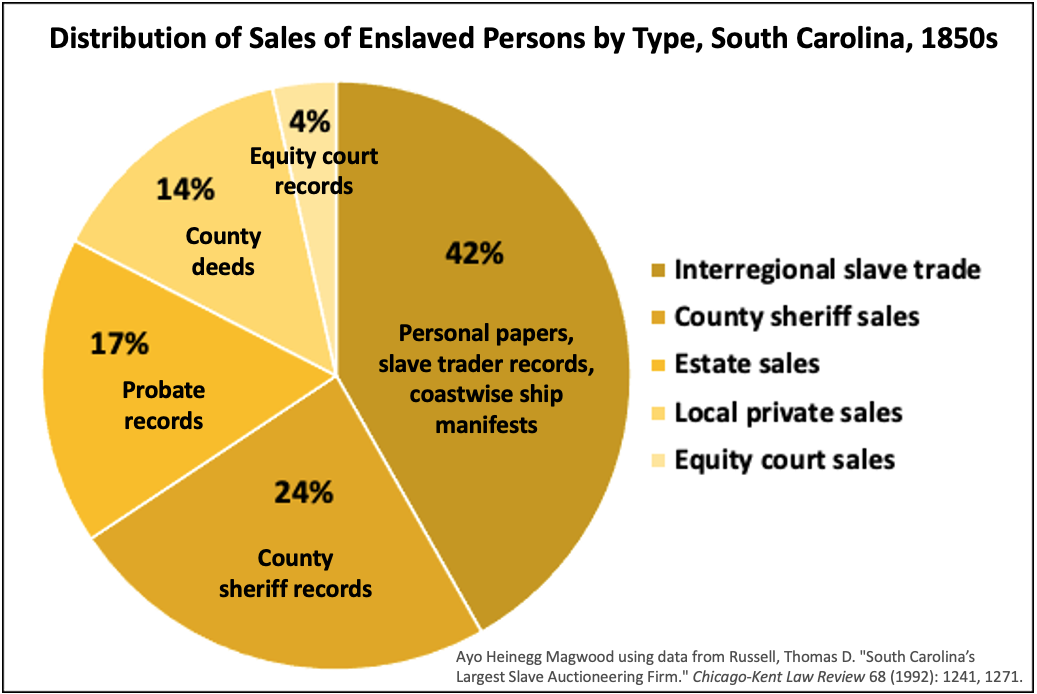
While we do not have data on the proportion of enslaved persons transferred through inheritance compared to those sold, we do have information on the relative importance of different methods of sale (Russell, 1992; Tadman, 1989).
The chart below illustrates the types of records typically generated by each method. Although this data pertains specifically to South Carolina, the authors noted that it is likely representative of the broader South.
Transfers of ownership through inheritance, on the other hand, would be documented in wills and probate records.
Understanding Slaveholding Size Differences: Anticipating Family Networks
Understanding whether your ancestor’s enslaver was a smaller farmer or a large planter can be helpful in guiding your research. Even if you don’t know the specifics of your ancestor’s enslaver(s), understanding the predominant type of slaveholding in the area can still be valuable.
The relative size of an enslaver’s or community’s slaveholdings has implications for patterns in enslaved family relationships and the types of records available.
The vast majority (88%) of slaveholders were middle-class farmers who enslaved fewer than 20 individuals. The term “planter” typically referred to the 12% of slaveholders who enslaved 20 or more individuals, and these larger estates were known as “plantations.” The chart below illustrates this distribution (Stampp, 1956).
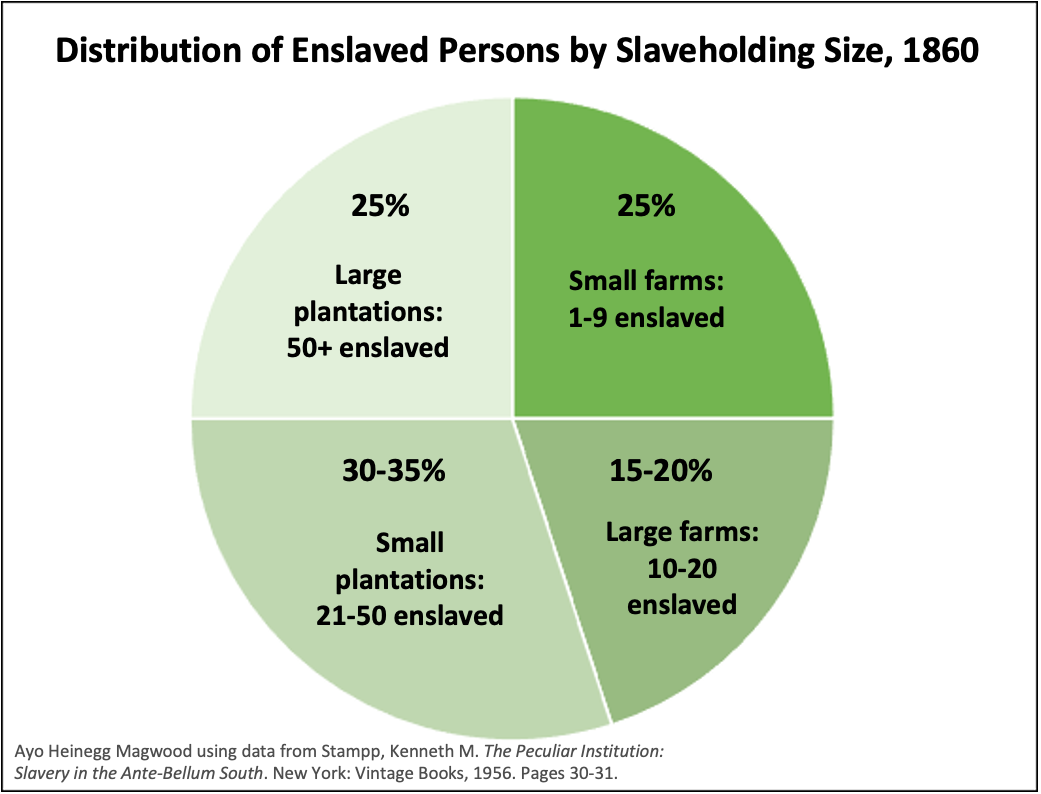
In other words, a small number of large plantations held the majority of enslaved persons. Thus, while most slaveholders owned fewer than 20 individuals, the majority (55-65%) of enslaved persons lived on plantations with 20 or more individuals, and about 25% lived on plantations with more than 50 enslaved persons (Stampp, 1956).
Very large plantations with 100 or more enslaved persons were concentrated in the cotton-producing states of Alabama, Mississippi, and Louisiana, as well as the rice-producing states of South Carolina and Georgia. The Deep South had the ideal climate and soil for growing cotton and rice, which were both land- and labor-intensive crops that were more efficiently cultivated on large plantations.
In contrast, smaller farms and plantations were more common in the Upper South, where tobacco and wheat could be effectively produced on smaller tracts of land with fewer enslaved laborers.
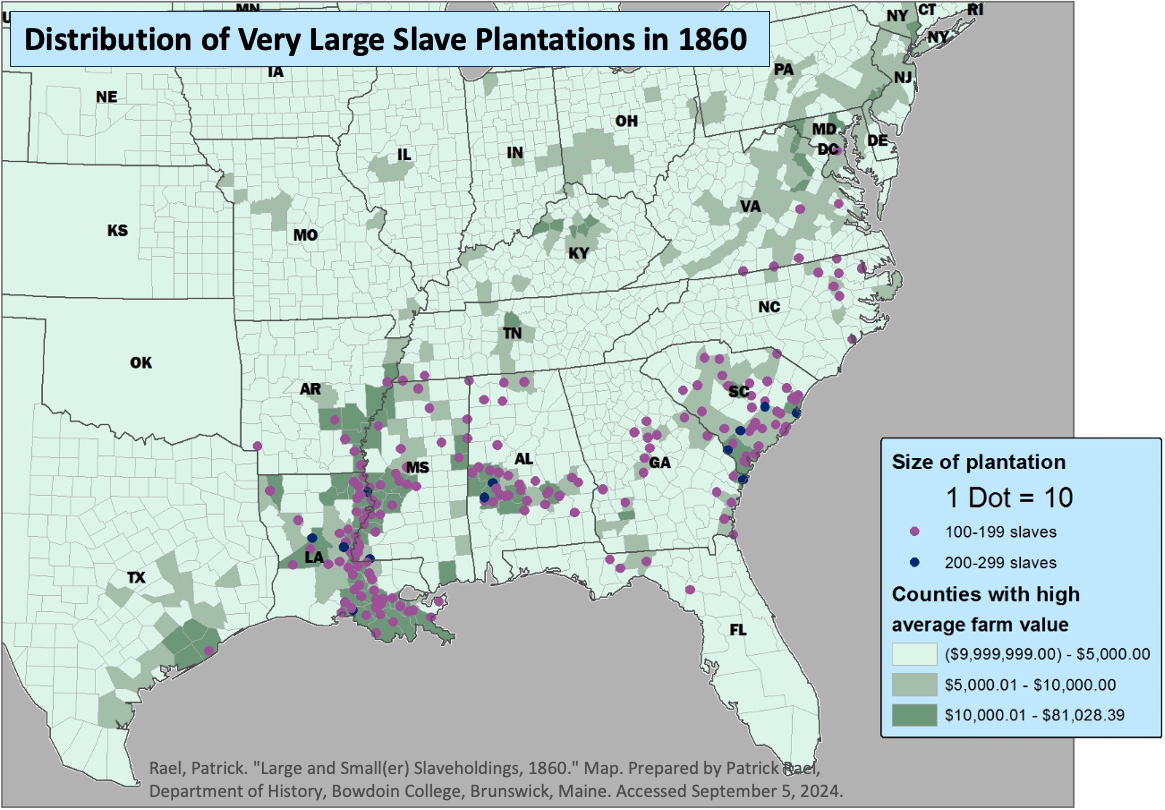
Dr. Dee Parmer Woodtor describes two types of enslaved communities in her African-American genealogy guide, Finding a Place Called Home. Enslaved communities on very large plantations with one hundred or more individuals typically included twenty to thirty interrelated families and often experienced relative family stability across generations. However, as large tracts of land became scarce, the children of these large planters often migrated south and west to frontier areas where land was more readily available and affordable.
In contrast, enslaved communities on smaller farms or plantations often maintained close community, kinship, and marriage ties across several nearby farms. Their enslavers were similarly closely connected, and often inherited and sold the individuals they enslaved among extended family members and close neighbors within their local community (page 248).
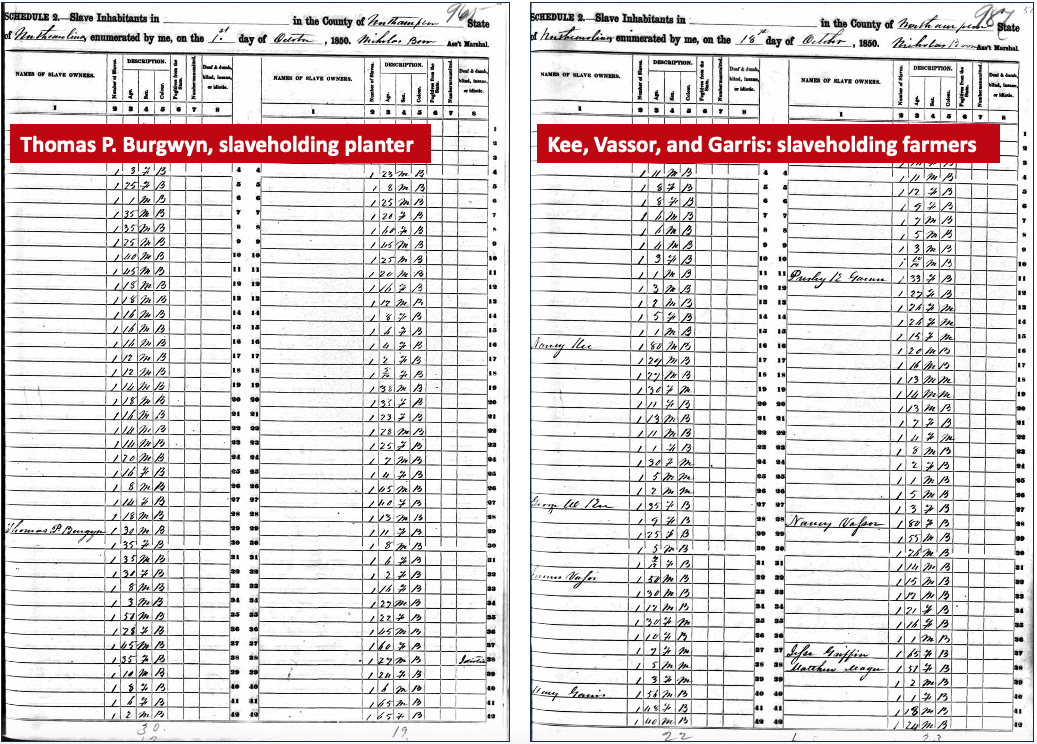
Slaveholding sizes can be determined from the 1850 and 1860 slave schedules. For example, the slave schedule on the left (which continues on the next page) lists the individuals enslaved by Thomas P. Burgwyn, a slaveholding planter, while the one on the right enumerates those enslaved by several slaveholding farmers.
Kee Family Case Study
Northampton County, North Carolina, where our enslaved Kee ancestors were from, is an example of a community with primarily smaller slaveholders. There were a few planters, but most enslavers, including the white Kee family who enslaved our ancestors, were smaller slaveholding farmers.
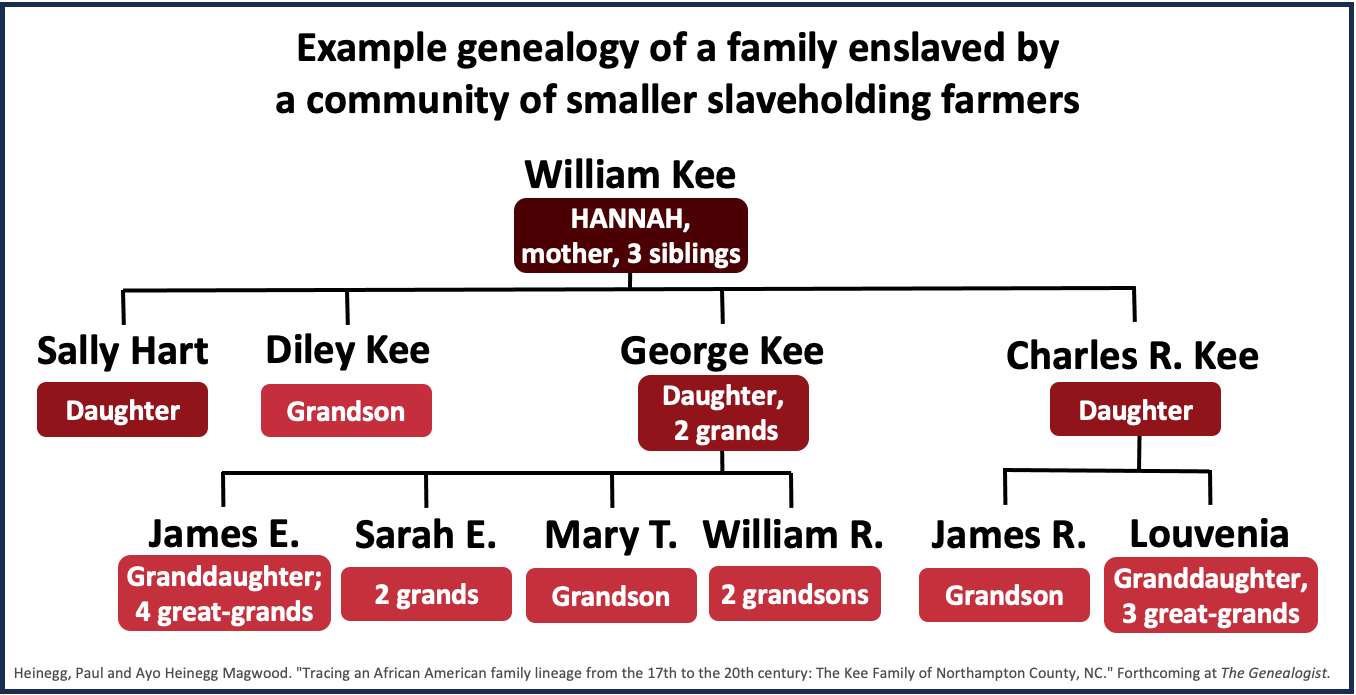
The chart below shows how the Kee family was enslaved by various members of the extended white Kee family, who lived on small slaveholding farms in the same area. A few members were also enslaved by unrelated neighbors in the same vicinity.
As discussed, researching the genealogy of enslaved families on large plantations, especially in the West and Deep South, requires different strategies and records compared to those on slaveholding farms in the Upper South. As exploring both types of research is beyond the scope of a single article, our Kee family research addresses the latter.
In this article, we will focus on strategies and sources for researching enslaved individuals on slaveholding farms. This research primarily involves examining wills, probate records, county sheriff records, county deeds, and equity court records. It also includes tracing enslaved family relationships across nearby farms owned by interrelated slaveholding families and over multiple generations.
Step 1: Reconstruct the Freedmen Generation
The first step is to create a profile of the freedmen generation in your family tree—the generation born enslaved but who survived the Civil War. This generation links your free ancestors on one side of the 1870 brick wall with your enslaved ancestors on the other.
Your goal is twofold:
- Reconstruct extended family relationships
- Identify family surnames
Both will also help you find potential enslavers and neighbors who may have been enslaved alongside your ancestors.
Remember — you’re researching not just your direct ancestor but their entire extended family. In 1870, rural communities often consisted of a few intermarried families.
Due to the sparse population, both white and Black families were frequently closely related within their groups. In areas with smaller white farmers who enslaved fewer than 20 people, enslaved African Americans often had strong kinship ties across multiple farms and were frequently bequeathed, inherited, sold, and purchased among a small number of intermarried enslaver families. Many formerly enslaved people also maintained close relationships with non-relatives with whom they were once enslaved.
Mapping these relationships within both Black and white communities will be crucial for identifying your ancestors in enslaver records and tracing their lineage. In this step, you will reconstruct your ancestor’s kinship and social network, and in step 3, you will do the same for their enslavers.
Start by identifying the following from the 1865–1880 period:
- The surnames and maiden names of your ancestor’s spouse(s), parents, in-laws, children, siblings, aunts, uncles, and cousins
- Their location in the 1870 census, and state of nativity as recorded in the 1870 and 1880 censuses.
- Their 1870 census neighbors — all households listed within 2–3 pages before and after your ancestor’s entry. African American neighbors may turn out to be extended family members, in-laws, or persons enslaved together with your ancestors. White neighbors may turn out to be their former enslavers or their relatives.
In part one we shared many useful strategies and resources for this. Here are some highlights.
The 1870 and 1880 Censuses
The 1870 census in particular is most likely to include family members who were formerly enslaved.
Watch for these clues in the 1870 census:
- Older household members may be the couple’s parents
- Adult household members with different surnames may be in-laws
- Those different surnames may provide clues about the wife’s maiden name
Your ancestor’s 1870 circumstances likely mirror their pre-1865 life. Lack of resources, poor rural transportation, family ties, and debt peonage kept most freedmen in the same geographical area in which they were enslaved. Thus, your ancestors’ county of residence in the 1870 census was likely the county in which they were enslaved. Your ancestors’ census neighbors likely include extended family members and families with whom they were enslaved.
Their census neighbors are also significant. They likely include extended family members and families with whom they were enslaved — and possibly their former enslaver families, working nearby as farm laborers or domestics. The 1870 census reports on household real estate value allow you to identify large landholders (and thus potential enslavers) living near your ancestors.
A note on the “Mulatto” designation. Both the 1870 and 1880 censuses include a subjective assessment of your ancestors’ skin color as “Black” or “Mulatto”. Keep in mind that “Mulatto” does not necessarily imply that your ancestor was the child of an enslaver. During the 1800s and early 1900s, the term “mulatto” referred to any person of mixed Black and white ancestry, regardless of the share of each race or how far back the racial admixture had occurred.
It was not until later that the term took on its modern definition as a person with one white parent and one Black parent.
The 1880 Census
Surnames of many formerly enslaved persons often remained in flux until about 1880. Some patterns to watch for:
- Some families were counted with the wife’s maiden name in the 1870 census, but with the husband’s surname in subsequent censuses.
- Some adult children who were enslaved with their mother by a different enslaver than their father were counted with their mother’s maiden name in the 1870 census, but with their father’s surname in later censuses.
- Some families were counted in the 1870 census with the surname of their most recent enslaver, but in subsequent censuses with that of their previous enslaver.
These surname changes may reflect efforts to follow traditional patrilineal surname practices, or to share the same name as their kin. Thus, changing surnames can provide clues about both maiden names and potential enslavers.
The 1880 census also provides useful information on family relationships and the birthplaces of your ancestors’ parents. The latter can be used to match your ancestors with enslaver families that had similar migration patterns.
Kee Family Case Study
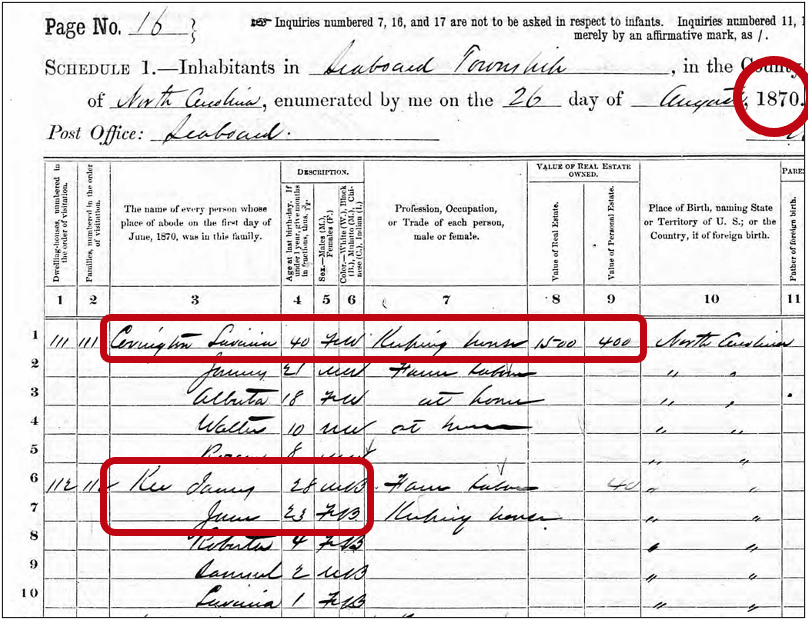
In the 1870 census, we found our freedman ancestor James8 Tann Kee living next to Lavinia Covington, a white woman who owned $1,500 in real estate. We later discovered that Livinia (Kee) Covington had enslaved James8’ mother, Tissa7, and sister, Hannah8, inheriting them from her father, Charles R. Kee.
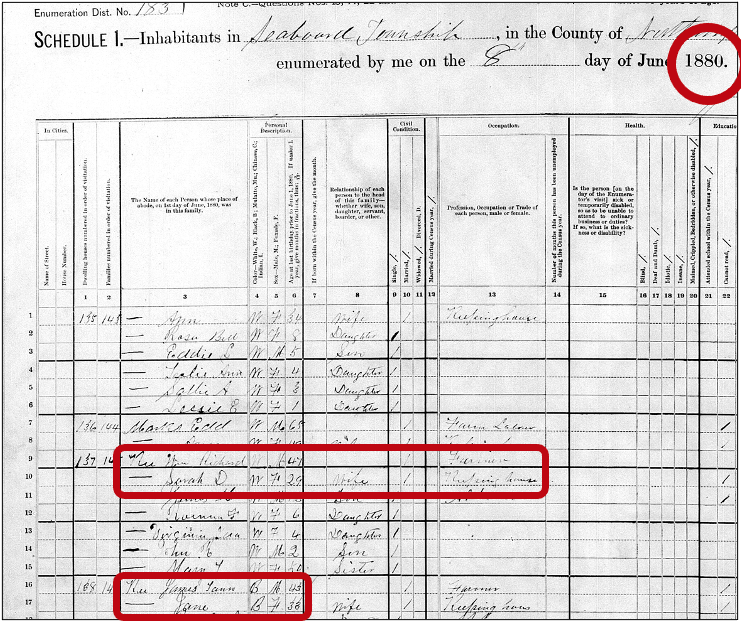
In the 1880 Census, James8 Tann was living next to William Richard Kee, with James R. Kee and William Robert Kee listed nearby. We later learned that James R. Kee was James8 Tann’s second enslaver. James R., the son of James Bruton Kee, married his cousin Frances Kee, who inherited James8 Tann from her father, Charles R. Kee.
William Richard Kee was the son of George Kee, and William Robert Kee was the son of Diley Kee. James Bruton, Charles R., George, and Diley were all sons of William Kee.
Freedmen Cohabitation Records
Cohabitation records include the couple’s full names and approximate year of union.
In some counties, these records also provide:
- information on the couple’s ages
- Name of children
- Place of birth
- Last known enslaver
Couples who registered their union on the same day may be related either biologically or through having been formerly enslaved in the same household.
A key resource for Virginia researchers: The Library of Virginia’s Virginia Untold: The African American Narrative database includes images of the original cohabitation records (“Register of Colored Persons Cohabitating Together as Husband and Wife on 27th February 1866”) and transcriptions for 33 Virginia counties.
Kee Family Case Study
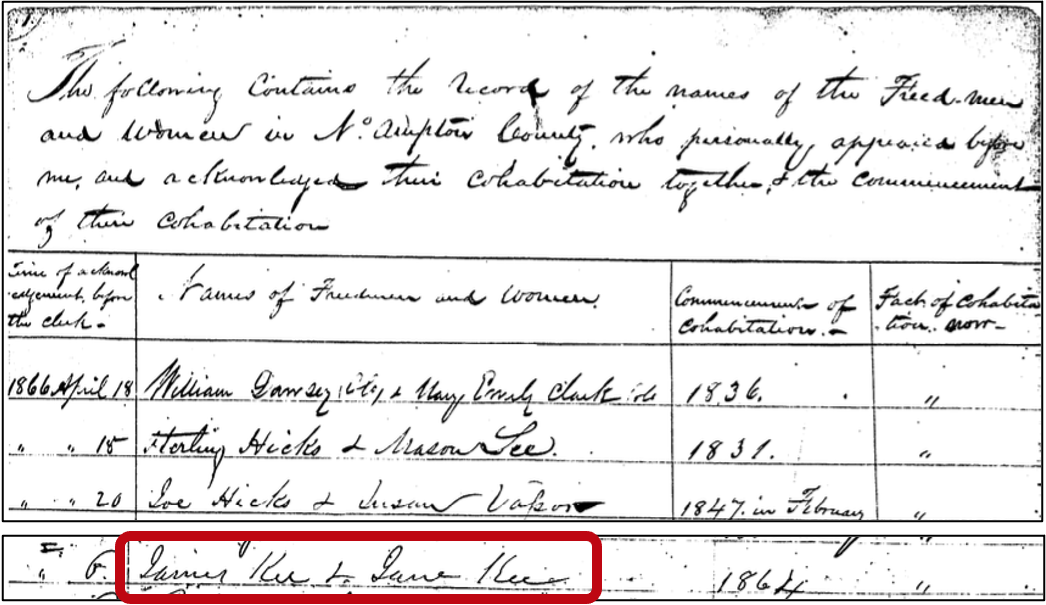
According to Northampton County’s freedmen cohabitation records, our ancestor Jane8, wife of James8 Tann Kee, had the maiden name “Kee.” However, her son Joe Kee’s death certificate lists his mother’s maiden name as “Mason,” as reported by his wife (Jane8’s daughter-in-law). Resolving this discrepancy was one of the many puzzles we had to solve.
Marriage Records
Due to high mortality rates in the late 1800s, many people were widowed and remarried at least once. As a result, researchers may find marriage certificates for formerly enslaved ancestors who remarried later in life, after their county began including the parents of the bride and groom on marriage certificates.
These certificates can reveal:
- Parents of the bride and groom
- Whether parents were “living” or “dead” (in some counties)
- Names of applicants and witnesses — usually close family members or friends
Remember: it was the applicant, not the bride or groom, who provided the information. The relationship of the applicant to the ancestor can be an indicator of the reliability of the information on the document. The names of applicants and witnesses can provide additional clues, as they were usually close family members or friends.
Kee Family Case Study
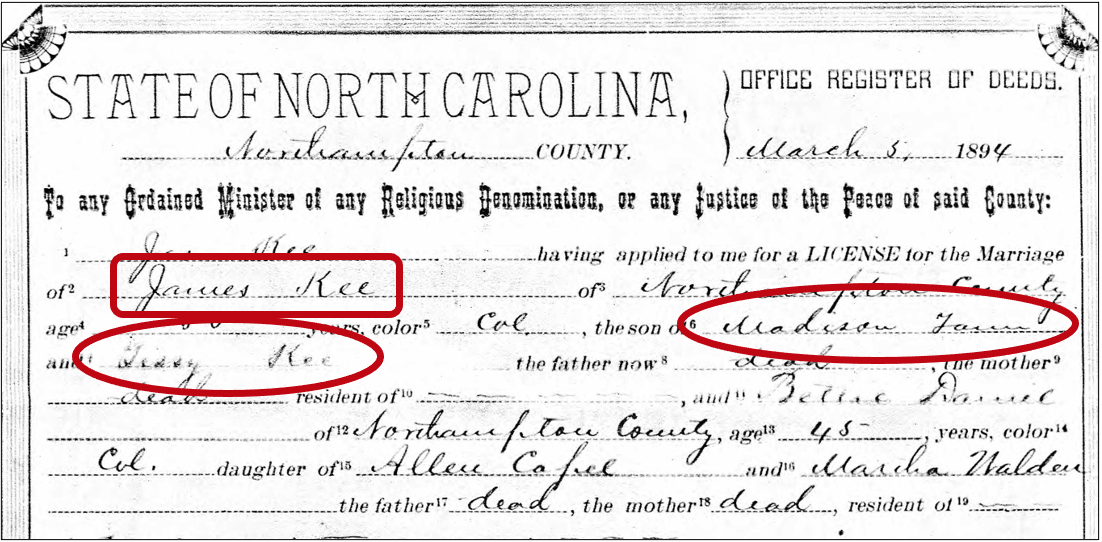
Like many freedmen, James Tann Kee was widowed and remarried later in life, after county marriage certificates began listing the parents of the bride and groom. When James applied for the marriage license, he reported that his parents were Madison Tann and Tissa Kee.
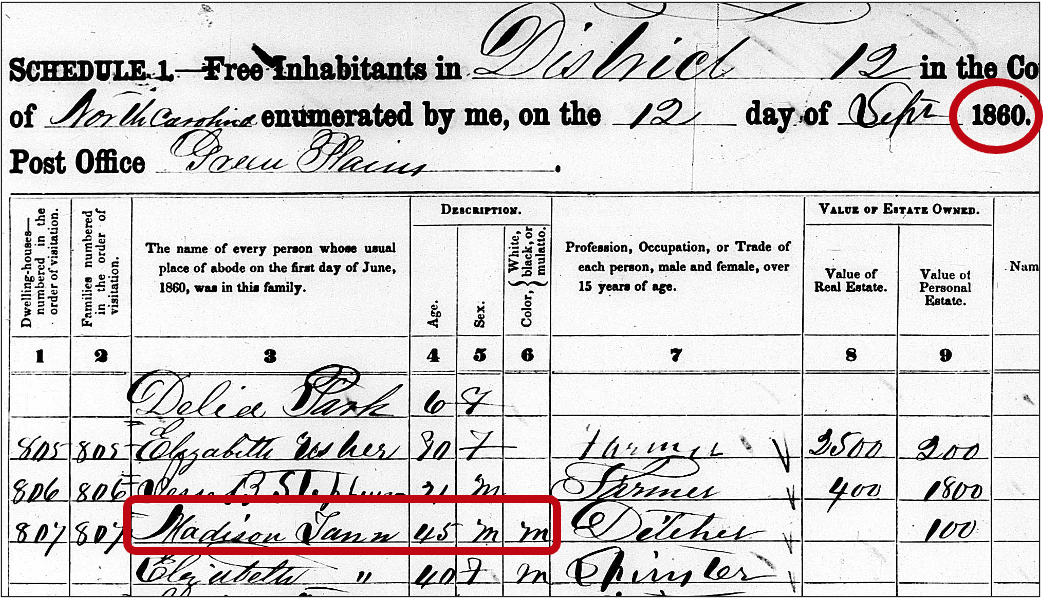
We later found Madison Tann listed as “mulatto” in the 1860 census, indicating he was a free African American. His parents were an example of a mixed free-enslaved marriage.
Interestingly, James’s new wife, Bettie Daniel, was also the product of a mixed free-enslaved marriage. Her father, Allen Capel, was enslaved, while her mother, Martha Walden, was a free African American. Such marriages were not uncommon in Northampton, a county with a significant population of low-income free African Americans. For more information, see the section below on free African Americans and the 1860 census.
Death Records
You may be able to find death records for freedmen ancestors who lived into the early 1900s when many counties began issuing them.
These records often contain:
- Place of birth
- Parents’ names
- Maiden names
Remember: death records are only as reliable as the informant. Most individuals did not know their exact age, birth date, or mother’s maiden name, and were even less likely to know this for their loved ones. The descendants of older individuals were probably even more uncertain about these details.
U.S. Freedmen’s Bureau Records
Freedmen’s Bureau bank records, in particular, can offer insights into family relationships.
Crop liens signed by two or more farmers together indicate a close relationship between the debtors, as these involved significant joint financial risk.
Joint crop liens were typically associated with:
- A parent and adult son or son-in-law
- A set of siblings and brothers-in-law
Most of FamilySearch’s crop liens and chattel mortgages are not indexed, but you can access them through their full-text search feature.
Kee Family Case Study
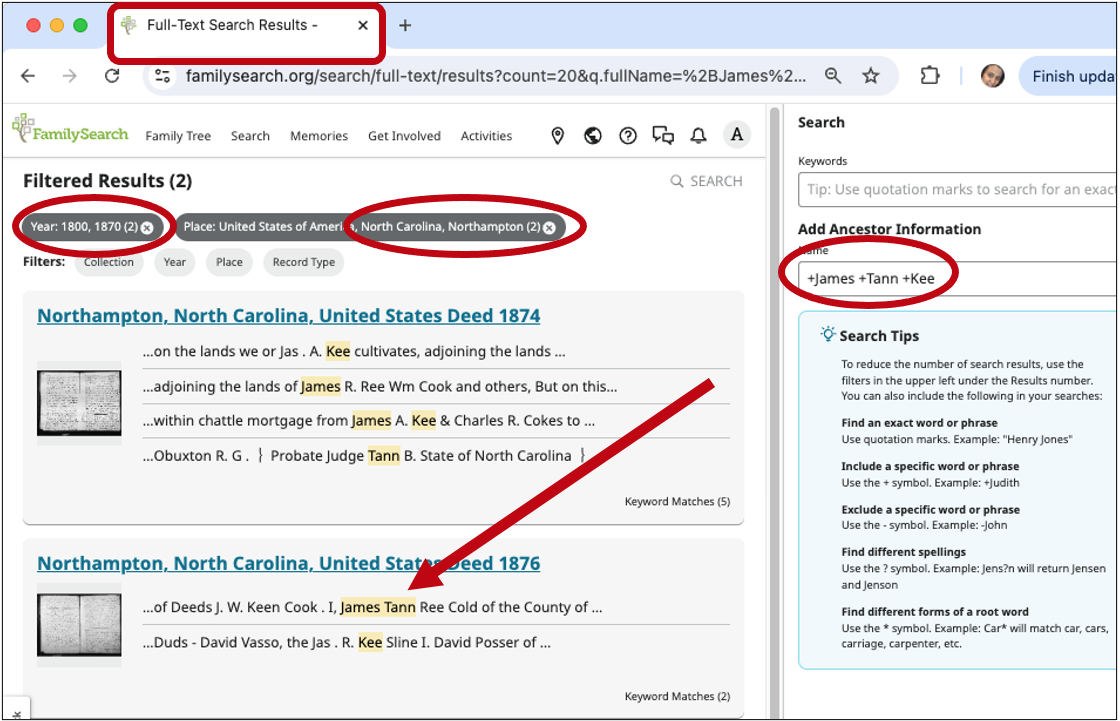
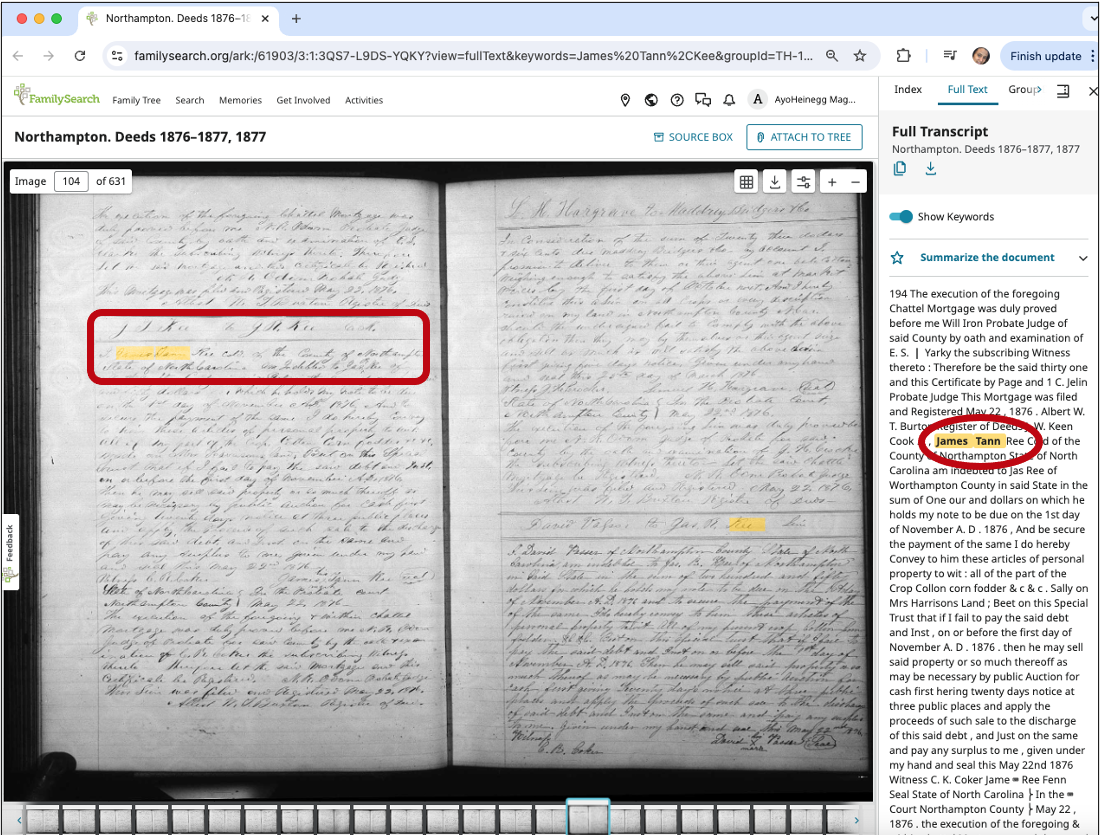
In a full-text search for our ancestor James Tann Kee, we found a crop lien he signed in May 1876 for a $150 loan from James R. Kee. The contract stated that if James Tann couldn’t repay the debt by November, James R. would sell his crops—cotton, corn, and fodder—at public auction. Any remaining funds after settling the debt would be returned to James Tann. As mentioned earlier, we later learned that James R. had been the enslaver of James Tann.
Civil War Pension Records
Although challenging to obtain, Civil War pension records can provide a wealth of information about an ancestor’s family.
These files contain records that prove:
- The veteran’s relationship to his widow
- The veteran’s relationship to his children
- Sometimes extensive supporting documentation
FamilySearch and Ancestry Trees
Family trees on Ancestry.com are often unreliable. However, they can provide leads that are worth scrupulously following up on.
Free African Americans and the 1860 Census
Check for the presence of free African American family members in the 1860 Census. According to FamilySearch’s wiki African American Slavery and Bondage, “by the time of the start of the Civil War in 1861 about 10% of African Americans were free.” Unlike their enslaved counterparts, free African Americans were counted in the censuses prior to 1870.
Marriages between enslaved and free African Americans were not uncommon in the Upper South, where most free Blacks were poor farm laborers or urban workers.
Children’s legal status followed their mother’s. According to the legal doctrine of partus sequitur ventrem (Latin for “that which is born follows the womb”), children inherited the legal status of their mothers. Thus, the children of enslaved fathers and free mothers were born free, while the children of enslaved mothers and free fathers were born enslaved.
Since marriages between free and enslaved African Americans could not be formalized, the free-born children of enslaved fathers carried their free mother’s maiden name.
Watch for these clues in the 1850 and 1860 censuses:
- Households headed by an apparently single “Black” or “Mulatto” woman with an increasing number of children may suggest the mother was married to an enslaved husband
- Free-born husbands and wives often lived near, or worked for, their spouse’s enslaver
After the end of slavery:
- Couples in mixed free-enslaved marriages often formalized their marriages in freedmen cohabitation registers
- Some formerly enslaved husbands adopted their free-born wives’ maiden names.
- Some free-born wives adopted their formerly enslaved husband’s new surname
- The couple’s adult free-born children often changed their surname to match their father’s as well
Anecdotally, we have noticed that a relatively higher number of couples in mixed free-enslaved marriages additionally applied for formal marriage licenses (possibly because they were more able to afford to do so).
Kee Family Case Study
As we mentioned above, we found James Tann Kee’s father, Madison Tann (listed as “mulatto”), in the 1860 census, indicating that he was a free African American.
Step 2: Identify Potential Enslavers
The next step is to identify your ancestors’ potential enslavers and construct their family trees.
Your ancestors likely shared a surname with some of their enslavers. In an informal poll on the Afrigeneas mailing list, genealogist Robyn N. Smith (Reclaiming Kin) found that that among 65 enslaved ancestors of 20 respondents:
- 57% adopted the surname of their most recent enslaver
- 26% took the name of a previous enslaver
- 17% had a surname of unknown origin.
Create a List of Potential Enslavers
Start with white landowners listed within 4–5 pages of your ancestors in the 1870 census. Focus particularly on large landowners, indicated by high real estate values on the census, as well as those who employ one of your ancestors’ family members as in-house domestic or farm laborers.
Also research these additional sources for potential enslaver leads:
- Tax lists
- Apprenticeship records
- Orphan records
- Freedmen’s Bureau and Freedman’s Bank records
- Civil War pension files
Account for surname spelling variations. Spellings can vary for the same person and across generations and branches. Use wildcard asterisks and the Soundex option in Ancestry.com to catch these variations.
Search for Potential Enslaver Families in the 1850 and 1860 Slave Schedules
Google “1860 slave schedules” along with either “FamilySearch” or “Ancestry” to find relevant records on these platforms.
Search broadly — not just for specific individuals:
- Look for all enslavers in the county with the surnames of the potential enslavers you identified
- The enslavers listed in the slave schedules might be the parents or in-laws of the individuals from the 1870 census
- Note the number and demographics of the persons they enslaved
- Note their neighbors in the slave schedules
Repeat this process for the 1850 slave schedules.
Create a Family Tree for the Enslaver Family(ies)
Narrow down your list of potential enslavers to two or three families.
Construct their family trees, ideally using FamilySearch to build on existing trees rather than starting from scratch. Verify all existing sources and facts first, then identify:
- Names, birthplaces, death dates, and deathplaces of the couple
- Their parents, previous spouses, siblings (and their spouses), and children.
Finally, attach any missing records — 1850 and 1860 censuses , slave schedules, and indexed wills and probate records (which you can find on Ancestry).
Kee Family Case Study
Through our research on the freedmen generation of our Kee family, we identified several possible enslavers: Lavinia Covington, James R., William Richard, and William Robert Kee. Our next step was to construct family trees for them.
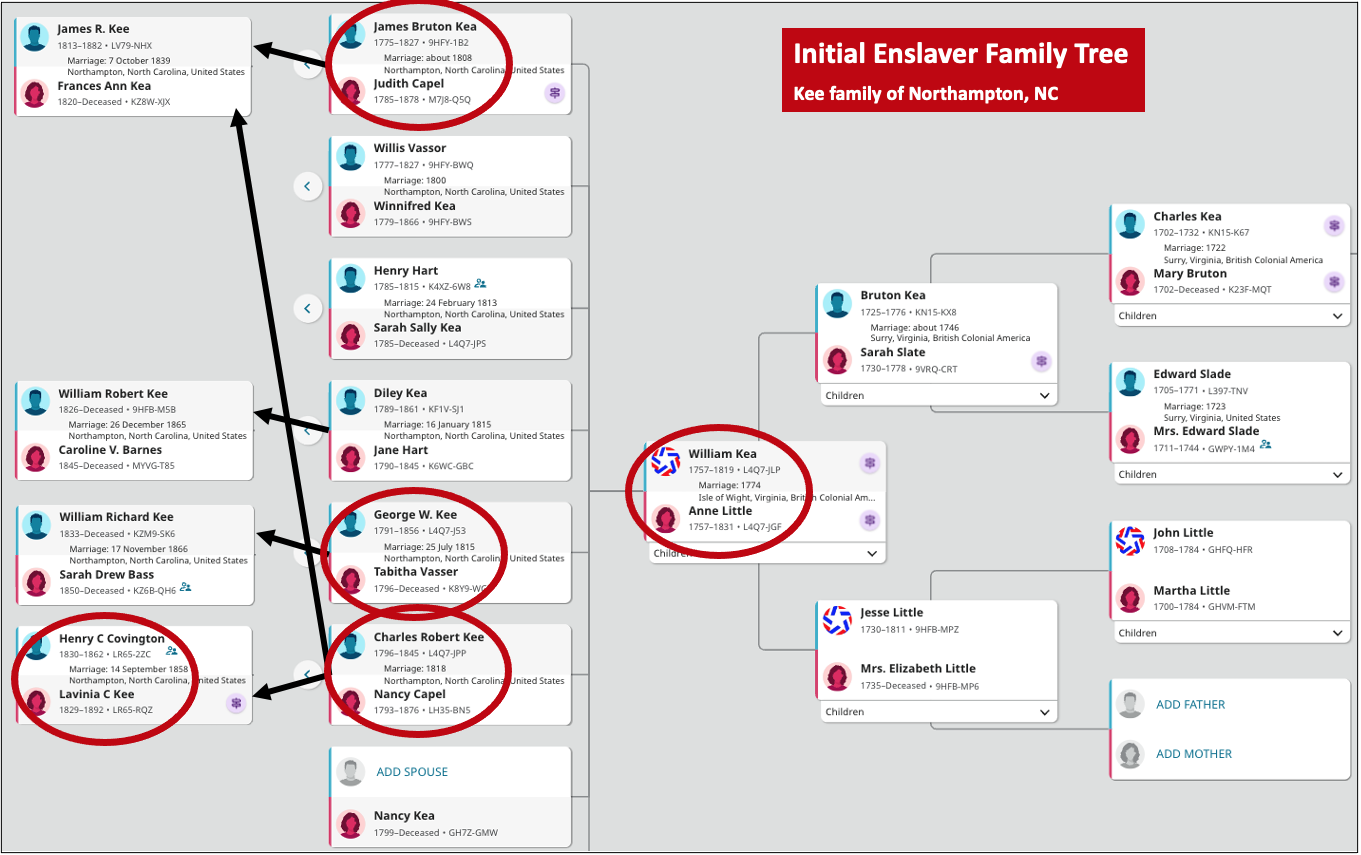
We reviewed and confirmed the information on their existing FamilySearch trees, and linked missing records as needed. Through WikiTree we also found and contacted a white descendant of William Kee, Curtis Bass, who was very helpful. This initial family tree is pictured below.
Through this exercise, we learned that Lavinia’s maiden name was Kee, and she had previously been married to Norfleet Harrison Taylor. We also discovered that Lavinia was William Kee’s daughter, and that James R., his wife Frances, and his first cousins William Richard and William Robert Kee were all William Kee’s grandchildren.
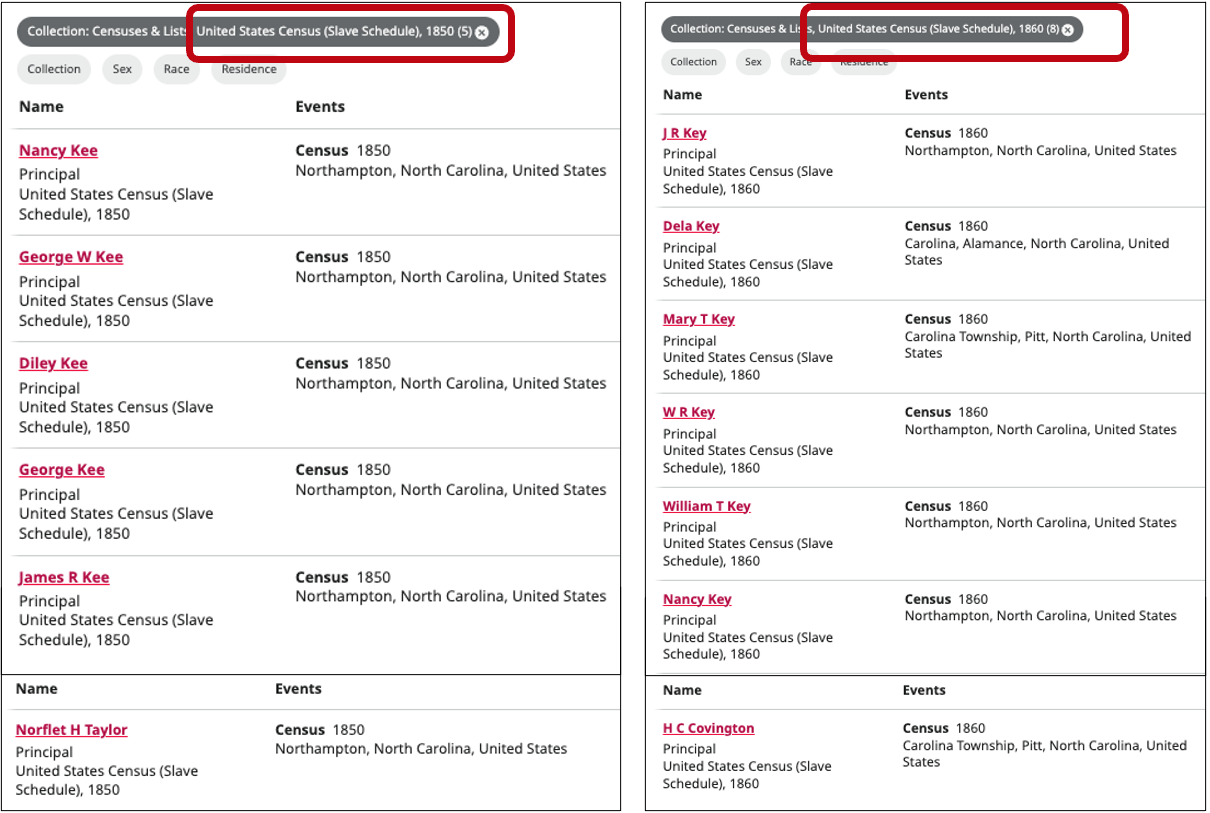
We then searched the 1850 and 1860 slave schedules for Northampton County and confirmed that several identified white Kee family members were enslavers.
The 1850 slave schedule listed:
- Siblings George, Diley, and Nancy Kee
- Their nephew James R. Kee (son of James Bruton Kee)
- Nephew George Washington Kee (son of Charles R. Kee)
- Norfleet Harrison Taylor, the first husband of their niece Lavinia Kee (daughter of Charles R. Kee)
The 1860 slave schedule included:
- Siblings Diley and Nancy Kee
- Their nephew James R. Kee
- Niece Mary T. Kee (daughter of George Kee)
- Nephew William Richard Kee (son of George Kee)
- Nephew William T. Kee (son of Charles R. Kee)
- Henry C. Covington, second husband of Lavinia Kee
Step 3: Search Enslaver Records
In this step, you will search for evidence of your enslaved ancestors and their family relationships within enslaver records.
Researchers will need to shift their focus to genealogical research through white enslaver families, as enslaved African Americans were legally considered chattel property rather than human beings. As a result, their names typically did not appear in public records except when they were being purchased, sold, bequeathed, inherited, or taxed as property by their enslavers.
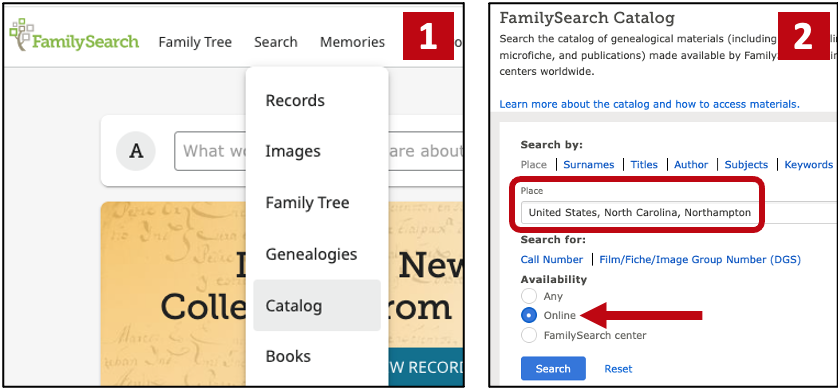
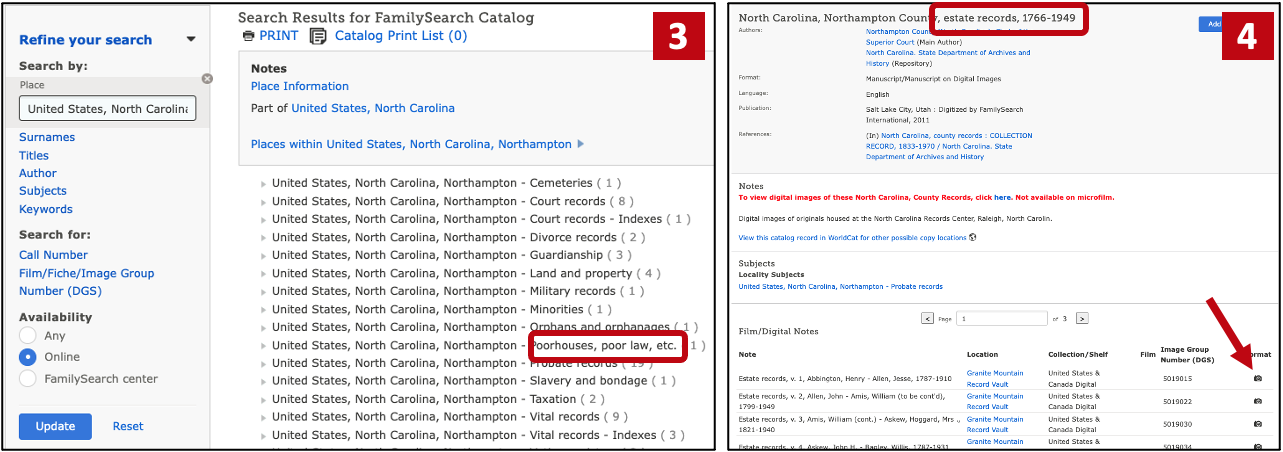
Two invaluable tools on FamilySearch are the catalog and ‘Full Text Search’ features.
To search the Catalog:
- Click on “Search” and then “Catalog” from the website’s dropdown menu.
- Enter the name of a county and state
- Select “Online”
To use Full-Text Search:
- Go to FamilySearch Labs and click “Go To Experiment”
- Enter the enslaver’s name and click “Search”
- Add the word “Negro” to the search
- Use the filters on the top left to narrow results by time period and county
- Choose a category of collections, then select the specific collection
- Click the camera icon on the right to view the records
FamilySearch’s county wikis provide valuable information on historical county boundary changes and the availability of state and county records. As an example, these are the wikis for Northampton County and for North Carolina.
Keep in mind that extended families may span two adjacent counties which could even be in different states.
Wills and Estate Probate Records
A family researcher’s best chance of finding an enslaved ancestor is through court records, such as wills where they were bequeathed to heirs, probate records where they were distributed or sold to pay debts, bills of sale, or court cases disputing their ownership.
However, these records come with significant limitations:
- Enslaved persons were often not mentioned by name
- Their existence in records depends on the timing of the enslaver’s death
- Even when named, details like age, relationships, or surnames were rarely included
Here are some tips on searching wills and estate probate records:
Expand your search beyond the immediate family. While you may start with the probate files of a potential enslaver and their immediate family, it’s worth reviewing files of anyone sharing the enslaver’s surname who died between 1840 and 1865.
Estate settlements can generate related documents:
- Guardianship records
- Inventories
- Account records
- Sale accounts
FamilySearch collections under ‘Slavery and Bondage’ or ‘Minorities’ can also provide useful information when available.
Inferring age from court records:
- “Old” likely refers to those over 45–50 years old and past their prime
- “Young,” “boy,” and “girl” typically refer to children under 10
- When two individuals share the same name, “Old” and “Young” may be used as relative distinctions
- Cash valuations rise until about age 45–50, after which they typically decline
Inferring maternal ancestry on smaller farms. Family relationships between enslaved persons were rarely mentioned, except for mothers with young children under 6 or 7. However, on smaller farms, where only a few individuals were enslaved, it may be possible to infer maternal ancestry based on age clues. If only one woman of childbearing age was present when a younger person was born, it is reasonable to assume she was the mother.
To support this conclusion, researchers should verify:
- No other woman of childbearing age was sold or removed during that period
- The younger person wasn’t purchased or inherited during that time
- Court, tax records, and Slave Schedules all support the assumption
Kee Family Case Study
Our next step was to examine the wills, probate, and court records of all Kee family members who died between 1800 and 1865. Although we eventually searched every existing record for the entire white Kee family who died in that period, our initial focus was on:
- James Bruton Kee
- George Kee
- Charles R. Kee
- their father William Kee
- both of Lavinia’s husbands
These five names are circled on our initial enslaver family tree above.
In Charles R. Kee’s 1845 estate probate records, we found an inventory listing “Tiza and two children Jim & Hannah.”
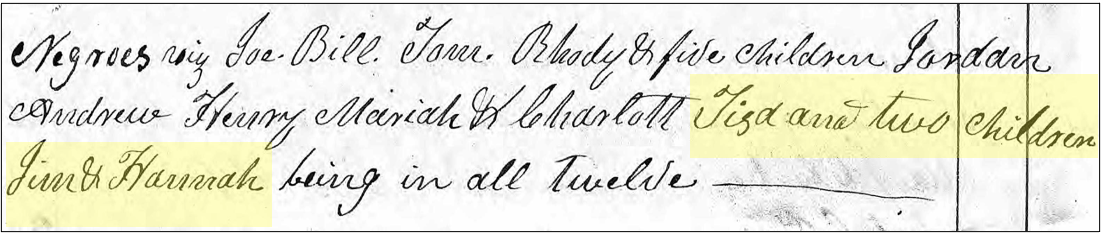
An estate distribution document revealed:
- Tissa and her daughter Hannah were allocated to Charles R.’s daughter Lavinia Kee (who later married Norfleet Taylor and Henry Covington)
- James Tann was given to Charles R.’s son-in-law James R. Kee, husband of Frances Ann Kee
Charles R.’s probate records also included a settlement of debts. Among the 1839 list of individuals who owed debts to his estate was Madison Tann — the free African American father of James Tann Kee. We also discovered that Diley Kee (D. Kee) paid Madison’s poll tax in 1843. This suggests that Madison likely worked for the Kee family, which could explain how he met Tissa.
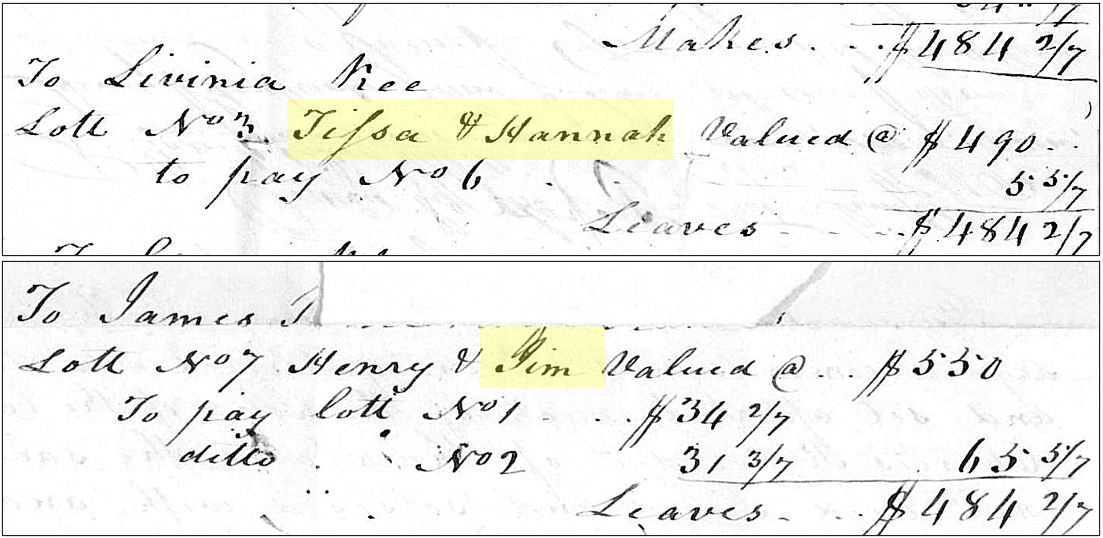
Since Lavinia was an unmarried 16-year-old minor at the time, her inheritance — including Tissa and Hannah — was managed by a court-appointed guardian. As a result, there were also guardianship records for her. In Charles R.’s estate probate records, we additionally found an 1848 document in which Lavinia’s new husband, Norfleet Taylor, acknowledged receipt of Tissa and Hannah from her guardian.
Hannah was also mentioned in Henry Covington’s 1862 estate probate file. In 1863, Lavinia Covington charged her widower’s estate $3 in reimbursement for the cost of a healthcare worker visit and medicine for Hannah.
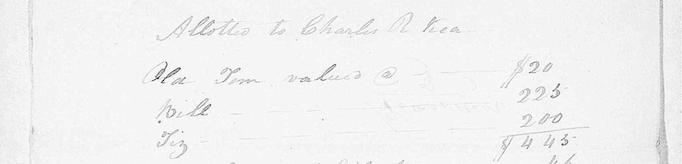
To identify Tissa’s mother, we examined whether Charles R. Kee inherited her from his parents or in-laws. We started by searching the will and probate records of his father, William Kee. Although Tissa was not mentioned in William Kee’s 1816 will, we discovered her in his final 1834 estate distribution. As we suspected, the estate awarded ‘Tiz’ to Charles.
State and County Court Cases
On rare occasions, disputes between heirs contesting the inheritance or ownership of an enslaved person were documented in county, and occasionally state, court cases.
When available, these cases can be invaluable, as they often mention the relationships between enslaved persons.
These disputes were most commonly handled by:
- The county Equity Court, also known as the Court of Chancery, which oversaw estate and inheritance matters
- In some instances, cases were escalated to the state-level Court of Appeals
Kee Family Case Study
Neither the will nor the estate distribution offered any clues about Tissa’s parentage or family ties. However, we found several interesting mentions of “Tiz” in references to a court case.
After some searches in FamilySearch catalog, we found the related records in:
- The county court files
- The 1829 probate records of James Bruton Kee, William’s eldest son
We learned that Tissa wasn’t named in William Kee’s will because she was born after he wrote it in 1816, but before it was executed following his death in 1819. His heirs disagreed about who should inherit her but agreed she was the daughter of Hannah.
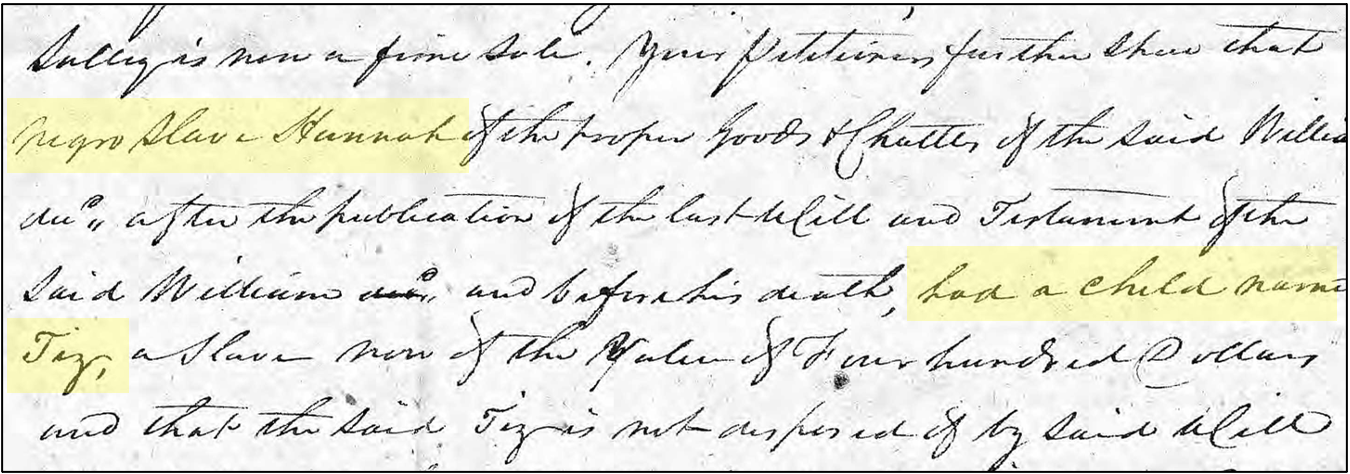
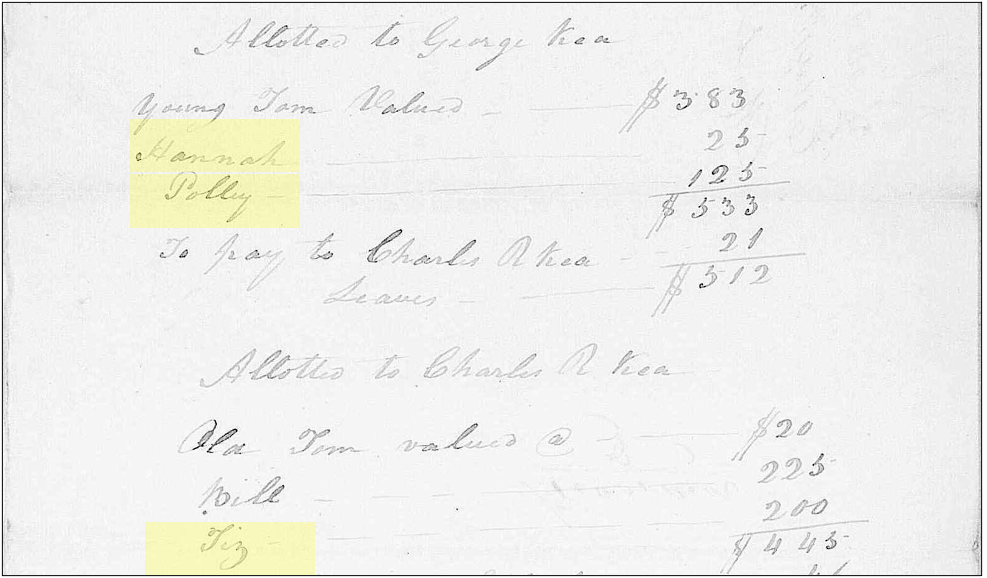
The 1834 estate distribution revealed:
- Tissa was given to Charles R. Kee
- Her mother Hannah and “Polly” were given to his brother George Kee
- Polly was likely Tissa’s sister, as Hannah appeared to be the only woman of childbearing age in William Kee’s household when Polly was born
Age clues from valuations:
- Tissa: $125
- Polly: $200 — suggesting Polly was younger
- Hannah: $25 — suggesting she was either older or infirm
Polly, her husband, and their three children were listed in George Kee’s 1845 estate probate records.
Slave Deed Databases
Although deed records are typically associated with land, enslaved people were unfortunately classified as property, so records of their sale and purchase can often be found in deed books. Enslaved people were also sometimes used as collateral for loans.
Many county slave deeds can be accessed through FamilySearch’s catalog and full-text search features.
A growing number of independently hosted slave deed databases are available. It is important to search for databases specific to your enslaved ancestor’s state and county, but here are some of the more well-known databases:
Virginia
- Virginia Untold: The African American Narrative — includes the Virginia Museum of History and Culture’s Unknown No Longer database
- Virginia Memory Chancery Records
- Virginia Slave Birth Index, 1853–1866
- Virginia Register of Births, 1869–1896
Multi-State / National
- Digital Library on American Slavery (DLAS) — includes People Not Property: Slave Deeds, mostly North Carolina but also other states
- Enslaved: Peoples of the Historical Slave Trade
- U.S. Definitive List of Slaves and Property, 1827–1828
- The Long Journey to Freedom database
- Slave Voyages
- The 10 Million Names Project
- Large Slaveholders of 1860
- Records of the Southern Claims Commission
- Slavery Era Insurance Registry
- The Northeast Slavery Records Index (NESRI)
Louisiana
Mississippi & Alabama
South Carolina
Texas
Tax Lists: Tracking Enslaved Ancestors Through the Gaps
When available, tax lists that identify enslaved persons can provide crucial information about our ancestors during the long periods between wills and probate records.
Three things to know before you search:
- Which taxes were levied in which county
- The years they were imposed
- The ages at which enslaved persons were taxable
Helpful resources for navigating tax lists:
- Bob’s Genealogy Filing Cabinet — two useful blog posts on tax lists
- Grapevine Public Library — additional guidance
- FamilySearch’s state wikis for your specific state and county
Tithables in Colonial Virginia
A tithable was a head tax. Note that most 17th-century lists of tithables are lost, except for those from Surry County, Virginia.
| Years | Who Was Taxed |
|---|---|
| 1624–1642 | Men age 16+ (freemen only) |
| 1644–1680 | White men age 16+, and all “Negroes” age 16+ |
| 1681–1704 | White men age 16+, and all “Negroes” age 12+ |
| 1706–1781 | White men age 16+, and all “negro, mulatto, and Indian” persons age 16+ |
Tithables in Colonial North Carolina
| Years | Who Was Taxed |
|---|---|
| 1715–1781 | Free men age 16+, and slaves age 12+ |
Personal Property Taxes (PPTs) in Virginia
After Independence (1781), the state of Virginia replaced tithable taxes with three types of taxes: a) land taxes, b) poll taxes, and c) personal property taxes (PPTs). However, poll taxes were bundled with PPTs, and the consolidated documents are still known as “PPTs”.
| Years | Who Was Taxed |
|---|---|
| 1782–1787 | White men age 21+, and slaves of all ages (categorized by ages 0–16 and 16+) |
| 1788–1865 | White men age 16+, and slaves age 12+ (categorized by ages 12–15 and 16+) |
PPTs in North Carolina
| Years | Who Was Taxed |
|---|---|
| 1782–1834 | Free men age 16+, and slaves age 12+ |
| 1835– | Free men age 21–45, and slaves age 12–50 |
Kee Family Case Study
William Kee, who migrated to Northampton County, North Carolina, with his family and the persons he enslaved in 1802, was originally from Surry County, Virginia. This migratory pattern was typical for slaveholding families at the turn of the century, as Virginia’s population grew and land became increasingly scarce. Before moving to Northampton, the family surname was typically spelled as “Kea.”
Surry County, Virginia, is one of the few counties with surviving 17th-century lists of tithables. Using these records, we were able to trace Hannah and her ancestors through their enslavers’ personal property tax lists and tithables.
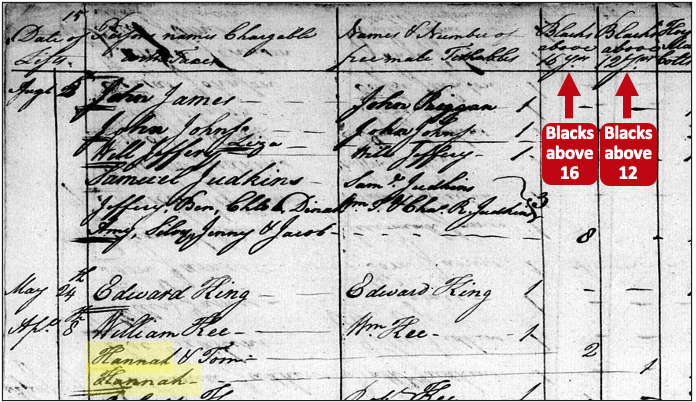
Tracing Hannah through William Kea’s PPT lists:
- Hannah was listed in William Kea’s Surry County PPT lists from 1787 to 1801
- Between 1787 and 1796, she was recorded as a minor under changing tax laws — listed under “Blacks under 16” in 1787, then “Blacks above 12 and under 16” from 1793 to 1796
- Also included in William’s PPT lists during these years were a “Hannah” and “Tom”
- As Hannah was the only woman of childbearing age present, we can reasonably conclude she was Hannah’s mother
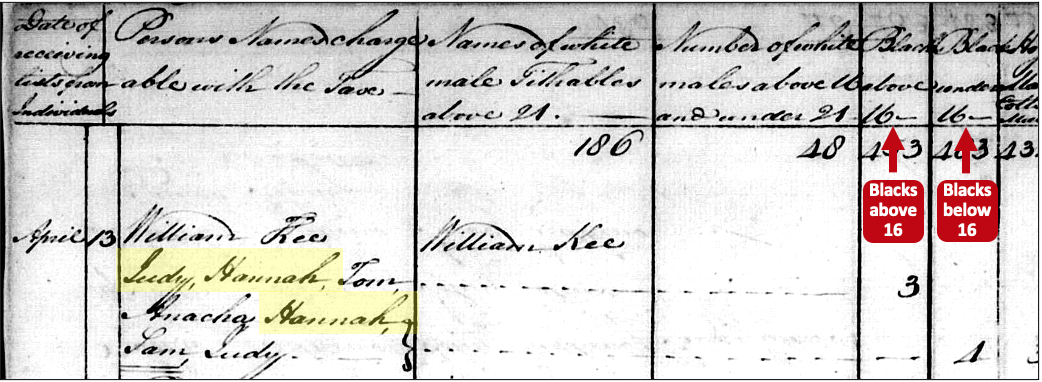
Tracing Hannah’s mother through earlier records:
- Hannah was listed in William Kea’s PPT lists from 1782 to 1801
- No tax lists for Surry County exist from 1704 to 1782
- The only other enslaved woman in the household at that time was “Judith,” whom William inherited from his father Bruton Kee in 1775
- We can therefore reasonably conclude that Hannah was the daughter of Judith (“Judy”)
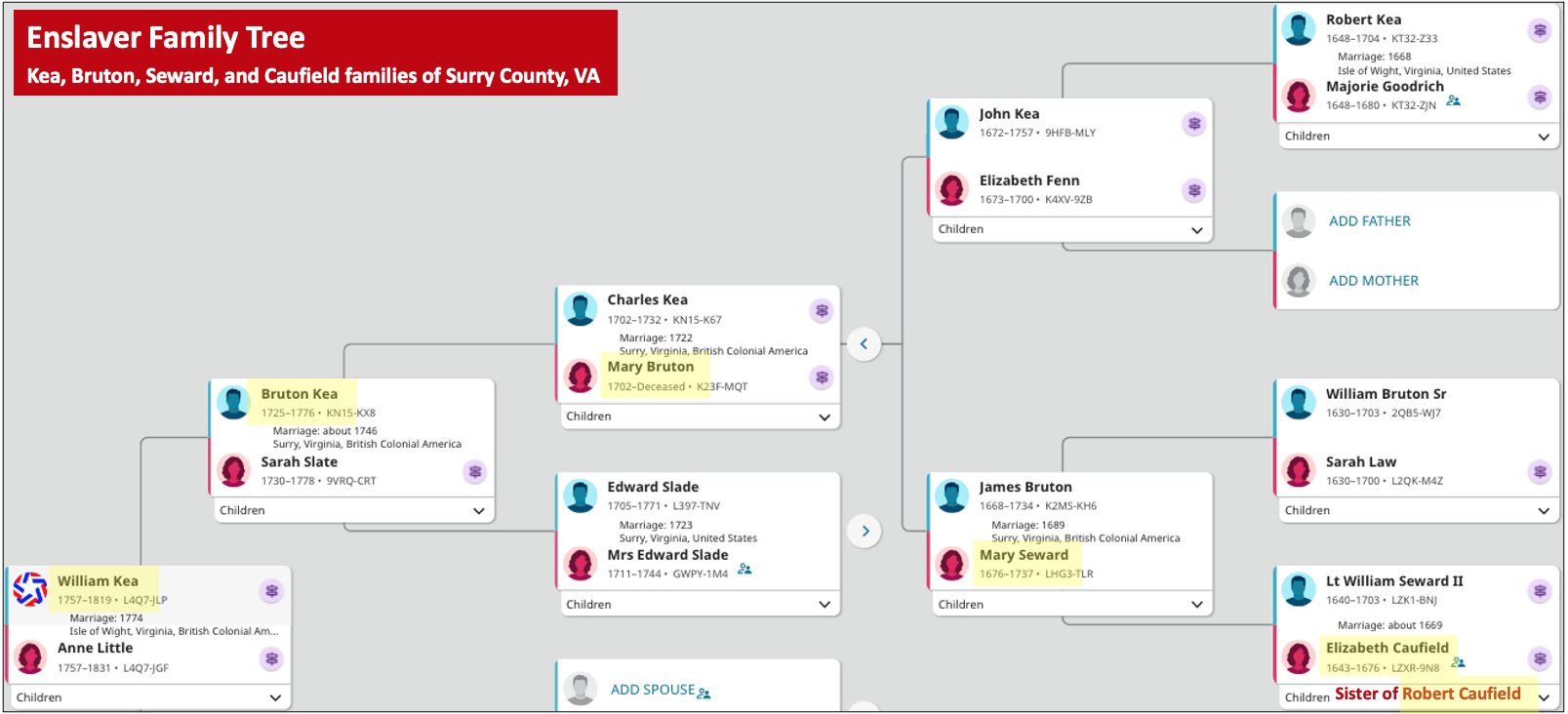
Tracing Judith’s lineage through wills and probate:
- Wills and probate records confirmed William inherited Judith from his father Bruton Kee in 1775
- Bruton had inherited “my Negro girl named Judy” from his maternal grandfather James Bruton in 1735
- James Bruton’s 1735 household included one older woman “Jenny,” three male adults, and five children including Judith — suggesting Judith⁴’s mother was likely Jenny³
- James Bruton’s tax lists from 1692 to 1703 recorded only one woman, “Judith” (or “Judah”) — suggesting Jenny³ was the daughter of Judith
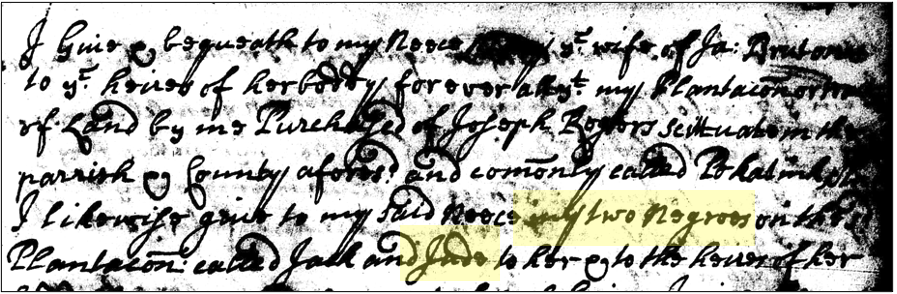
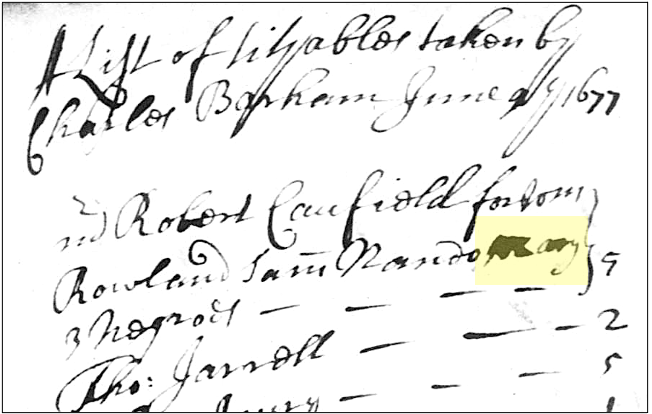
Tracing Mary and Judith back to Robert Caufield:
- It was James Bruton’s wife, Mary (Seward) Bruton, who inherited Judith (“my two negroes… Jack and Juda”) from her maternal uncle Robert Caufield in 1691
- Judith was listed with Jack in Robert Caufield’s tax lists in 1690 and 1691
- Judith then appeared in James Bruton’s lists from 1692 until the last available list in June 1703
- Judith was likely the daughter of Mary, as Mary was the only enslaved woman in Caufield’s household from 1677 to 1685
- Mary appeared as taxable in Robert Caufield’s lists from 1667 to 1692, in his widow Elizabeth’s household from 1694 to 1699, and later in Elizabeth’s second husband John Joseph Jackman’s list from 1700 to 1703
- Mary was probably born in Virginia, as Caufield did not claim headrights for her
Using DNA Analysis to Confirm What the Records Suggest
Even informal, do-it-yourself DNA analysis can be invaluable in confirming ancestral relationships uncovered through genealogical research.
Comparing results across multiple test types can help confirm suspected relationships. Using your FamilyTreeDNA autosomal DNA, Y-DNA, and mitochondrial DNA (mtDNA) results with those of the descendants of a suspected relative of your ancestor can help confirm the relationship.
Kee Family Case Study
Autosomal DNA provided a key confirmation. We discovered that the authors’ mother and wife, the great-granddaughter of James Tann Kee, shares autosomal DNA with several white descendants of William Seward, the father of Mary Seward Bruton.
Our ancestor Jenny was born a few years after Mary and her husband, James Bruton, inherited Jenny’s mother, Judy, from Mary’s uncle, Robert Caufield.
Notably, James Tann Kee’s descendants did not inherit any DNA from the white Kee family — which also aligns with our genealogical findings.
DNA testing is still ongoing. We are also eagerly waiting for DNA test results from two newly-discovered descendants of Sarah Kee, who we suspect was the sister of our ancestor Tissa Kee. Since we do not seem to have other ancestors in common, a DNA match would lend support to our inconclusive genealogical findings.
References
- Russell, Thomas D. “South Carolina’s Largest Slave Auctioneering Firm.” Chicago-Kent Law Review 68 (1992): 1241, 1271.
- Smith, Robyn N. “Slave Surnames: Where Are They From?” Reclaiming Kin, June 25, 2009.
- Stampp, Kenneth M. The Peculiar Institution: Slavery in the Ante-Bellum South. New York: Vintage Books, 1956. Pages 30–31.
- Tadman, Michael. “Speculators and Slaves in the Old South: A Study of the American Domestic Slave Trade, 1820–1860.” PhD diss., University of Hull, 1977.
- Tadman, Michael. Speculators and Slaves: Masters, Traders, and Slaves in the Old South. Madison: University of Wisconsin Press, 1989.
- Woodtor, Dee Parmer. Finding a Place Called Home: A Guide to African-American Genealogy and Historical Identity. New York: Random House, 1999. Page 248.

About the Authors
Paul Heinegg
Genealogist
Paul Heinegg is a genealogist with 35 years of experience. He was identified as “the world’s expert on the Free Black population in the United States” by Henry Louis “Skip” Gates, Jr., and as “the leading authority on early African American families” by FamilySearch and Genealogical.com.
Paul is the recipient of four major genealogy awards, and has authored three books and four journal articles. These publications include the origin and family history of over 1,100 African American families that were free in North Carolina, Virginia, Maryland, and Delaware during the colonial period (FreeAfricanAmericans.com).
Paul has also traced the ancestry of an enslaved family back to the mid-1600s in a journal article that meets rigorous genealogical standards.
Contact him at paulheinegg@gmail.com for genealogy research services. Visit his website at PaulHeinegg.com

Ayo Heinegg Magwood
Author and Genealogist
Ayo Heinegg Magwood is Paul’s daughter and is the founder of Uprooting Inequity LLC and the author of two book chapters and a journal article on teaching pedagogy. She is also co-author (with her father) of the genealogy journal article “Tracing an African American family lineage from the 17th to the 20th century: The Kee Family of Northampton County, NC.”, forthcoming at The Genealogist.